

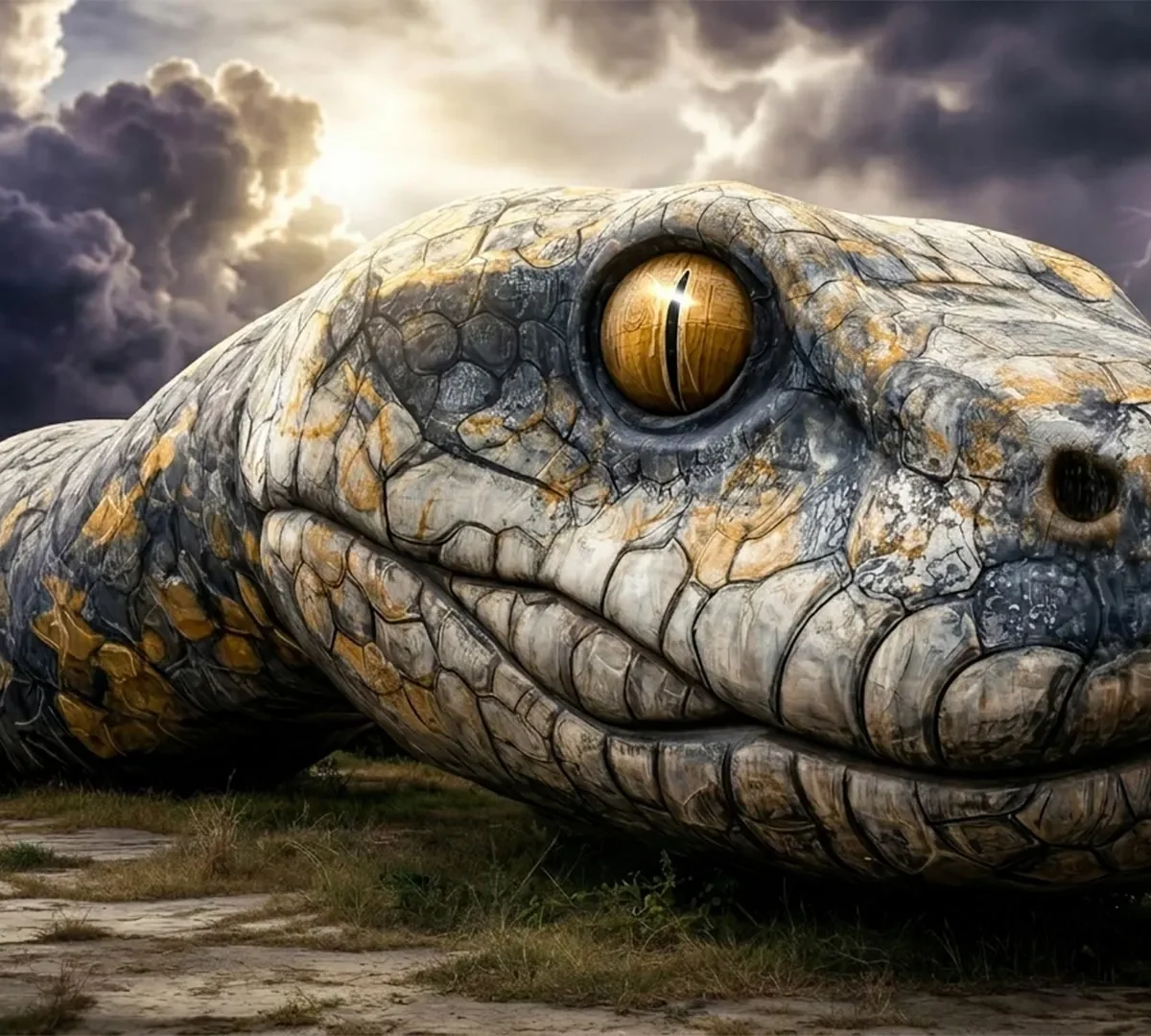
A newly identified species of ancient snake, Vasuki indicus, may rank among the largest snakes to ever exist. The massive reptile lived around 47 million years ago in what is now Gujarat, India, according to research published in Scientific Reports. Scientists estimate it reached an extraordinary length of about 11 to 15 meters (36 to 49 feet). While it belonged to the extinct madtsoiidae family, researchers say it represents a unique lineage that originated on the Indian subcontinent.
The discovery comes from a specimen described by Debajit Datta and Sunil Bajpai, who studied fossils recovered from the Panandhro Lignite Mine in Kutch, Gujarat State, India. These remains date back to the Middle Eocene period, roughly 47 million years ago. The name Vasuki indicus honors the mythical serpent associated with the Hindu deity Shiva, as well as the country where the fossil was found.
The fossil material includes 27 mostly well-preserved vertebra, some still connected, indicating they belonged to a fully grown snake. These bones offer crucial clues about the animal’s overall size and structure.
Size Estimates Suggest a Colossal Snake
Each vertebra measures between 37.5 and 62.7 millimeters (1.48 to 2.47 inches) in length and 62.4 and 111.4 millimeters (2.46 to 4.39 inches) in width. These dimensions point to a thick, cylindrical body. Based on these measurements, researchers estimate the snake’s total length ranged from about 10.9 to 15.2 meters (35.8 to 49.9 feet).
That puts Vasuki indicus in the same size range as Titanoboa, the largest snake ever discovered, though scientists note there is still some uncertainty in these estimates. Given its massive build, the snake was likely slow-moving and relied on ambush tactics, similar to modern anacondas.
A Widespread Ancient Snake Family
Researchers classify Vasuki indicus within the madtsoiidae family, a group of snakes that existed for nearly 100 million years, from the Late Cretaceous to the Late Pleistocene. Members of this family lived across a wide geographic area, including Africa, Europe, and India.
The study suggests that Vasuki indicus may belong to a group of large madtsoiid snakes that first evolved in India. From there, these snakes could have spread through southern Europe and into Africa during the Eocene, a period spanning roughly 56 to 34 million years ago.