
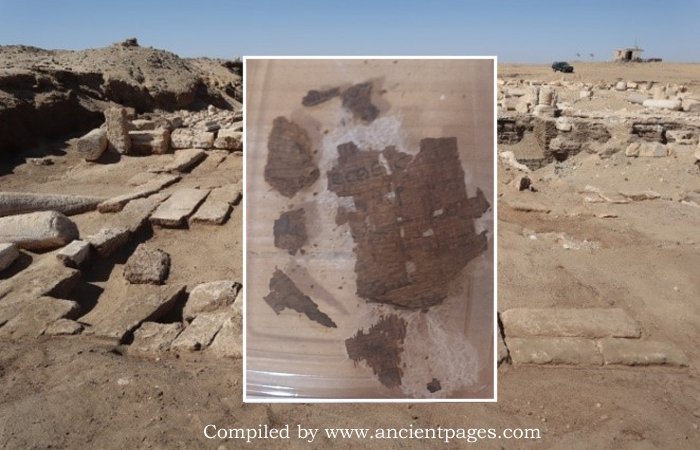
Conny Waters – AncientPages.com – The discovery marks a significant milestone in archaeology: for the first time, a Greek literary text has been found intentionally incorporated into the mummification process. In this case, a papyrus containing a section of Homer’s Iliad was placed in the abdomen of a mummy as part of the embalming ritual, and the text includes part of the famous “catalogue of ships.”
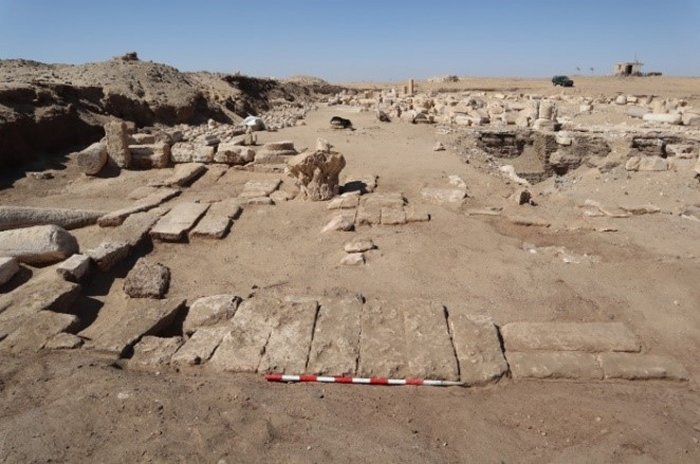
View of one of the areas in the archaeological site at the ancient city of Oxyrhynchus in Egypt. Credit: University of Barcelona
The find was made by The Oxyrhynchus Archaeological Mission, directed by the Institute of Ancient Near East Studies (IPOA) at the University of Barcelona and led by Maite Mascort and Esther Pons. The papyrus was discovered in a Roman-era tomb, about 1,600 years old, in the town of Al Bahnasa (ancient Oxyrhynchus) in Egypt.
During the November–December 2025 campaign, the team led by Núria Castellano uncovered a Roman-era mummy in Tomb 65 of Sector 22. The mummy featured an unusual element: a papyrus placed on the abdomen as part of the embalming ritual. In earlier campaigns, the mission had documented Greek papyri in similar positions, but those texts were always magical or ritual in nature. A literary work like the Iliad had never previously been found in this context.
In a subsequent campaign in January–February 2026, the papyrus underwent detailed analysis by conservator Margalida Munar, papyrologist Leah Mascia, and classical philologist Ignasi-Xavier Adiego, a professor in the Department of Classical, Romance and Semitic Languages and director of the Oxyrhynchus project. Based on Mascia’s reading, Adiego identified the text as part of the “catalogue of ships” in Book II of Homer’s Iliad, the renowned passage listing the Greek forces before Troy and one of the most iconic texts in Western literature.
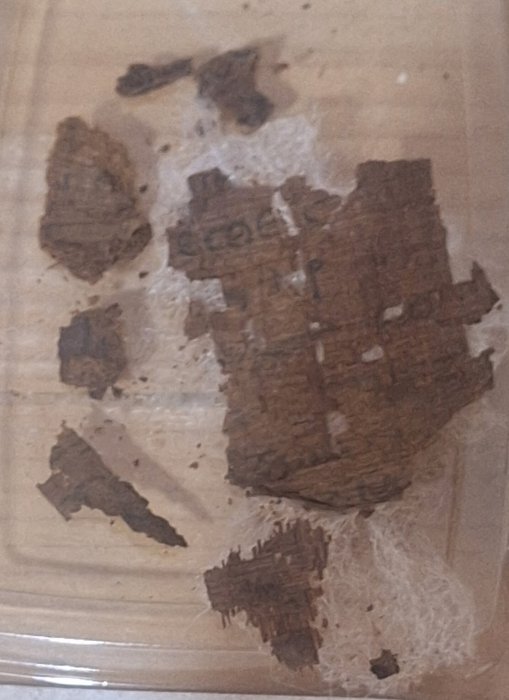
The papyrus, which was placed inside the mummy’s abdominal cavity, contains a detailed catalogue of ships. Credit: University of Barcelona
“This is not the first time we have found Greek papyri, bundled, sealed, and incorporated into the mummification process, but until now, their content was mainly magical. Furthermore, it is worth noting that, since the late 19th century, a huge number of papyri have been discovered at Oxyrhynchus, including Greek literary texts of great importance, but the real novelty is finding a literary papyrus in a funerary context,” Professor Adiego explains.
See also: More Archaeology News
The discovery was made at the Al Bahnasa necropolis, the Egyptian site identified with ancient Oxyrhynchus, one of the most important cities of Greco-Roman Egypt. It is located approximately 190 kilometers south of Cairo, next to the Nile branch known as Bahr Yussef. The excavation has revealed a funerary complex comprising three limestone chambers, in which Roman-era mummies and decorated wooden sarcophagi were found, many of which were in a state of disrepair due to past looting.
Source: University of Barcelona
Written by Conny Waters – AncientPages.com Staff Writer