

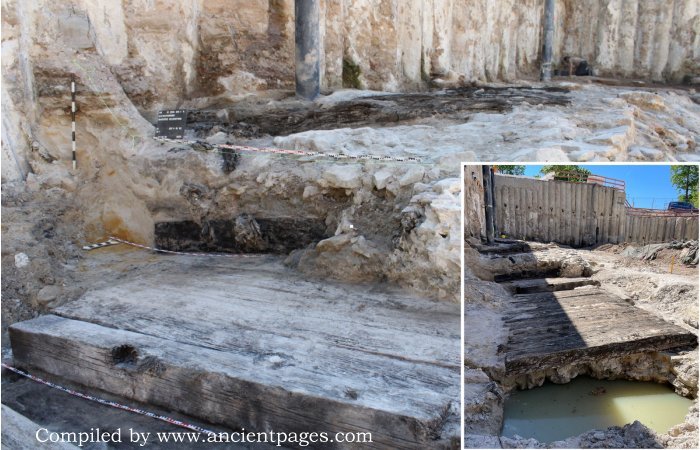
Jan Bartek – AncientPages.com – Workers discovered archaeological structures dating to the 4th century BC while building a stormwater overflow basin north of the Willigis Bridge in Aschaffenburg, Germany. The Bavarian State Office for the Preservation of Monuments (BLfD) later confirmed the discovery.
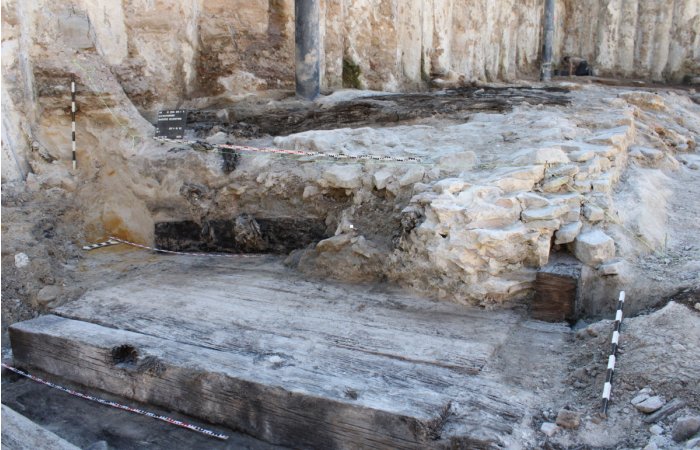
Credit: Bayerisches Landesamt für Denkmalpflege (BLfD)
In March 2026, the city of Aschaffenburg informed the Bavarian State Office for the Preservation of Historical Monuments (BLfD) of the discovery of wooden remains during excavation. Since then, work on the site has moved quickly.
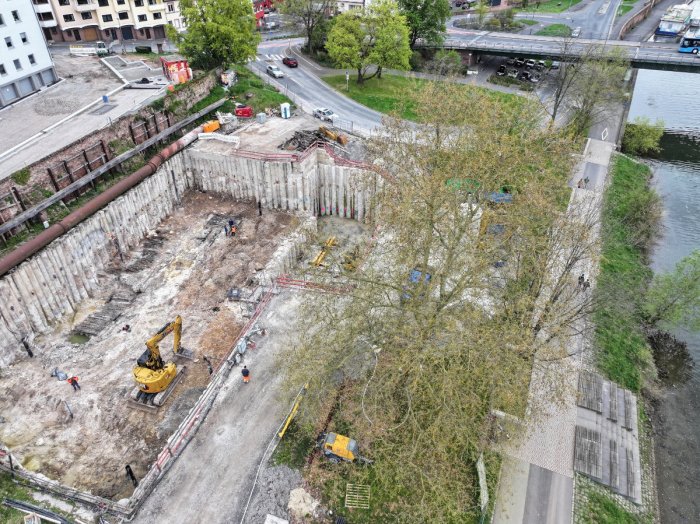
Credit: Bayerisches Landesamt für Denkmalpflege (BLfD)
Because no archaeological monuments were known or expected in this area and the site had already been cleared for construction, the BLfD, on behalf of the Free State of Bavaria, is funding the excavation, documentation, and recovery of this important discovery.
2,400-Year-Old Iron Structure
The timbers were found about eight meters deep and were so well preserved that scientists at the Bavarian State Office for the Preservation of Monuments (BLfD) first thought they belonged to a more recent structure. But when oak beam samples were analyzed in the dendrochronology lab in Thierhaupten, the results were surprising. By studying the annual rings and comparing them with local oak-ring records, researchers found that the wood came from trees cut down and used for building in the 4th century BC.
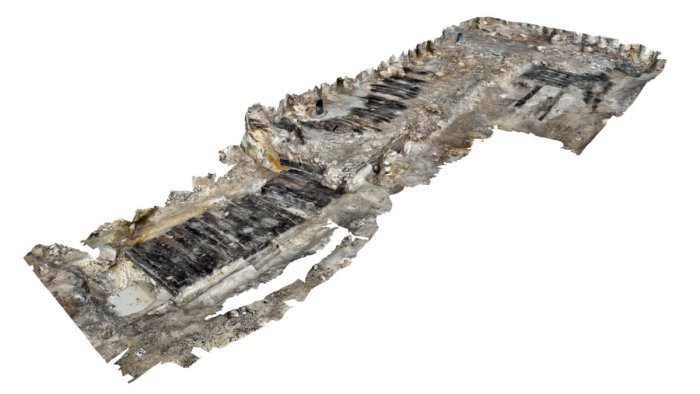
A 3D model illustrates the complete extent of the Iron Age structure discovered in Aschaffenburg. Credit: Bayerisches Landesamt für Denkmalpflege (BLfD)
Dr. Stefanie Berg, Head of the Department of Archaeological Heritage Management at the Bavarian State Office for Heritage Management (BLfD), states that the combination of the site’s exceptional location on the Main River, its remarkable preservation, its unique timber-and-stone construction, and its Iron Age origin makes this discovery exceptional.
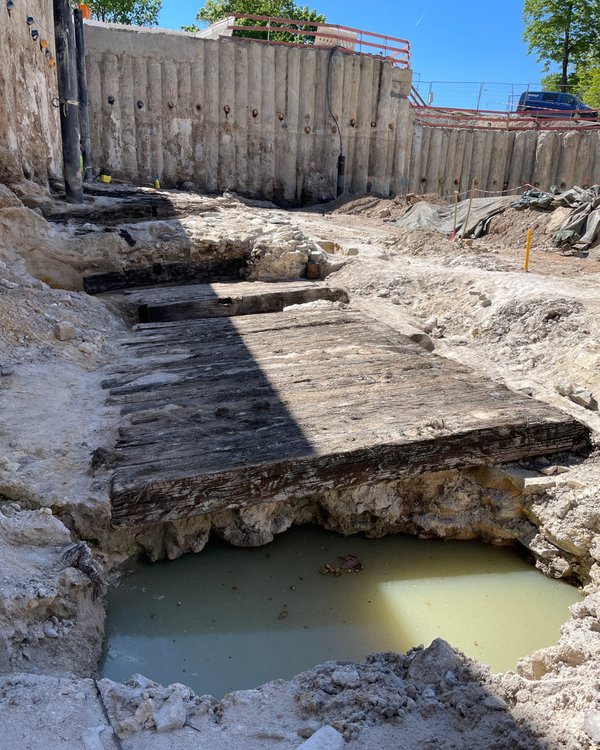
Credit: Wolfgang Maier. Stadt Aschaffenburg
Initial findings indicate that many large oak beams were used in a structurally advanced, likely prestigious building that ended with a dry-stone wall facing the river. Stone masonry from the Iron Age is extremely rare, and when present, it typically forms part of fortified structures such as post-and-beam walls.
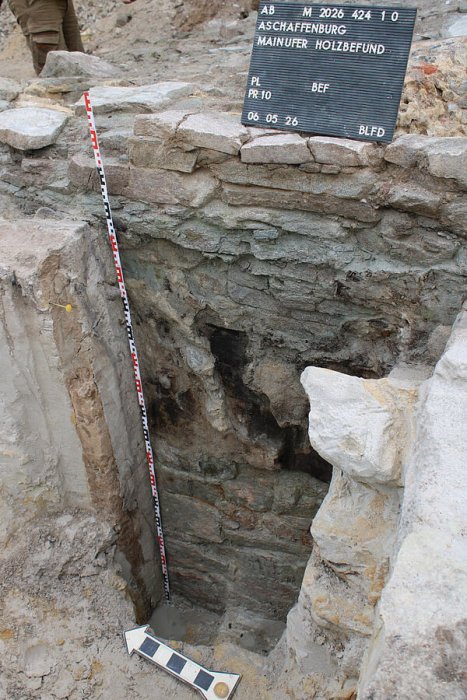
Credit: Bayerisches Landesamt für Denkmalpflege (BLfD)
Evidence of an early La Tène settlement in present-day Aschaffenburg Old Town has primarily come from significant finds, including an animal-head fibula, a gold finger ring, and isolated archaeological features.
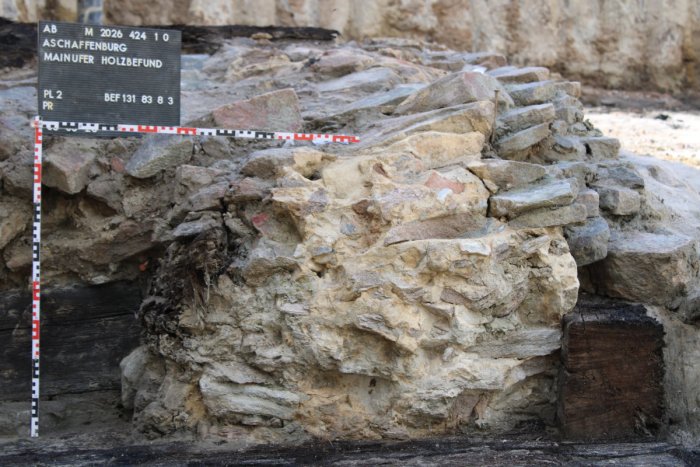
Credit: Bayerisches Landesamt für Denkmalpflege (BLfD)
These discoveries have led to the longstanding assumption that a central Iron Age settlement may have existed in this area. However, the specific structure of the La Tène site remains largely unknown.
See also: More Archaeology News
The recently discovered archaeological structure on the banks of the Main River offers significant scientific potential. Researchers anticipate that ongoing excavation, documentation, and analysis will provide new insights into the site’s function and the early settlement history of Aschaffenburg.
The archaeological investigations are conducted in close coordination with the city of Aschaffenburg. Due to the challenging excavation conditions in a construction pit up to eight to ten meters deep, all activities are carefully aligned with the project’s technical, structural, and safety requirements.
Source: Bayerisches Landesamt für Denkmalpflege (BLfD)
Written by Jan Bartek – AncientPages.com Staff Writer