

Yves here. Because I have been devoting so much attention to the Iran war, I’ve been able to monitor what is going on with the Ukraine war, and the bizarre threats from many UK and EU leaders when they lack the means to do much, out of the corner of one eye. It would take at least a decade to muster even sort-of a serious threat to Russia (ex nukes), given their hollowed-out manufacturing and high energy costs and Iran-war-related commodity shortage a big headwind to reindustrialization. On top of that, as Stanislav Krapivnik has explained long-form, nominally European weapons depend on critical US-supplied components. Krapivnik has estimated it would take at least a decade, and more like two, for the EU to design and build truly indigenous weapons systems.
Oh, and how cooperative will China be in providing the needed chips and materials if the EU gets even uglier vis-a-vis Russia?
Having said that, even a weak party in a geographically favorable position can cause a lot of harm. For instance, Russia is well aware that its Kalingrad enclave and Baltic Sea shipping are exposed.
By Andrew Korybko, a Moscow-based American political analyst who specializes in the global systemic transition to multipolarity in the New Cold War. He has a PhD from MGIMO, which is under the umbrella of the Russian Foreign Ministry. Originally published at his website

There are really only three scenarios left: NATO finally agrees to some form of Russia’s proposals; Russia launches a preventive war against European NATO betting that the US won’t directly intervene; or Russia peacefully subordinates itself to the West.
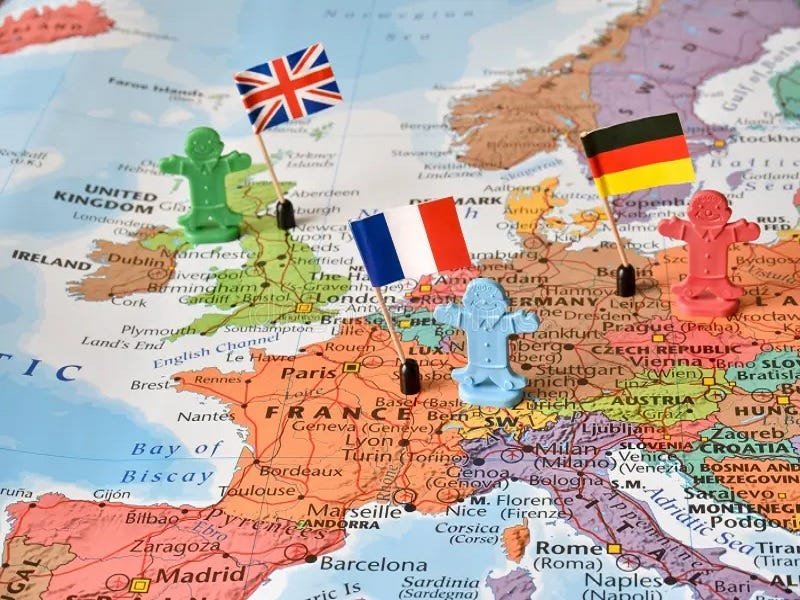
Last weekend’s surprise call between Presidents Emmanuel Macron and Alexander Lukashenko followed Deputy Chair of the Russian Security Council Dmitry Medvedev warning about the 1941-like threat posed by Germany’s remilitarization and the UK assembling a multinational navy to contain Russia. These three developments collectively draw attention to how the Brits, French, and Germans, Russia’s traditional European rivals, are now right on its doorstep. The security implications are profound.
The Brits are nestling up in Estonia, from where they plan to lead Russia’s containment along the Arctic -Baltic front, while the Germans opened a base in Lithuania and the French just announced regular nuclear drills with Poland. As a reminder, Estonia borders “mainland Russia” while Lithuania and Poland border its exclave of Kaliningrad and mutual defense ally Belarus. The “military Schengen” between the Netherlands, Germany, and Poland might thus soon be expanded to include France and the Baltic States.
That would maximally optimize the flow of troops and equipment from Western Europe to Russia’s borders, thus conforming with Russian policymakers’ fears that the EU is gearing up for a potential invasion of their country sometime in the future. Given France’s base in Romania and military pact with neighboring Moldova, which constitute a critical flank in the Ukrainian Conflict due to enabling France to aid Odessa in the scenario of its threatened conventional intervention, they and others might join too.
To make matters even more concerning from the perspective of Russia’s national security interests, Germany recently clinched a deep-strike defense co-production deal with Ukraine, thus expanding its military footprint even deeper within what Russia considers to be its “sphere of influence”. The result is that the UK is entrenching its influence along the Arctic-Baltic front, Germany is doing so in the Baltic (Lithuanian) and Ukrainian ones, while France is already entrenched in Poland, Romania, and Moldova.
Germany aspires to build European NATO’s largest army, which would require overtaking Poland and ideally from its perspective subordinating that country as a vassal, while France and the UK are nuclear powers. The threat posed by their military-strategic convergence right on Russia’s doorstep therefore cannot be overestimated. At the very least, it could embolden their partners to behave aggressively against Russia, calculating as they might that those Great Powers would deter Russian retaliation.
That would be a mistake of epic proportions because Russia cannot allow such a scenario to unfold, let alone become the “new normal”, as it would amount to them weaponizing it for coercing never-ending concessions that would culminate in time with Russia’s subordination and ultimately “Balkanization”. In other words, a hot NATO-Russian war would likely be inevitable, though nobody can say for sure whether the US would help its European allies, nor to what extent if so, or whether it would hang them out to dry.
It’s therefore more urgent than ever that the European security architecture be reformed like Russia sought to do through diplomatic means before the special operation, the failure of which was why Putin sought to advance this through military ones instead. There are really only three scenarios left: NATO finally agrees to some form of Russia’s proposals; Russia launches a preventive war against European NATO betting that the US won’t directly intervene; or Russia peacefully subordinates itself to the West.