
Episode Transcript
Olivia Allen-Price: If you’ve been listening to the show for a while you may have intuited by now, but San Francisco’s Golden Gate Park is one of my absolute favorite places. I love all its nooks and crannies, the unique playgrounds, those long undulating pathways. But I’d argue the crown jewel of the park is the Conservatory of Flowers, partly because of the incredible and rare plants housed inside…
News Clip: The rare corpse flower at the Conservatory of flowers is now open to view and smell.
Olivia Allen-Price: Like the corpse flower, which only blooms for 48 hours every 3-5 years! And stands more than 6 feet tall.
The Conservatory of Flowers is also renowned for its architecture. A Victorian glass building – delicate, intricate – topped with a stately domed roof. It’s like nothing else in the city! Or so I thought.
Turns out San Francisco has another conservatory across town near Glen Park. It’s much smaller, only a quarter the size, but still lovely. I’m talking about Sunnyside Conservatory.
Mary Balmana: My name is Mary Balmana. I live in the Mission Terrace area of San Francisco, and I don’t know anything about it, but I’ve passed it my whole life, basically.
Olivia Allen-Price: Mary drives by Sunnyside Conservatory on Monterey Boulevard often, but never sees anyone going in or out. She wants to know its history – and how such a curious building ended up in what is otherwise a very residential area.
Bay Curious editor and producer Katrina Schwartz is here to tell us all about it. Hi, Katrina.
Katrina Schwartz: Hi Olivia
Olivia Allen-Price: Maybe you could start by just painting a picture of the conservatory as it looks now.
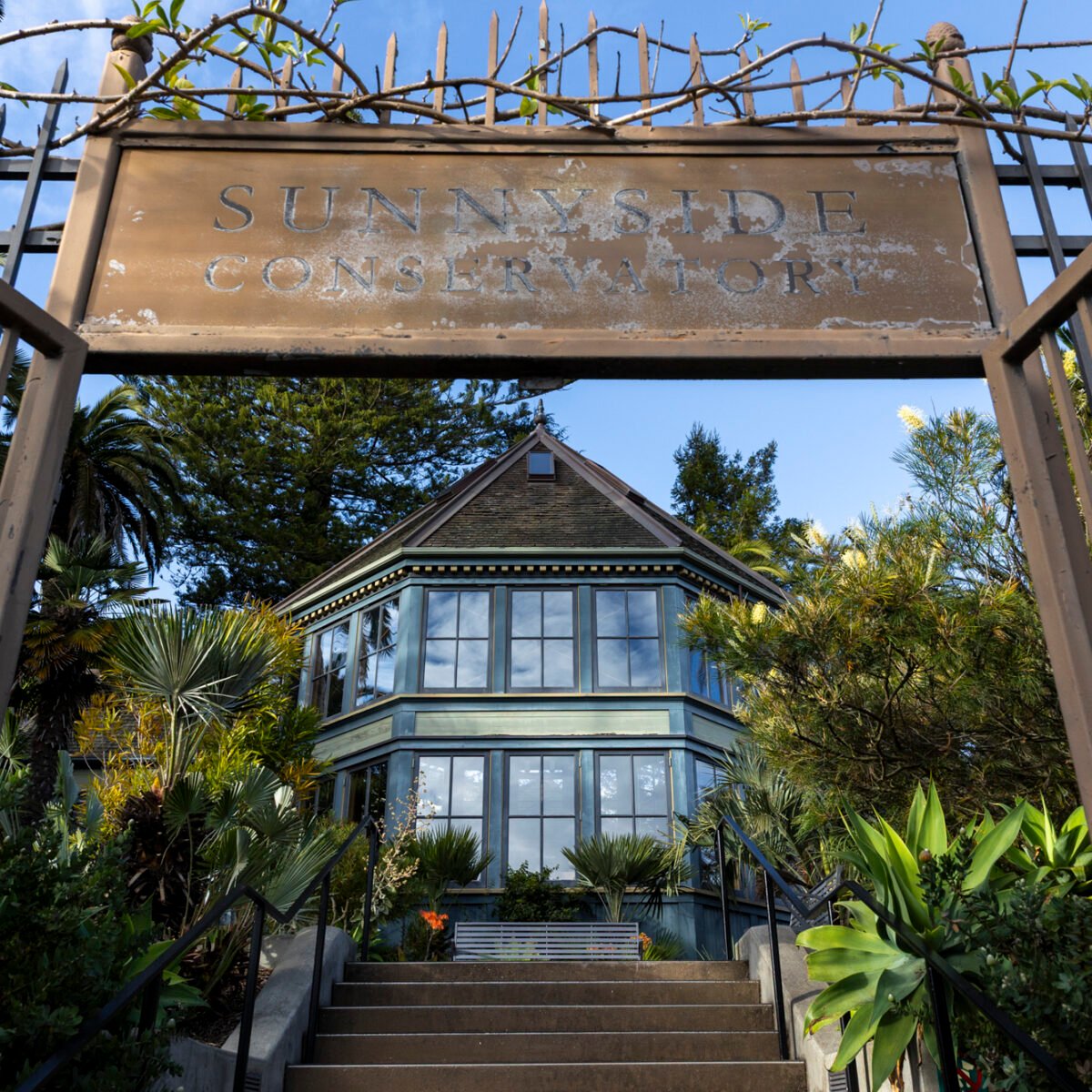
Katrina Schwartz: The Sunnyside Conservatory is set back from the street a little ways and is surrounded by a lush garden with huge palm trees, ferns and beautiful flowering bushes. It kind of feels like a cloud forest right in the middle of a residential neighborhood.
Olivia Allen-Price: What about the building itself?
Katrina Schwartz: The building is made of redwood and features a two story octagonal center that dominates the senses. Two levels of windows that let in beautiful amounts of light…
Olivia Allen-Price: What kind of fabulous plants are inside? Anything to rival the corpse flower?
Katrina Schwartz: Sadly, this conservatory no longer has plants inside at all. It’s now used as an events space. But when it was first built in 1902, it was the pride of its owner – who was just the first of a line of quirky residents the property has had over its 100 or so years. Let’s meet some of them.
Amy O’Hair: It was built by an eccentric and unique man.
Katrina Schwartz: Amy O’Hair runs the Sunnyside History Project and lives nearby.
Amy O’Hair: He was an inventor, William Augustus Merralls, he moved here to Sunnyside when there was very little on Monterey Boulevard.
Katrina Schwartz: Even though Sunnyside is part of San Francisco now, back then the area was rural. Picture a smattering of houses and dairy farms. Merralls bought a big house here in 1897 and then several adjoining plots of land over the next few years.
Amy O’Hair: He accumulated seven lots, and then built his conservatory in 1902. He collected exotic plants and he liked to have a place for them.
Katrina Schwartz: Merralls made his money engineering mining equipment — but his true heart’s desire was invention. Over the years he invented dozens of things, some useful stuff, and some less so. Amy actually met his great grandson, who had some of Merralls’ old papers.
Amy O’Hair: I thought I’d show you some stuff. Things that belonged to William Merrill’s like his patents. So I have all the patents for things that he made. This is a stamp mill. That’s a thing that crushes rock.
Katrina Schwartz in scene: Look at those seals.
Amy O’Hair: Yes, they’re very fancy.
Amy O’Hair: This is a letter he wrote while he was in New York City raising money for the automobile starters.
Katrina Schwartz in scene: Will you read a little bit of it?
Amy O’Hair: Darling, you should see the Merralls starter at work on that big engine. You would be tickled to pieces. It is a dandy. And when you come on for Thanksgiving, you shall be the first lady to ride in an automobile that has the only commercial, perfect self-starter in the world, and that one is a Merralls.
Katrina Schwartz in scene: He’s like promoting himself to his wife.
Amy O’Hair: To his wife, for God’s sake.
Katrina Schwartz: The thing is, Merralls probably had his hand in one too many projects. He had a tendency to move on before things were finished and he was sued a number of times. By the time of his death in 1914, he was having money problems.
Olivia Allen-Price: Mmm. Unfortunately, you can’t just create the thing, but you have to sell it too…
Katrina Schwartz: Yes, and unfortunately that meant that when he died, the bank repossessed the whole property, including the conservatory.
Olivia Allen-Price: What happened to it?
Katrina Schwartz: The house and its grounds sat empty for three years and then another couple bought it. The next in the line of curious owners…
Amy O’Hair: The name of this couple was Ernest and Angel Van Beck. They were very strange.
Katrina Schwartz: Ernest Van Bech was essentially a scam artist. He made a boatload of money selling worthless mining bonds to people…basically swindling them out of their money. The district attorney even brought charges, but when the witnesses didn’t show up to testify, they had to let Ernest go. And he lived out his life on the property with the conservatory.
Amy O’Hair: Ernest would not show his face. There were a lot of rumors about him.
Olivia Allen-Price: Kind of the Boo Radley of Sunnyside.
Katrina Schwartz: He really was. The neighborhood kids were all afraid of him. But after decades living in the house next to the conservatory he died in 1951. His wife, Angele, kept living there, but she needed money.
Amy O’Hair: She slowly sold off all the property to a neighbor.
Katrina Schwartz: The neighbors were friends of hers. They built a house on the other side of the conservatory — the east wing of the building was actually in their backyard. At the time, that wasn’t a big deal because Angele and her friends basically shared the conservatory and its grounds like one big yard.
Katrina Schwartz: But eventually Angele moved away and her friends sold their home – and they leave behind the conservatory, which now straddles two properties.
Olivia Allen-Price: Is this foreshadowing?
Katrina Schwartz: This is foreshadowing.
Olivia Allen-Price: We’ll find out what happened after this quick break.
Sponsor message
Olivia Allen-Price: Alright, Katrina, you were telling us what happened to the conservatory after Angele Van Beck and her friends next door moved away and sold the property.
Katrina Schwartz: The bulk of the conservatory and its grounds ended up in the hands of a man named Robert Anderson.
Amy O’Hair: It’s 1975 by now, and there’s a lot of local interest in the conservatory as a historic structure.
Katrina Schwartz: People who live nearby had grown attached to the conservatory. They view it as a symbol of the neighborhood. A group called the Sunnyside Neighborhood Association forms and they start researching the history of the conservatory in order to get it landmarked as a historic building.
Amy O’Hair: They wanted to save it from demolition because in the 50s and 60s and 70s, along Monterey Boulevard, we’d had so many empty lots, and it was rezoned after the war, that apartment buildings were growing up all the way along it.
Katrina Schwartz: The neighbors succeeded in getting the building landmarked, but that didn’t keep it safe.
Amy O’Hair: But then Robert Anderson decided he actually would build some apartment buildings and he got a permit to demolish the conservatory, which he attempted to do at the end of 1978. And it was only saved because of two people who had their eye on the conservatory. Greg Gaar is one.
Greg Garr: Well, I was riding my bicycle along Monterey Boulevard. I think I was going to City College at that time. And I passed by the Sunnyside Conservatory and I saw heavy equipment in there. And part of the building had been removed. And I said, what the heck? I mean, are they demolishing it? I knew it was a registered historic landmark.
Katrina Schwartz: Greg Garr and other neighbors started frantically calling city hall and they got the demolition halted.
Amy O’Hair: When they were done, the glass was knocked out of most of the windows.
Music starts
Olivia Allen-Price: This seems like an impasse. Robert Anderson can’t knock the conservatory down and build anything new – but he owns it. So what happens?
Katrina Schwartz: Well, the city buys the land from him. But there wasn’t any money to renovate the building then.
Amy O’Hair: Sunnyside Neighborhood Association tried to get it renovated and they looked after it.
Katrina Schwartz: They scraped graffiti off the building and boarded up all the broken windows to keep rain out. But unfortunately the whole thing was falling into disrepair.
At some point in the 1980s, the east wing of the conservatory – the part that crossed over onto another property – it gets knocked down, leaving the building looking kind of lopsided.
Amy O’Hair: And it is a loss, because it’s no longer, it’s whole, whole self.
Olivia Allen-Price: Wait, after saving it from being knocked down by the developer…part of it was still demolished?
Katrina Schwartz: Yes, sadly. Amy says the circumstances are a bit mysterious, but that eastern wing is in photos of the conservatory through early 1980 and then it’s just gone. If you go there now, there’s a fence right up against the main part of the building.
Olivia Allen-Price: Sounds like these neighbors really had to be vigilant to keep this thing from being torn down completely.
Katrina Schwartz: You know, they did their best. And there was a man who lived behind the conservatory…
Amy O’Hair: Whose name was Ted Kipping. And he was a professional botanist, arborist, and plant collector, and photographer, speaker. Very ambitious, very dedicated. He took care of the grounds in the 90s.
Katrina Schwartz: The conservatory becomes something of a pet project for him. A very expensive one…
Amy O’Hair: One time, when I was talking to him, he said, I spent $1,000 a month on water.
Olivia Allen-Price: How does it turn into the beautiful building it is today?
Katrina Schwartz: A group called the Friends of Sunnyside Conservatory forms in 1999 and spend about 10 years raising money and getting San Francisco Rec and Park on board. They did a big multimillion dollar renovation in the 2000s.
Reopening video clip: We’re here at the Sunnyside’s Conservatory that’s re-opening and this has been a long fought community effort to make this happen.
Katrina Schwartz: There was a big party at the conservatory to celebrate its reopening in 2009. Then mayor Gavin Newsom was there.
Gavin Newsom: In a hundred years they’ll be talking about, in 2009…
Katrina Schwartz: Everyone was so excited that this neighborhood gem had been restored.
Reopening video clip: Here’s the original spire. It was somewhere up there.
Olivia Allen-Price: The conservatory has a spire?
Katrina Schwartz: Yes — the original 1902 building that William Merralls built had a redwood spire on top. And a neighbor kept that spire in his garage for 30 years.
Amy O’Hair: This man volunteered this finial, redwood finial from the original building and said, well, here it is. You know, you can put it back on the new building.
Olivia Allen-Price: And did they?
Katrina Schwartz: Well, by then it was fairly rotten. So, instead they made an exact replica, covered it in copper and that’s what’s now on top of the current building.
Olivia Allen-Price: A bit of a cherry on top, if you will. So now the neighborhood has this pretty special place for everyone to enjoy.
Katrina Schwartz: Not only that, but working to preserve the conservatory brought the community together
Olivia Allen-Price: Thanks for sharing this history with us, Katrina.
Katrina Schwartz: My pleasure. And if you haven’t been to the Sunnyside Conservatory, you should really check it out!
Olivia Allen-Price: One thing I love about the Bay Area is that most neighborhoods have little gems like this one. They’re usually not things people would go out of their way to visit…but they do make each little corner of this area special. If you’ve got a spot near you that you’ve always wondered about, head on over to bay curious dot org and submit a question.
If you’re interested to know more about Sunnyside, Amy O’Hair has a book called History Walks of Sunnyside coming out very soon. So keep your eyes peeled for that.
If you’ve been enjoying the double dose of Bay Curious we’ve been putting out this month, consider making a donation to KQED to support our work. Every little bit helps, just head over to KQED dot or slash donate.
Bay Curious is made in San Francisco at member-supported KQED.
Our show is produced by Katrina Schwartz, Christopher Beale and me, Olivia Allen Price.
With extra support from Maha Sanad, Katie Sprenger, Jen Chien, Ethan Toven-Lindsey and everyone on team KQED.
Some members of the KQED podcast team are represented by The Screen Actors Guild, American Federation of Television and Radio Artists, San Francisco Northern California Local.
I’m Olivia Allen-Price. Have a great week.