

Conny Waters – AncientPages.com – Recent research suggests that the earliest known dice in human history were created and used by Native American hunter-gatherers on the western Great Plains more than 12,000 years ago, at the end of the last Ice Age. This predates the earliest known dice from Bronze Age societies in the Old World by over 6,000 years.

The study, led by Colorado State University Ph.D. student Robert J. Madden, shows that dice, games of chance, and gambling have been a consistent part of Native American culture for at least 12,000 years. The oldest examples come from Late Pleistocene Folsom-period archaeological sites in Wyoming, Colorado, and New Mexico, significantly pushing back the timeline for the use of dice in human history.
“Historians have traditionally treated dice and probability as Old World innovations,” Madden said. “What the archaeological record shows is that ancient Native American groups were deliberately making objects designed to produce random outcomes, and using those outcomes in structured games, thousands of years earlier than previously recognized.”
What Did Ice Age Dice Look Like?
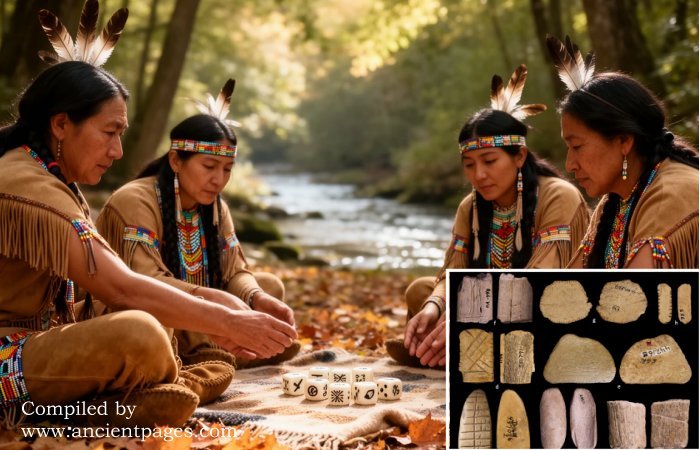
The study identifies the earliest known examples of these objects at Folsom archaeological sites, dating to approximately 12,800–12,200 years ago. Unlike modern six-sided (cubic) dice, these were two-sided dice called “binary lots.” They were carefully made from small pieces of bone that were flat or slightly curved, often oval or rectangular, and sized to fit comfortably in the hand so they could be tossed in groups onto a playing surface.

Folsom diagnostic and probable Native American dice. All photographs, except (j), are by the author). Credit: Robert Madden
Each binary lot had two distinct faces, differentiated by markings, surface treatments, coloration, or other visible modifications—similar in concept to the “heads” and “tails” on a coin. One of these faces was designated as the “counting” side. When thrown, the pieces consistently landed with one face or the other facing upward, producing a simple two-outcome (binary) result. Multiple dice were cast at the same time, and the score was determined by how many landed with the counting face up.
“They’re simple, elegant tools,” Madden said. “But they’re also unmistakably purposeful. These are not casual byproducts of bone working. They were made to generate random outcomes.”
Rather than relying on subjective resemblance or guesswork, the study introduces a new attribute-based morphological test—a systematic checklist of measurable physical features—for identifying North American dice archaeologically. The test was derived from a comparative analysis of 293 sets of historic Native American dice documented across the continent by ethnographer Stewart Culin in his 1907 Bureau of American Ethnology monograph, Games of the North American Indians.
The study then applies this test systematically to the published archaeological record, essentially re-examining artifacts long labeled as possible “gaming pieces” or otherwise overlooked to determine whether they meet the new objective criteria for dice. In most cases, the evidence had been in the archaeological record for decades, but without a clear standard for identifying dice, it had never been analyzed as part of a larger pattern.
Using this approach, Madden identified over 600 diagnostic and probable dice from sites spanning every major period of North American prehistory, from the Late Pleistocene through and after the period of European contact.

Flat dice types illustrated by Culin. Credit: DOI: 10.1017/aaq.2025.10158
“In most cases, these objects had already been excavated and published,” Madden said. “What was missing wasn’t the evidence, it was a clear, continent-wide standard for recognizing what we were looking at.”
The earliest examples were examined directly in museum collections at the Smithsonian Institution, the University of Wyoming Archaeological Repository, and the Denver Museum of Nature and Science.
Ice Age Hunter-Gatherers And Probabilistic Thinking
Historians of mathematics widely regard dice games as humanity’s earliest structured engagement with randomness, serving as an intellectual precursor to probability theory, statistics, and later scientific thinking. Until recently, the origins of these practices were believed to lie exclusively in complex Old World societies, beginning around 5,500 years ago.
This study, however, indicates that the history of such practices is both older and more geographically widespread than previously assumed.

Late Pleistocene (13,000 to 11,700 BP), Early Holocene (11,700 to 8,000 BP), Middle Holocene (8,000 to 2,000 BP), and Late Holocene (2,000 to 450 BP) diagnostic and probable prehistoric Native American dice: (a, d) Signal Butte, Nebraska (Middle Holocene), NMNH-A437076, NMNH-550791; (b) Agate Basin, Wyoming (Early Holocene), UW-11327; (c, f) Agate Basin, Wyoming (Late Pleistocene), UW-OA111, UW-OA448; (e, g) Lindenmeier, Colorado (Late Pleistocene), NMNH-A442165, NMNHA440429; (h) Irvine, Wyoming (Late Holocene). (Figures 1a, d, e, and g courtesy of the Division of Anthropology, Smithsonian Institution, American Museum of Natural History. Figures 1b, c, f, and h courtesy of the Department of Anthropology, University of Wyoming.). Credit: Robert Madden
“These findings don’t claim that Ice Age hunter-gatherers were doing formal probability theory,” Madden said. “But they were intentionally creating, observing, and relying on random outcomes in repeatable, rule-based ways that leveraged probabilistic regularities, such as the law of large numbers. That matters for how we understand the global history of probabilistic thinking.”
A 12,000-Year-Old Tradition Still Kept Alive
The research highlights both the wide distribution and the long-lasting presence of Native American dice games. From Paleoindian times through the Archaic and Late Prehistoric periods, dice have been found at 57 archaeological sites across a 12-state area, associated with many different cultures and ways of life.
See also: More Archaeology News
According to Madden, this extensive use over time and space indicates that these games held significant social importance.
“Games of chance and gambling created neutral, rule-governed spaces for ancient Native Americans,” he said. “They allowed people from different groups to interact, exchange goods and information, form alliances, and manage uncertainty. In that sense, they functioned as powerful social technologies.”
The study was published in the journal American Antiquity
Written by Conny Waters – AncientPages.com Staff Writer