

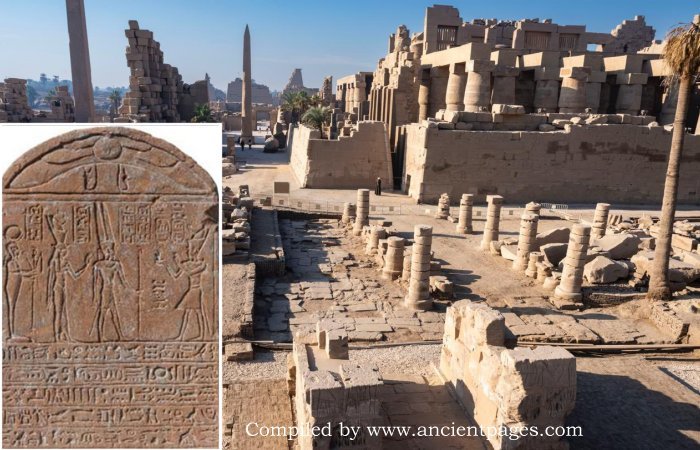
Conny Waters – AncientPages.com – Amid the sands of Karnak, a rare stone stela from the time of Emperor Tiberius has emerged, reminding us how human stories can echo across thousands of years.
Once a complex and controversial ruler of Rome, celebrated for his military achievements yet remembered for the tensions of his reign, Tiberius now appears in a very different light: as a figure quietly recorded in the sacred heart of ancient Egypt.

Credit: Ministry of Tourism and Antiquities
In his time, Egypt knew a rare calm. Rome reduced its military presence, and Tiberius chose caution over conflict, seeking to avoid provoking the Greeks or Egyptians. Today, that era speaks again through a modest stone, about 60 by 40 centimetres, discovered during the restoration of the gateway of King Ramesses III at Karnak.

Credit: Ministry of Tourism and Antiquities
On it, Tiberius stands before the Theban triad—Amun-Re, Mut, and Khonsu—accompanied by a five-line hieroglyphic inscription that records restoration work on the enclosure wall of the Temple of Amun-Re. Even in antiquity, people were not only building, but also preserving what came before them.
This discovery is the fruit of a powerful modern partnership. A joint Egyptian-French mission, led by the Franco-Egyptian Center for the Study of the Temples of Karnak and working with the Supreme Council of Antiquities and the National Centre for Scientific Research, has completed the reconstruction and restoration of the northern gateway of the enclosure wall built by King Ramesses II. Between 2022 and 2025, in the northwestern sector of the temple precinct, their work became part of a greater, ongoing effort: to protect, understand, and share one of humanity’s greatest sacred landscapes.

Credit: Ministry of Tourism and Antiquities
Sherif Fathy, Minister of Tourism and Antiquities, called this collaboration a “model of international cooperation in heritage preservation.” It is more than a project; it is a vision. The restoration is woven into a broader plan to develop the Karnak Temples, upgrade the open-air museum, and improve visitor services—so that every person who walks these ancient paths can feel more deeply connected to the past.
The work itself has been both meticulous and revealing. As Secretary General of the SCA Hisham El-Leithy explained, the gateway was carefully dismantled, its stone blocks conserved, documented, and then reassembled using modern techniques. In the process, archaeologists uncovered reused decorated blocks from the reign of Amenhotep III, hinting at an even earlier gateway and reminding us that history is often built, quite literally, layer upon layer.

Credit: Ministry of Tourism and Antiquities
Further excavations, led by Mohamed Abdel-Badie, head of the Egyptian Antiquities Sector at the SCA, uncovered remains of the northern enclosure wall of the Temple of Amun-Re and traces of multiple construction phases spanning the New Kingdom, as well as later Greek and Roman interventions. In 2025, additional work revealed a paved processional road linking the gateway of Ramesses III to the courtyard of the Third Pylon—an ancient route first documented in the early 20th century, now brought into clearer focus.

Credit: Ministry of Tourism and Antiquities
Together, these discoveries do more than fill in academic gaps. They illuminate the long, continuous story of Karnak, a place where pharaohs, priests, artisans, and worshippers shaped one of the world’s most enduring religious and cultural centers. Each stone, each inscription, each rediscovered pathway is a reminder that human creativity, belief, and cooperation can transcend time.
See also: More Archaeology News
Archaeologists believe these findings are helping to build a more complete understanding of Karnak’s architectural evolution across millennia. In doing so, they reaffirm something deeply hopeful: that through patience, collaboration, and respect for the past, we can keep the world’s shared heritage alive—not as silent ruins, but as a living source of knowledge, wonder, and inspiration for generations to come.
Source: Ministry of Tourism and Antiquities
Written by Conny Waters – AncientPages.com Staff Writer