

Episode Transcript
Olivia Allen-Price: If you grew up here in the Bay Area … or if you’ve lived here a long time … I bet this sound is familiar to you:
Sounds of Pacific tree frogs chorusing
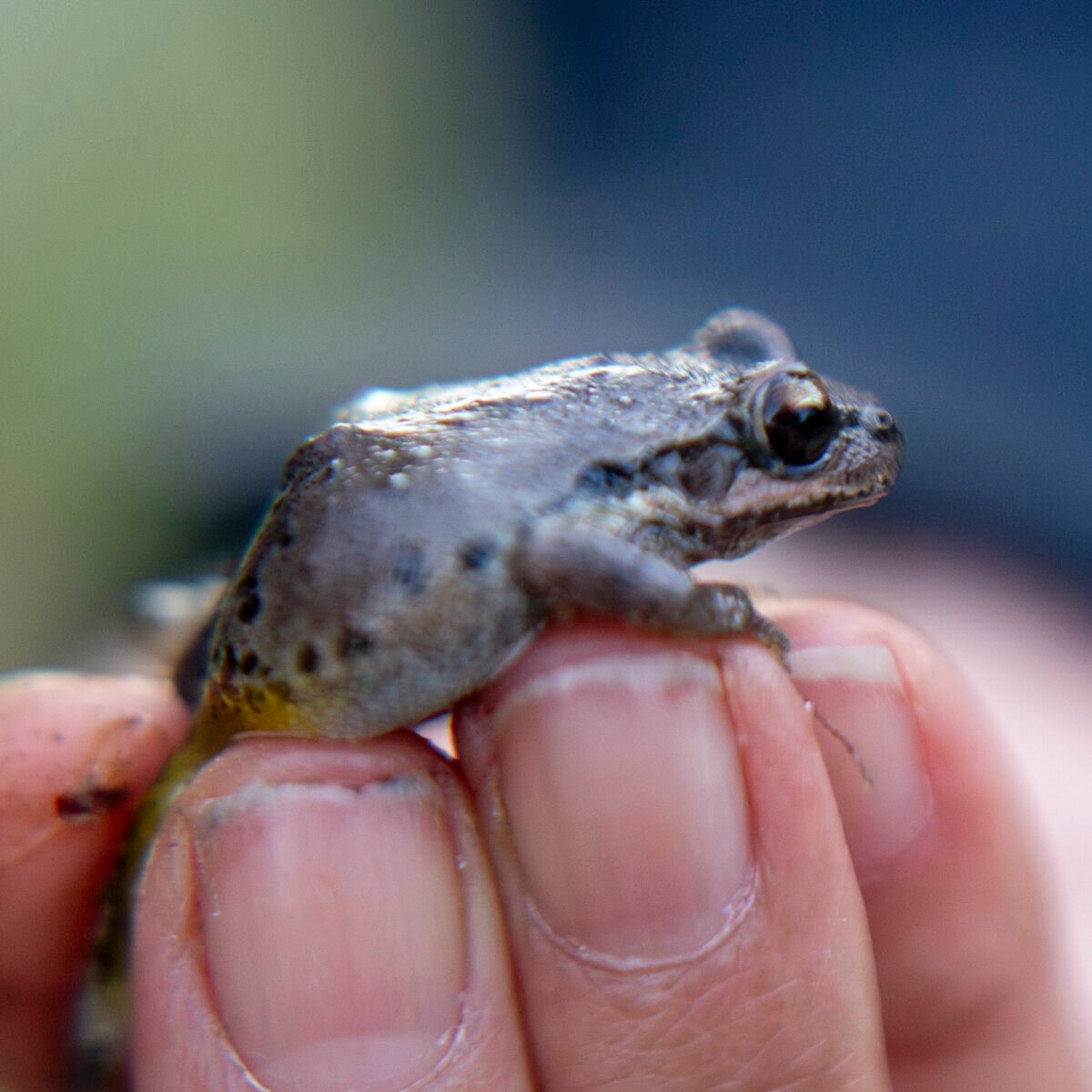
Olivia Allen-Price: Tree frogs. A quintessential soundtrack to the Bay Area. These aren’t your stereotypical big, bloated bullfrogs. They’re little green frogs just a couple inches long, with bulging eyes and giant toe pads that allow them to climb trees.
They’re especially noisy during the springtime, which is their mating season.
Dave Ellis: I used to wonder how people that lived next to them could sleep in the springtime because the frogs were so loud. It was really cool.
Olivia Allen-Price: Dave Ellis grew up in the South Bay city of Saratoga.
Dave Ellis: We live about a quarter mile from the creek, and you could hear the tree frogs that far away.
Olivia Allen-Price: When he was a kid, he used to go to the creek, which ran through a community college campus, to try to see the frogs for himself.
Dave Ellis: We used to go to West Valley College and we used to catch them in the creek there um because they had like a little bridge you could climb down it was really easy to get into the creek um and you could hear lots of them there too.
Olivia Allen-Price: Dave still lives in Saratoga, not too far from that creek. But now, come springtime, it’s silent.
Dave Ellis: It’s so weird, it used to be so loud this time of year, and it’s just dead silent. All of a sudden, the silence was just deafening.
Olivia Allen-Price: He says he has hardly heard a single frog sound for years.
Dave Ellis: So I was wondering what happened. I mean, it could be pesticides. It could be climate change. It could mean, who knows, but it’s such a dramatic change because for years and years and probably before we moved here when I was a kid, even there was tree frogs and now there’s like literally none. There’s not a single one.
Olivia Allen-Price: Dave’s question won a public voting round at BayCurious.org. Which reminds me, head over to Bay Curious dot org to cast your vote in this month’s contest.
Bay Curious theme music
Olivia Allen-Price: I’m Olivia Allen-Price, and today on Bay Curious, we look into the mystery of the disappearing tree frogs. We’ll visit that creek on the West Valley College campus … and enlist the help of some students … all to find out what happened to the tree frogs. Stay with us.
Sponsor message
Olivia Allen-Price: This week, we’re looking into the odd lack of tree frog choruses that one Bay Curious listener has noticed. We sent Bay Curious reporter Dana Cronin on a hunt to find out what’s going on with the tree frogs.
Dana Cronin: I can totally relate to Dave’s nostalgia for the sound of frogs in the springtime. I, too, grew up across the street from some frogs. I’m not sure how many of them there were, but boy, were they loud.
I figured the best way to find out what happened to Dave’s frogs was to go straight to the source.
So I headed to the West Valley College campus — the one in the neighborhood where Dave grew up, with the creek running through it.
Dana Cronin (in scene): So this is the creek?
Leticia Gallardo: This is the Creek.
Dana Cronin: I met up with West Valley College biology professor Leticia Gallardo … who has agreed to go on this frog hunt with me.
Leticia Gallardo: I thought we’d walk up a little bit farther up … We have a little, bit of a wetland. I’m hoping we might have some luck looking for some frogs up there.
Dana Cronin (in scene): That sounds great!
Dana Cronin: So, we set off. It’s early fall, which isn’t the best time of year to be looking for them since it’s so dry.
But nonetheless, Professor Gallardo tells me we’re looking for the Pacific tree frog.
Leticia Gallardo: Their characteristic look is this black stripe over their eye. So if you see a little frog, maybe about two inches or so, with a black almost mask. Over their face, you’re probably looking at a tree frog.
Dana Cronin: Pacific tree frogs like living in cool, wet environments. In creekbeds … but even underneath a drip from a garden hose, or in a fountain.
And we’re keeping our ears — as well as our eyes — peeled. Because even though these frogs are small, their sound is mighty.
Leticia Gallardo: In fact, it’s the frog that Hollywood records right in the hills. And so they call it sometimes the Hollywood frog because when you hear frogs in the background of a movie or a TV show, is oftentimes that Pacific tree frog. That’s the one chorusing.
Dana Cronin: We walk along the creek, which winds through campus. We pass by classrooms, walk through a mini golf course, all the while looking for frog habitat.
Professor Gallardo spots a utility box, makes a beeline for it, and turns it over.
Leticia Gallardo: They sometimes hang out in the nice little cozy, moist utility box. They like those.
Dana Cronin: But not today. So, we keep walking.
Leticia Gallardo: Do you hear that?
Dana Cronin (in scene): Yeah.
Dana Cronin: We think we hear one. So we start to follow the sound back down to the creek.
Leticia Gallardo: I was trying to find a spot that doesn’t have as much poison oak.
Dana Cronin: But someone — ahem, me — wasn’t willing to brave the poison oak. So we keep walking.
Professor Gallardo has one more spot in mind.
Leticia Gallardo: The next spot where there’s water, we might get lucky.
Dana Cronin (in scene): Sure, let’s do it.
Sounds of running water
Dana Cronin: We start walking back downstream, and get to a part of the creek where there’s a slow, steady drip – IDEAL frog habitat.
Leticia Gallardo: I thought I heard one. Were you recording?
Dana Cronin (in scene): I was, I didn’t hear.
Leticia Gallardo: You didn’t hear it?
Dana Cronin (in scene): No. Now we’re imagining frogs. (laughs)
Dana Cronin: We wait in silence, hoping for just one croak.
Dana Cronin (in scene): Well dang, it might be a strikeout.
Leticia Gallardo: No frogs.
Dana Cronin: I’m bummed. But Professor Gallardo is more than bummed; she seems disturbed.
Leticia Gallardo: It just seems that there should be something in here.
Dana Cronin: After all, this little creek is perfect habitat for tree frogs.
So, where are they all?
Music starts
Dana Cronin: Dave’s right. What was once a booming tree frog population at West Valley College seems to have been nearly erased.
And it’s difficult to pinpoint exactly what happened to this particular population.
But still, I tried by asking Emily Taylor, a biology professor at Cal Poly, who specializes in amphibians and reptiles.
Emily Taylor: So my guess would be that they could be declining in some areas due to a combination of increased pesticide use, possibly. Which could be directly harming them, or it could be killing the insects that they rely on for food.
Dana Cronin: Indeed, there was a noticeable lack of bugs along the creekbed at West Valley College.
And sure enough, when I asked, a West Valley spokesperson said the college quote “uses limited pesticides in specific locations on campus when necessary.”
Professor Taylor said the decline could also be due to habitat changes in the creek bed where these frogs used to live. Like, maybe the college has paved over certain parts of it or has disturbed it in some other way.
Emily Taylor: If you bulldoze or cover in concrete a creek bed to manage the watersheds, then a lot of times you’ll wipe out the water-loving species, including amphibians.
Dana Cronin: Frogs in general are especially vulnerable to changes in their environment because they have permeable skin, which makes them susceptible to certain types of toxins and also disease. Some scientists even refer to them as canaries in the coal mine.
And that’s why both locally here in California and globally, amphibians are on the decline.
Because think about how much things have changed here for frogs over time.
Emily Taylor: We used to, up until literally just a couple hundred years ago, like pre-Gold Rush era, have just this vast untouched landscape full of pristine wetlands.
Dana Cronin: We’ve destroyed a lot of that habitat over time to make room for interstate freeways, housing developments and farms.
And in that time, our climate has also changed a lot, leading to more drought, which — as we’ve learned — is not good for frogs.
New diseases have cropped up over time as well, including one caused by the chytrid fungus, which affects frogs’ skin and prevents them from regulating their water intake.
The chytrid fungus is a major factor in amphibian declines around the world and here in California, too.
Emily Taylor: If you look at California frogs in general, more than half of them are threatened or endangered. It’s really dire.
Dana Cronin: But interestingly, Pacific tree frogs — the ones that Dave asked about — are not threatened or endangered.
In fact, their population is thriving.
Emily Taylor: They are known for being very resilient. So, whereas other species of frogs have become locally extinct in certain areas, Pacific chorus frogs are doing very well still.
Dana Cronin: Professor Taylor says their propensity for living in urban areas … including under garden hose drips, in backyard water features, and small creeks has made them resilient to all the changes the Bay Area has seen over time.
So the fact that Dave’s not hearing his neighborhood frogs anymore means there’s something going on more locally.
Emily Taylor: I think that’s actually something that’s really concerning, because this is probably one of the most resilient amphibian species that we have. And so if it is being impacted, then that does imply that there’s probably something amiss in that particular neighborhood.
Dana Cronin: The good news is that the solution is also pretty hyperlocal. Dave doesn’t need to solve climate change or cure any diseases to bring his neighborhood frogs back.
The solution is actually quite simple.
Emily Taylor: The best thing people can do, really, is to plant native plants in your yard, have a water feature, and really avoid pesticide use.
Sounds of flowing water
Dana Cronin: Which is exactly what Leticia Gallardo has done at West Valley College.
Leticia Gallardo: This little plant right in here, this big-leafed, low-growing plant, is called yerba mansa.
Dana Cronin: Professor Gallardo and her students have been working on installing native gardens for the past few years. They want to create habitat for all kinds of native critters.
And they’re starting to see results! Just this year, a monarch butterfly caterpillar affixed its chrysalis to a big metal pole right outside their classroom. It’s the first time they’ve seen a monarch on campus, and they’re very protective of it.
Student Melanie Zarza reads me a sign that students pinned up next to the chrysalis.
Melanie Zarza: “This is a monarch butterfly chrysalis. He is cooking. Don’t bug him If you hurt this little creature the entire biology department will have beef with you and you and will release the curse of Ra.
Dana Cronin: As Melanie and I are admiring the chrysalis, Professor Gallardo is examining the native milkweed they have planted in the garden nearby.
Leticia Gallardo: There’s more caterpillars!
Melanie Zarza: Really?!
Dana Cronin: There are more of them, she says.
Leticia Gallardo: There’s an itty bitty tiny one right here. …
Melanie Zarza: There’s one right there, under you.
Leticia Gallardo: You see another one?
Melanie Zarza: Yeah.
Leticia Gallardo: Oh my God, oh my God! There’s more!
Dana Cronin: We fan out and start peeking under leaves and closely examining stalks — and we keep seeing more and more caterpillars, with vibrant yellow, black and white stripes lining their chunky bodies.
Melanie Zarza: So, how many do we have now?
Leticia Gallardo: I think we should count them. Oh, look, there’s another one. Oh my god, that’s so exciting.
Leticia Gallardo: It’s amazing when you like, spend so much time planting and like waiting for the critters to come and then they come. It makes it all worth it.
Dana Cronin (in scene): Do you think this could be? I mean, not that it has to be all about the frogs, but do you think that this could be an indication that the frog species here on campus could start to really come back?
Leticia Gallardo: Well, I think if you restore the habitat, you make a home for them, you make space for them. Yeah. If we can have less contaminants going into that creek, it’s totally hospitable. They are really adaptable, generalized little critters, And so I think they totally could.
Dana Cronin (in scene): Fingers crossed.
Dana Cronin: Sure enough, a couple months after my visit to West Valley College, I got an email from Professor Gallardo.
She said that winter rains brought out some frogs and that they’re now consistently hearing a few frogs in the gardens and the creek.
It’s not a huge chorus yet, she said, not like the one that Dave remembers. But it’s a step in that direction.
Olivia Allen-Price: That was KQED’s Dana Cronin. Thanks to Dave Ellis for asking this week’s question, which won a public voting round on Bay Curious dot org. There’s still time left to vote in February’s contest, so head on over and cast your vote.
Bay Curious is made in San Francisco at member-supported KQED.
Our show is produced by Katrina Schwartz, Christopher Beale and me, Olivia Allen-Price.
With extra support from Maha Sanad, Katie Sprenger, Jen Chien, Ethan Toven-Lindsey and everyone on team KQED.
Some members of the KQED podcast team are represented by The Screen Actors Guild, American Federation of Television and Radio Artists. San Francisco Northern California Local.
I’m Olivia Allen-Price. Have a wonderful week.