

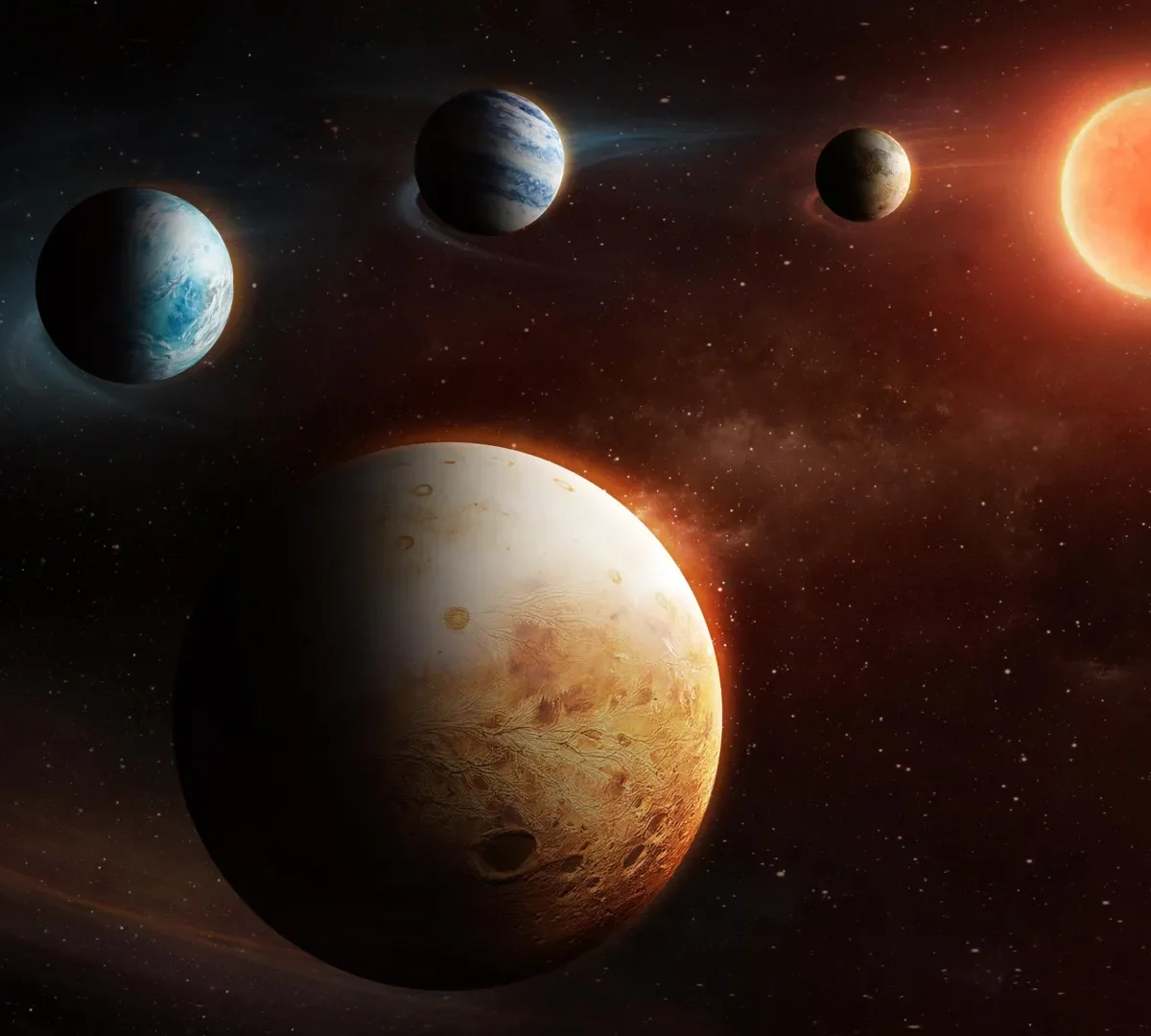
An international group of astronomers has identified a faraway planetary system that calls into question one of the most widely accepted ideas about how planets take shape.
In most planetary systems observed across the Milky Way, scientists see the same basic layout. Small, rocky planets circle close to their star, while large gas giants orbit at greater distances. Our own Solar System fits this pattern. The inner planets: Mercury, Venus, Earth and Mars, are made mostly of rock and metal. Farther out, Jupiter, Saturn, Uranus and Neptune are dominated by thick layers of gas.
This arrangement is explained by a leading theory of planet formation. Young stars emit intense radiation that can strip away gases from nearby developing planets, leaving behind solid, rocky worlds. Farther from the star, cooler temperatures allow planets to hold onto thick atmospheres, leading to the formation of gas giants.
A Rule Breaking System Around LHS 1903
A newly identified system orbiting the star LHS 1903 does not follow that script. The discovery, reported in Science, centers on a small, faint red dwarf star that is cooler and less massive than the Sun.
Researchers led by Prof. Ryan Cloutier of McMaster University and Prof. Thomas Wilson of the University of Warwick combined data from telescopes on Earth and in space to study the system. They initially identified three planets. The innermost world is rocky, followed by two gas rich planets similar to smaller versions of Neptune, a lineup that matches standard expectations.
But years of additional observations brought an unexpected twist. New measurements from the European Space Agency’s CHEOPS satellite revealed a fourth planet, called LHS 1903 e, orbiting farthest from the star. Surprisingly, this outer world appears to be rocky.
“We’ve seen this pattern: rocky inside, gaseous outside, across hundreds of planetary systems. But now, the discovery of a rocky planet in the outer part of a system forces us to rethink the timing and conditions under which rocky planets can form,” says Cloutier, who is an assistant professor in the Department of Physics and Astronomy.
Ruling Out Collisions and Planetary Shifts
The team explored several possible explanations. They considered whether a massive impact might have stripped away the planet’s atmosphere. They also examined whether the planets could have shifted positions over time. Detailed computer simulations and studies of the planets’ orbits ruled out both scenarios.
Instead, the findings point to a more unexpected idea. The planets in this system may not have formed simultaneously. Rather, they could have developed one after another as conditions around the star changed.
Inside Out Planet Formation
Standard models propose that planets arise within a protoplanetary disc, a swirling cloud of gas and dust surrounding a young star. In this environment, clumps of material form several planetary embryos at roughly the same time. Over millions of years, these growing bodies evolve into fully formed planets with a range of sizes and compositions.
The structure of the LHS 1903 system suggests a different pathway known as inside out planet formation. In this scenario, planets take shape sequentially in shifting environments. The local conditions at the time each planet finishes forming determine whether it becomes gas rich or remains rocky.
This framework could explain the unusual nature of LHS 1903 e. By the time it began to assemble, much of the gas in the surrounding disc may have already dissipated, leaving too little material to build a thick atmosphere.
“It’s remarkable to see a rocky world forming in an environment that shouldn’t favour that outcome. It challenges the assumptions built into our current models,” says Cloutier, who adds that the discovery raises broader questions about whether LHS 1903 is an anomaly or an early example of a pattern scientists have yet to recognize.
“As telescopes and detection methods become more precise, we are strengthening our ability to find planetary systems that don’t resemble our own and that don’t conform to longstanding theories,” he says.
“Each new system adds another data point to a growing picture of planetary diversity — one that forces scientists to rethink the processes that shape worlds across the galaxy.”