

Episode Transcript
Olivia Allen-Price: Bay Curious in your feed on a Monday? It’s true. We’re dropping two episodes each week for a while — and experimenting with some new things along the way. Let us know what you think! Our email is baycurious@kqed.org.
Now on to the episode…
Sounds of crows
Chances are good, that is a familiar sound.
Crow sounds
Those would be “Corvus brachyrhynchos” aka crows.
Our often unwanted urban neighbors. Crows are thought to be loud, pesky, aggressive — even sinister. No matter what you think of them, they’re hard not to notice. They really demand our attention.
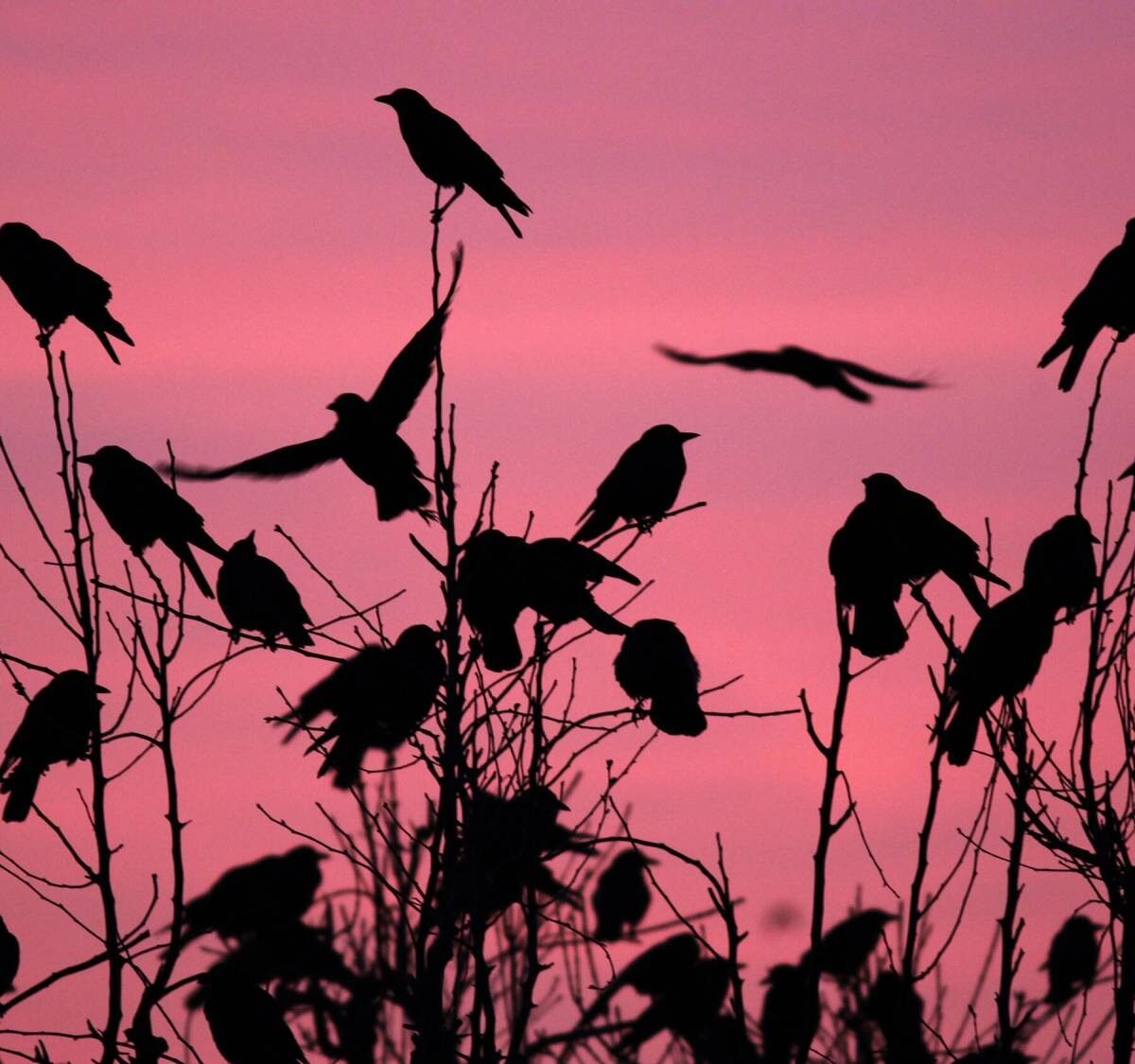
I’m Olivia Allen-Price. This is Bay Curious and recently several listeners have written to us observing there’s a “crow-maggedon” happening in downtown Oakland and San Francisco. Listeners are seeing huge flocks of crows flying across the sky around sunset, congregating in the same locations night after night after night.
Glenn Phillips: This is a seasonal phenomenon that crows gather in large roosts during the winter.
Olivia Allen-Price: Glenn Phillips is the executive director of the Golden Gate Bird Alliance. They count the crows every winter. The most recent count happened in December 2025 and in Oakland and San Francisco, the crow population basically doubled from the year before.
Glenn Phillips: One reason for roosting in large numbers is that there’s safety in numbers. Any predator that would be wanting to take out a crow is gonna have to deal with not just one crow but thousands.
Olivia Allen-Price: But also, crows are social animals. They share information about where to find food when they gather to sleep at night. And they certainly have some favorite places to sleep.
They’re looking for good places to perch, with views of predators, shelter from wind and rain…
A place they can let their metaphorical hair down – or, in a crow’s world, let their claws tighten.
Glenn Phillips: When you relax your hand, it’s loose. When a bird relaxes its claw, it is firm and tight. So that they actually have to actively open their feet in order to let go of something. So when they’re sleeping, they aren’t gonna fall off because that grip is tight.
Olivia Allen-Price: Pretty wild!
So that answers some of your questions about crows. But for the rest of today’s episode we’ll focus on this one sent in from San Mateo listener Kevin Branch in 2019.
Kevin Branch: There are so many crows around nowadays. Are they pushing out the old normal birds that I grew up with — the bluejays, the mockingbirds, the redwing blackbird — the birds I used to grow up listening to in the morning.
Olivia Allen-Price: Kevin also wanted to know if there is a plan to, ahem, reduce their populations. We asked KQED’s Dan Brekke, who has a fascination with just about everything including the natural world, to take a stab at answering them.
So Dan, what have you got for us?
Dan Brekke: Let’s just say Kevin isn’t imagining things.
Sounds of birds
Dan Brekke: I visited him at work — a theatrical rigging company down in Redwood City — and he says it’s the same thing every day — crows.
Kevin Branch: I see ‘em in the morning, I see ‘em in the afternoon, I see ‘em up in trees, I see ‘em on top of buildings. They’re everywhere. I kind of feel like the crow has taken over big time.
Dan Brekke: And after hearing all those crows, Kevin has a pretty good crow caw himself.
Kevin Branch: CAW CAW!
Dan Brekke: Kevin’s right — we’re seeing more crows these days. How many more? The numbers are surprising. I spoke with Bob Lewis, who helps run the Golden Gate Audubon Society’s Annual Christmas Bird Count.
Bob Lewis: So, I just took a look at the count today, and starting with 2000, year 2000, there were 167 crows in our circle.
Dan Brekke: That ‘circle’ covers Oakland and a large part of the East Bay shoreline and hills. Around Christmastime, 300 volunteers canvas the area and tally the birds.
Bob Lewis: It’s the biggest count in the U.S. Actually, it’s the biggest count in the world.
Dan Brekke: So, we started in 2000 with 167 crows. And since then?
Bob Lewis: In 2002, there were 250, it went up significantly. In 2005 there were 400. At 2010, there was over a thousand. 2015 almost fifteen hundred. And in 2018, there were almost twenty-five hundred crows.
Dan Brekke: From 167 crows to twenty-five hundred in less than 20 years. That’s fifteen times as many!
Not everywhere in the Bay Area has seen that kind of spike. For instance, South Bay crow populations have fallen in the Christmas Bird Count over the last decade, apparently because of a spike in West Nile virus that killed many of the birds.
But John Marzluff, a University of Washington wildlife biologist, says the pattern of increasing crow populations is a familiar one.
John Marzluff: That’s a common trend for a lot of corvids across the western U.S., for sure.
Dan Brekke: That word he said is “corvids.”
That’s a family of birds that includes crows and ravens — another species whose Bay Area population has soared in recent decades.
Olivia Allen-Price: OK, so we clearly have more crows, at least in most parts of the Bay Area. Kevin also wanted to know why?
Dan Brekke: The people who watch the birds point to an equation with two major parts.
The first part has to do with where crows are not very welcome. Here’s Bob Lewis again.
Bob Lewis: One argument, which may be true, is that crows are smart birds, and crows have historically inhabited the countryside. Farmers put up scarecrows and crows eat corn. But in the country, crows get shot, too, and crows have perhaps discovered in the cities and towns that it’s a much safer place to be.
Sounds of a hunting video sneak up
Dan Brekke: That’s sound from one of the many, many crow hunt videos you can find online.
You can’t really blame crows for feeling like they’re not wanted out there in the country.
Shotgun sound in the clear
Dan Brekke: One hundred years ago this year a company in the ammunition industry launched a “national crow shoot,” ostensibly to get rid of a threat to crops and other birds.
And this wasn’t just a “country activity.”
San Francisco’s Golden Gate Park employed a hunter — usually a city cop — to shoot crows and other unwanted animals, like jays and coyotes.
Crow shoot with hunter voices: “Take him,” (laughter) “I think you hit him that one.”
Dan Brekke: And here in California, crows are fair game in most rural areas from December 1st to the beginning of April. In 2015, California hunters reported killing about 35,000 crows.
Hunting video: Nice! There you go!”
Dan Brekke: But unfriendly humans are just one factor that has led to more crows becoming city dwellers.
John Marzluff: I think it’s kind of simple myself. Basically, we’ve provided more food for them. Now, the reasons for that may be more complex, because it includes things like garbage, like fast-food restaurant waste, like road kill, so there are a lot of ways we provide them food. But that’s the bottom line. That’s why they’re more abundant.
Olivia Allen-Price: But haven’t we city dwellers have always been pretty messy. Look at the giant open garbage dumps that used to be on the edge of every big city. If garbage is attracting crows — where were they before?
John Marzluff: You don’t have to have a dump. I mean, I think actually in terms of territoriality and increasing the breeding population, it’s better to have food more uniformly distributed.
Dan Brekke: Our urbanized area is much, much larger than it used to be. And we’re providing rich, dependable sources of food — from lawns to leftovers. More food allows crow populations to become more dense.
John Marzluff: They only defend enough space that’s necessary to get enough food to raise their young and survive. So as more food is available, they can live in tighter and tighter quarters and you can fit more of them into the place.
Olivia Allen-Price: When we return, we get to the bloody truth. Are these crows killing other birds? Stay with us.
Sponsor break
Olivia Allen-Price: So now we know that we do have more crows, and we have some ideas about why. The next question is: Are they killing other species of birds? Like those songbirds Kevin remembers?
Songbird sounds
Dan Brekke: One of the “crow people” I talked to is named Kaeli Swift, a wildlife scientist who has done lots of research on crows.
She said there are limited instances where crows — abetted by humans, typically — can pose an unusual threat to endangered species like snowy plovers.
Kaeli Swift: But your standard suburban backyard like L.A. or Seattle or New York or anywhere else in the country — not so much. Most people that contact me feeling like crows wiped away all of the birds in their neighborhood — and just have this perception that if you see a flock of crows it means none of your songbirds aren’t going to reproduce, that everything is doomed — the science just does not back that up.
Dan Brekke: So research does not show that crows are remorseless killers.
And if there are in fact fewer songbirds than when Kevin grew up, it could be for many reasons — loss of habitat, those pesky squirrels or even our domestic cats.
Swift points to a long list of the birds’ winning qualities.
Kaeli Swift: There’s a lot of qualities that I don’t think you can help but find really attractive — like their ability to learn our faces and be pretty excited to see us when you’ve built up a positive relationship with them by feeding them, for example. They play, so you can watch them play games, particularly the young birds. And they’re just kind of charismatic and goofy in the way that a dog with a really strong personality is. For me, crows have the same sort of quality where if you watch them you just see them do all these things that are so interesting that you just kind of can’t help falling in love with them if you just open yourself up to that.
Olivia Allen-Price: They sound like humans.
Dan Brekke: Kaeli Swift says many of our problems with crows may stem from how much we share in common with them.
Kaeli Swift: They’re clever, so they’re able to outsmart some of the ways we try to keep them out of our garbage or out of our property. They are social, so they are really noisy. They are protective parents, so they can be aggressive around their babies when they feel like they’re being a threat.
Dan Brekke: I keep coming back to this thing John Marzluff said, that it’s important to remember crows are “sentient beings,” like us, and that we ought to learn to use our big human brains to discover and address the problems we have with a growing crow population.
John Marzluff: I do end every one of my talks about crows with a slide that’s like, ‘OK, these things can get under our skin. Why? And what should we do?’ And my take-home is that we should celebrate them for being successful, and if we need to control them in places, we need to think hard about it. Like they think about how to live with us, we need to think about how to live with them and come up with strategies that will have meaningful effects on their populations — not just kill a bunch of them.
Dan Brekke: Things like better managing our waste and being faster about removing roadkill.
Olivia Allen-Price: But mostly, it sounds like we need to just learn to co-exist with crows. And see the good in them?
Dan Brekke: Exactly. While I was doing research for this story I came across a poetry collection about crows.
Olivia Allen-Price: Sounds good. We will listen to one of those poems on the way out. But first, thank you — reporter Dan Brekke — for your reporting this week.Dan Brekke: You’re welcome
Olivia Allen-Price: And also a big thanks to our question asker, Kevin Branch.
Kevin Branch: Bay Curious is made in San Francisco at KQED.
Olivia Allen-Price: This episode was produced by Amanda Font, Christopher Beale, Katie McMurran, Katrina Schwartz and me, Olivia Allen-Price. Special thanks this week to Pauline Bartolone.
And now the poem we promised you.
Sasha Khokha reads “Early Morning Crow” by Jim Natal:
Crows have no shame. They caw at 6 a.m.,
expect a response from the windows reflecting
overcast skies, wait for an echo
to return across the canyon, for the bottle
to wash up on shore, the telephone
to ring, the empty half of the bed to fill.
You cannot throw
a boot at them like sex-struck cartoon cats
yowling backlit by the moon, cannot
shoo them like pie-faced pasture cows ruminating
with the intensity of low-watt bulbs.
The crows wake you
too early. And there you are, an overdue
bill, over-ripe melon, alone with your thoughts sluicing
back through the gates you had to lower by hand
the night before, cranking rusty cogs and wheels
so you could get some sleep.
The bed floods
and you rise, afloat with black wings spread
like oil upon the surface, a near-fatality
the cold almost got, wet through and hearing
a solitary crow that croaks:
Is anybody there?
Is anybody there?
then flies away before you can form
a suitable answer.
Olivia Allen-Price: Some members of the KQED podcast team are represented by The Screen Actors Guild, American Federation of Television and Radio Artists. San Francisco Northern California Local.
I’m Olivia Allen-Price. Have a wonderful week.