

Jan Bartek – AncientPages.com – Tongeren, recognized as the oldest city in Belgium, is situated in the province of Limburg in the eastern part of the country. Its history dates back to the Roman era, originating from the settlement known as Atuatuca Tungrorum, which is believed to have been destroyed by the Huns in 451. The city continues to yield significant archaeological discoveries from Roman times.

In the 1930s, a substantial number of wooden fragments were unearthed in Tongeren. Initially thought to be remnants of boards or boxes, these pieces were later identified as parts of Roman wax tablets. These tablets consisted of wooden frames that held a thin layer of wax used for writing various texts. When messages were inscribed into the wax with a stylus, impressions often remained on the wood beneath.
Although none of the original wax has survived over time, researchers once believed that no traces of writing could be recovered from these artifacts. The wooden fragments were largely forgotten until their rediscovery in 2020 by Else Hartoch, director of Tongeren’s Gallo-Romeins Museum. This renewed interest has provided valuable insights into daily life and communication during Roman times in Tongeren.
Deciphering The Roman Was Tablets Found In Tongeren
A year ago, Professor Markus Scholz, a provincial Roman archaeologist and inscription expert at Goethe University, gained international attention for deciphering the “Frankfurt Silver Inscription.” This discovery was significant because it provided evidence that people north of the Alps believed in Jesus Christ as early as the 3rd century. Scholz’s expertise has now contributed to another important breakthrough: working with Professor Dr. Jürgen Blänsdorf (Emeritus at the University of Mainz), he has helped identify writing on wooden fragments from Roman wax tablets found in Tongeren, Belgium.

The researchers employed several methods, including Reflectance Transformation Imaging (RTI), an advanced photographic technique, to decipher the text found on the wooden fragments. Credit: Gallo-Romeins Museum Tongeren-Borgloon
The project began in 2021 during the pandemic when Hartoch approached Scholz for his expertise. With support from Blänsdorf, Scholz managed to extract valuable information from these challenging artifacts. Unlike their previous work with silver inscriptions, deciphering these wooden tablets presented unique difficulties. The wood was completely dried out and its natural grain made it hard to distinguish between intentional markings and accidental grooves or damage caused by drought. Additionally, some tablets had been overwritten multiple times—creating palimpsests—which further complicated their analysis.

Credit: Gallo-Romeins Museum Tongeren-Borgloon
In total, 85 fragments were examined from two sites: one near a forum well where documents had been deliberately destroyed—possibly an ancient form of data protection—and another mud pit used for discarding unusable tablets and other waste materials. The first group included contracts and official records; scribes often pressed hard enough that text impressions reached deep into the wood itself. The second site yielded copies intended for authorities or student writing exercises—often marking a tablet’s final use—as well as a draft inscription for a statue honoring Caracalla before he became emperor in 207 AD.
Scholz describes this research as painstakingly slow—even with advanced visualization tools like Reflectance Transformation Imaging (RTI)-dome technology—and required frequent in-person meetings despite pandemic restrictions. By sharing their findings collaboratively while adhering to safety protocols such as mask-wearing, Scholz and his colleagues were able to gradually piece together new insights into Roman administrative practices and daily life through these ancient texts.
Multicultural Society – Names Of Celtic, Roman, And Germanic Origin
Of the 85 tablets discovered, only about half display traces of writing. Despite this, the deciphered letters, words, and names have yielded significant new insights. The tablets provide evidence for the existence of certain political offices in the province; for instance, they mention a decemvir—a high-ranking magistrate—and lictors, who were personal attendants to senior state or municipal officials. Notably, lictors are rarely documented in the northern provinces of the Roman Empire.

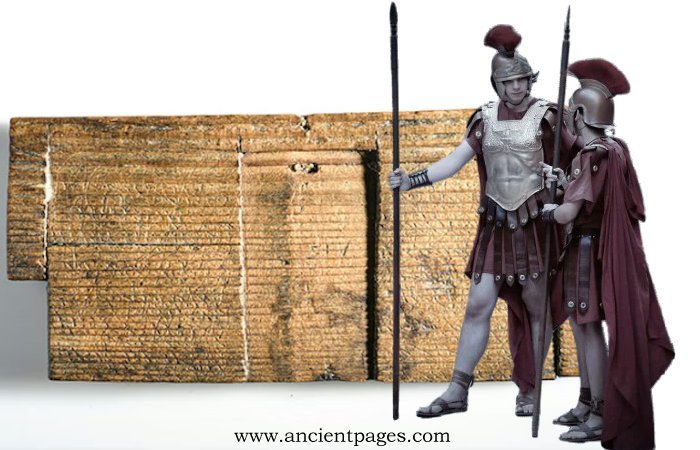
A lictor was a Roman civil servant who served as both an attendant and bodyguard to magistrates possessing imperium, or executive authority. Historical records indicate that lictors have been present since the era of the Roman Kingdom, and it is believed that their role may have originated with the Etruscans. Credit: Sergey Sosnovskiy – CC BY-SA 2.0, Kharmacher – Public Domain
The tablets also shed light on local inhabitants: some individuals settled in Tongeren after completing service in the Roman army, with a few having served specifically in the Rhine fleet. Additionally, numerous names appear on these tablets—of Celtic, Roman, and Germanic origin—some of which have not been recorded elsewhere. This diversity points to a multicultural society within the region.
See also: More Archaeology News
According to Markus Scholz, working on these tablets was as engaging as his previous research on a well-known amulet from Roman Nida (now Frankfurt-Heddernheim). While these materials may seem unremarkable at first glance and their inscriptions less dramatic than others’, their decipherment has made substantial contributions to both archaeological and ancient historical research.
Written by Jan Bartek – AncientPages.com Staff Writer