

Conny Waters – AncientPages.com – A significant discovery of rare Iron Age artifacts, dating back approximately 2,000 years, has been made in West Norfolk, England. Among the items unearthed is an almost complete trumpet known as a carnyx, along with parts of another.

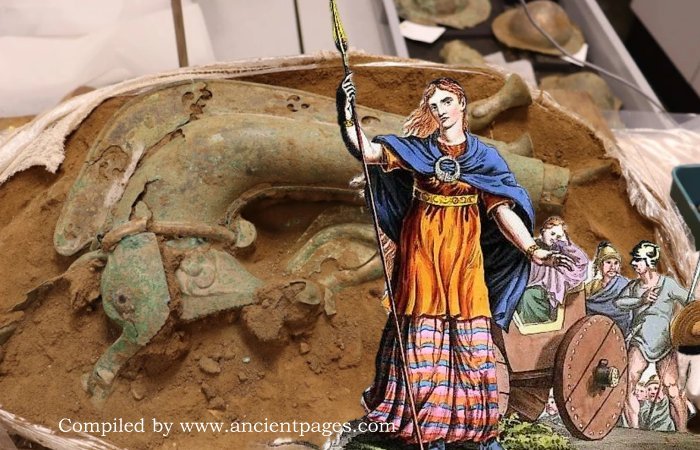
Background: Part of the discovered Iron Age hoard in Norfolk. Credit: Norfolk Museums Service/Historic England – Right: Illustration of Queen Boudicca. Public Domain. Image compilation by AncientPages.com
Why Is The Iron Age Hoard Exceptional?
These animal-headed bronze instruments played a crucial role among Celtic tribes across Europe, inspiring warriors on the battlefield and earning recognition from the Romans, who frequently showcased them as war trophies.
The recent discovery of this carnyx is especially significant—it is one of only three known examples from Britain and among the most complete ever found in Europe. This remarkable find not only enriches our understanding of ancient Celtic culture but also highlights its rarity and historical importance.

Credit: Norfolk Museums Service/Historic England
Archaeologists describe the hoard as “internationally significant.” It was uncovered during a routine archaeological investigation at a privately owned site in eastern England that had been designated for residential development. The excavation was conducted last summer by a team from Pre-Construct Archaeology as part of standard planning procedures.
In addition to the carnyx, the hoard contains a sheet-bronze boar’s head believed to have come from a military standard, five shield bosses, and an iron object whose purpose remains unknown. Such finds are exceptionally rare not only within Britain but also across Europe.

Credit: Norfolk Museums Service/Historic England
“Before this dig began our Project Manager had ‘a feeling’ that this site would be special,” Mark Hinman, chief executive of archaeological services firm Pre-Construct Archaeology, said in the statement from Historic England.
“They discovered something completely unexpected, paused for breath, then followed best excavation practice to recover these rare and fragile objects.”
After their discovery, the objects were carefully extracted from the site within a block of soil to preserve their context. Initial scans were conducted to determine the arrangement of the items inside the soil block. Conservation specialists at Norfolk Museums Service then meticulously removed each object for a preliminary assessment. Because they are extremely fragile, these artifacts require significant stabilization before more detailed research can be conducted.
Linked To The Celtic Iceni Tribe?
Fraser Hunter, Iron Age and Roman curator at National Museums Scotland and an expert on carnyces, suggests that this collection was buried approximately 2,000 years ago. He associates it with the Celtic Iceni tribe, who inhabited the area and are well known for their revolt against Roman rule in 60 or 61 AD under Queen Boudica’s leadership.

Credit: Norfolk Museums Service/Historic England
Hunter said in the statement that the discovery “will add enormously to our understanding of the Iron Age world.”
He went on to say: “I’ve looked at carnyces from around Europe, and the full research and conservation of these incredibly fragile remains will reshape our view of sound and music in the Iron Age.”
See also: More Archaeology News
Tim Pestell, senior curator of archaeology for Norfolk Museums Service, said in the statement: “The Norfolk Carnyx Hoard will provide archaeologists with an unparalleled opportunity to investigate a number of rare objects and ultimately, to tell the story of how these came to be buried in the county two thousand years ago.”
Source: Historic England
Written by Conny Waters – AncientPages.com Staff Writer