

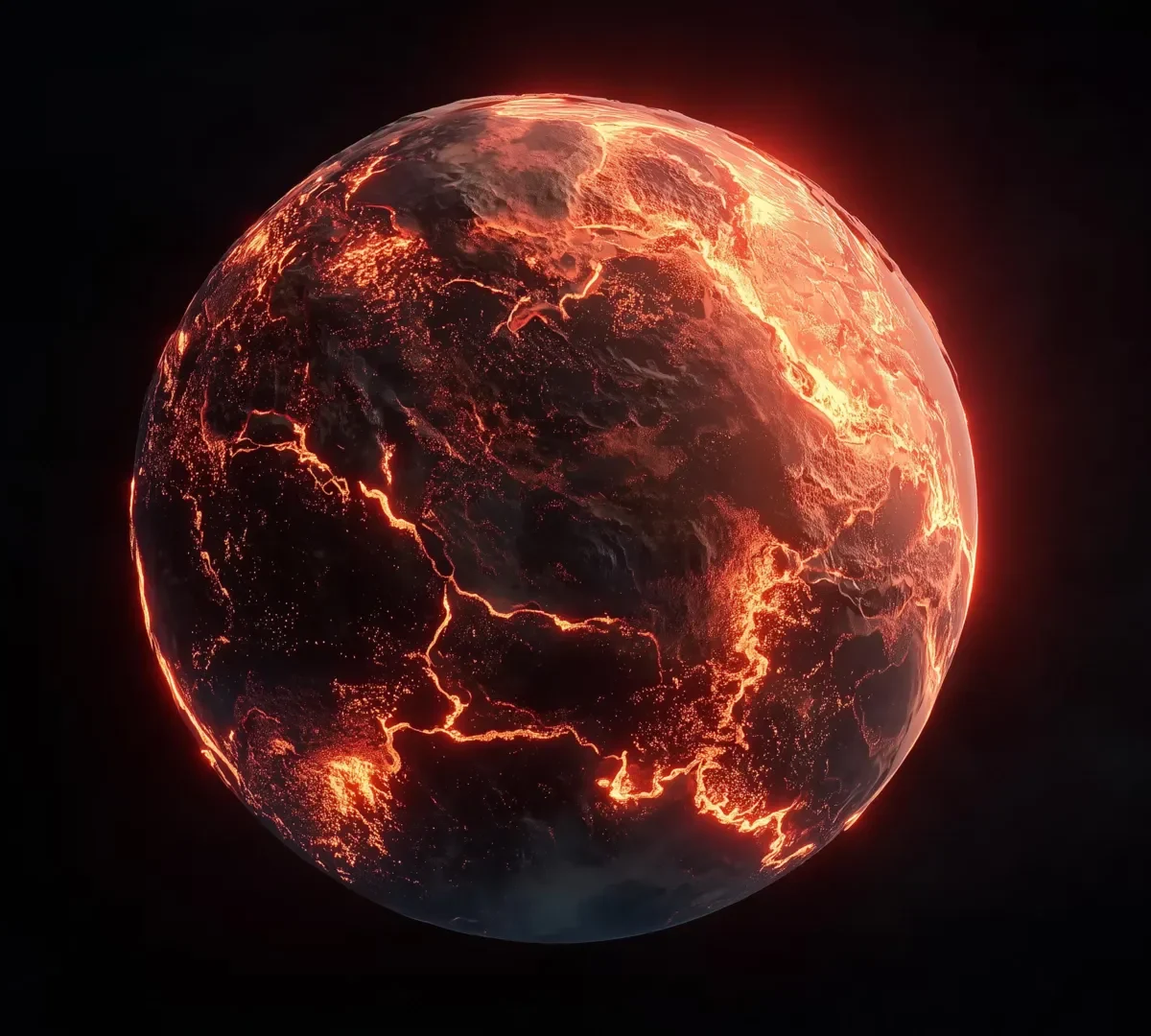
Around 4.6 billion years ago, Earth looked nothing like the calm, blue world we see today. Repeated and powerful impacts from space kept the planet’s surface and interior in a turbulent, molten state. Much of Earth was covered by a global ocean of magma, with temperatures so extreme that liquid water could not survive. The young planet more closely resembled a blazing furnace than a place capable of supporting oceans or life.
Today, however, oceans cover about 70% of Earth’s surface. How water managed to endure the transition from this molten early phase to a largely solid planet has long puzzled scientists and driven decades of research.
Water Hidden Deep Inside the Planet
A recent study led by Prof. Zhixue Du of the Guangzhou Institute of Geochemistry of the Chinese Academy of Sciences (GIGCAS) offers a new explanation. The team found that large amounts of water could have been stored deep within Earth’s mantle as it cooled and crystallized from molten rock.
Their results, published in Science on December 11, are changing how scientists think about water storage deep inside the planet. The researchers showed that bridgmanite, the most abundant mineral in Earth’s mantle, can function like a microscopic “water container.” This ability may have allowed early Earth to trap significant amounts of water below the surface as the planet solidified.
According to the team, this early reservoir of water may have played a key role in Earth’s transformation from a hostile, fiery world into one capable of supporting life.
Testing Water Storage Under Extreme Conditions
Earlier experiments suggested that bridgmanite could only hold small amounts of water. Those studies, however, were conducted at relatively low temperatures. To revisit the question, the researchers had to overcome two major hurdles. They needed to recreate the intense pressures and temperatures found more than 660 kilometers beneath Earth’s surface, and they had to detect extremely small traces of water in mineral samples, some thinner than one tenth the width of a human hair and containing only a few hundred parts per million of water.
To meet these challenges, the team built a diamond anvil cell system combined with laser heating and high-temperature imaging. This custom-designed setup allowed them to push temperatures as high as ~4,100 °C. By reproducing deep mantle conditions and accurately measuring equilibrium temperatures, the researchers were able to explore how heat affects the way minerals absorb water.
Advanced Tools Reveal Hidden Water
Using the advanced analytical facilities at GIGCAS, the scientists applied techniques including cryogenic three-dimensional electron diffraction and NanoSIMS. Working with Prof. LONG Tao from the Institute of Geology of the Chinese Academy of Geological Sciences, they also incorporated atom probe tomography (APT).
Together, these methods acted like ultra-high-resolution “chemical CT scanners” and “mass spectrometers” for the microscopic world. This approach allowed the team to map how water is distributed inside tiny samples and confirm that water is structurally dissolved within bridgmanite itself.
A Much Wetter Deep Mantle Than Expected
The experiments revealed that bridgmanite’s ability to trap water, measured by its water partition coefficient, increases sharply at higher temperatures. During Earth’s hottest magma ocean phase, newly formed bridgmanite could have stored far more water than scientists once believed. This finding challenges the long-standing assumption that the lower mantle is almost completely dry.
Using these results, the team modeled how Earth’s magma ocean cooled and crystallized. Their simulations suggest that, because bridgmanite held water so efficiently under extreme heat, the lower mantle became the largest water reservoir within the solid Earth after the magma ocean cooled. The model indicates that this reservoir could be five to 100 times larger than earlier estimates, with total water amounts ranging from 0.08 to 1 times the volume of today’s oceans.
How Deep Water Shaped Earth’s Evolution
This deeply stored water did not simply remain trapped. Instead, it acted as a “lubricant” for Earth’s internal engine. By lowering the melting point and viscosity of mantle rocks, the water helped drive internal circulation and plate motion, giving the planet long-term geological energy.
Over vast spans of time, some of this water was slowly returned to the surface through volcanic and magmatic activity. This process contributed to the formation of Earth’s early atmosphere and oceans. The researchers suggest that this buried “spark of water” may have been a decisive factor in turning Earth from a molten inferno into the blue, life-friendly planet we know today.