


More than a third of regional centers’ funding comes from Medicaid, which is facing deep cuts under Trump’s budget. The money runs out at the end of January, and it’s unclear what services will be cut.
Schools also rely on Medicaid to pay for therapists, equipment, vision and hearing tests and other services that benefit all students, not just those with disabilities. In light of state budget uncertainty, it’s not likely the state could backfill the loss of Medicaid funding, and schools would have to pare down their services.
Uncertain futures
For Lelah Coppedge, whose teenage son has cerebral palsy, the worst part is the uncertainty. She knows cuts are coming, but she doesn’t know when or what they’ll include.
“I go down this rabbit hole of worst-case scenarios,” said Coppedge, who lives in the Canoga Park neighborhood in Los Angeles. “Before this happened, I felt there was a clear path for my son. Now that path is going away, and it’s terrifying.”
Coppedge’s son, Jack, is a 16-year-old high school student who excels at algebra and physics. He loves video games and has a wide circle of friends at school. He uses a wheelchair and struggles with speech, communicating mostly through eye movements. He’ll look at his mom’s right hand to indicate “yes,” her left hand for “no.”
Coppedge and her husband rely on a nurse who comes four days a week to help Jack get dressed, get ready for bed and do other basic activities. Medicaid pays for the nurse, as well as other services like physical therapy. Even though Coppedge and her husband both work and have high-quality private health insurance, they could not afford Jack’s care without help from the government.
They also rely on the local regional center, which they assumed would help Jack after he graduates from high school, so he can remain at home, continue to hone his skills and generally live as independently as possible. If that funding vanishes, Coppedage worries Jack will someday end up in a facility where people don’t know him, don’t know how to communicate with him and don’t care about him.
“It feels like we’re going backward,” Coppedge said. “Half the time, I put my head in the sand because I’m just trying to manage the day-to-day. The rest of the time I worry that (the federal government) is looking at people like Jack as medical problems, not as unique people who want to have full, happy lives. It feels like that’s getting lost.”
The current uncertainty is stressful, but it’s even harder for families who are immigrants, Wright said. Those families are less likely to stand up for services they’re entitled to and are facing the extra fear of deportation. English learners, as well as low-income children, are disproportionately represented among students in special education, according to state data.
“That’s the other piece to all this — how it’s affecting immigrant families,” Wright said. “It’s a whole other level of anxiety and fear.”
Decades of progress on the line
Karma Quick-Panwala, an advocate at the nonprofit Disability Rights Education and Defense Fund, said she worries about the rollback of decades’ worth of progress that was hard-won by the disability rights community.
The Individuals with Disabilities Education Act, the 1975 law that created special education, actually predates the federal Department of Education. In fact, Congress created the department in part to oversee special education. Removing special ed would be a devastating blow to the disability community — not just because services might be curtailed, but philosophically, as well, Quick-Panwala said.
In the Department of Education, special education is under the purview of education experts who promote optimal ways to educate students with disabilities, so they can learn, graduate from high school and ideally go on to productive lives. In the Department of Health and Human Services, special education would no longer be overseen by educators but by those in the medical field, where they’re more likely to “look at disability as something to be cured or segregated and set aside,” Quick-Panwala said.
“The disability rights community has worked so hard and gave so much to make sure people with disabilities had a right to a meaningful education, so they could have gainful employment opportunities and participate in the world,” Quick-Panwala said. “The idea is that they wouldn’t just be present at school, but they would actually learn and thrive.”
For the time being, Wright, Quick-Panwala and other advocates are reminding families that federal funding might be shrinking, but the laws remain unchanged. Students are still entitled under federal law to the services outlined in their individual education plans, regardless of whether there’s money to pay for it. The funding will have to come from somewhere, at least for now, even if that means cutting it from another program. And California is unlikely to roll back its own special education protections, regardless of what happens in Washington, D.C.
An imperfect but successful routine
Those reassurances are scant comfort to Crain, whose daughter Lena will rely on government support her entire life. Born seven weeks prematurely, Lena has cerebral palsy, epilepsy, a cognitive impairment and is on the deaf-blind spectrum. But she has a 100-watt smile and a relentless spirit, Crain said. Even after the whole family has been up all night, Lena insists on going to school and getting the most out of every day.
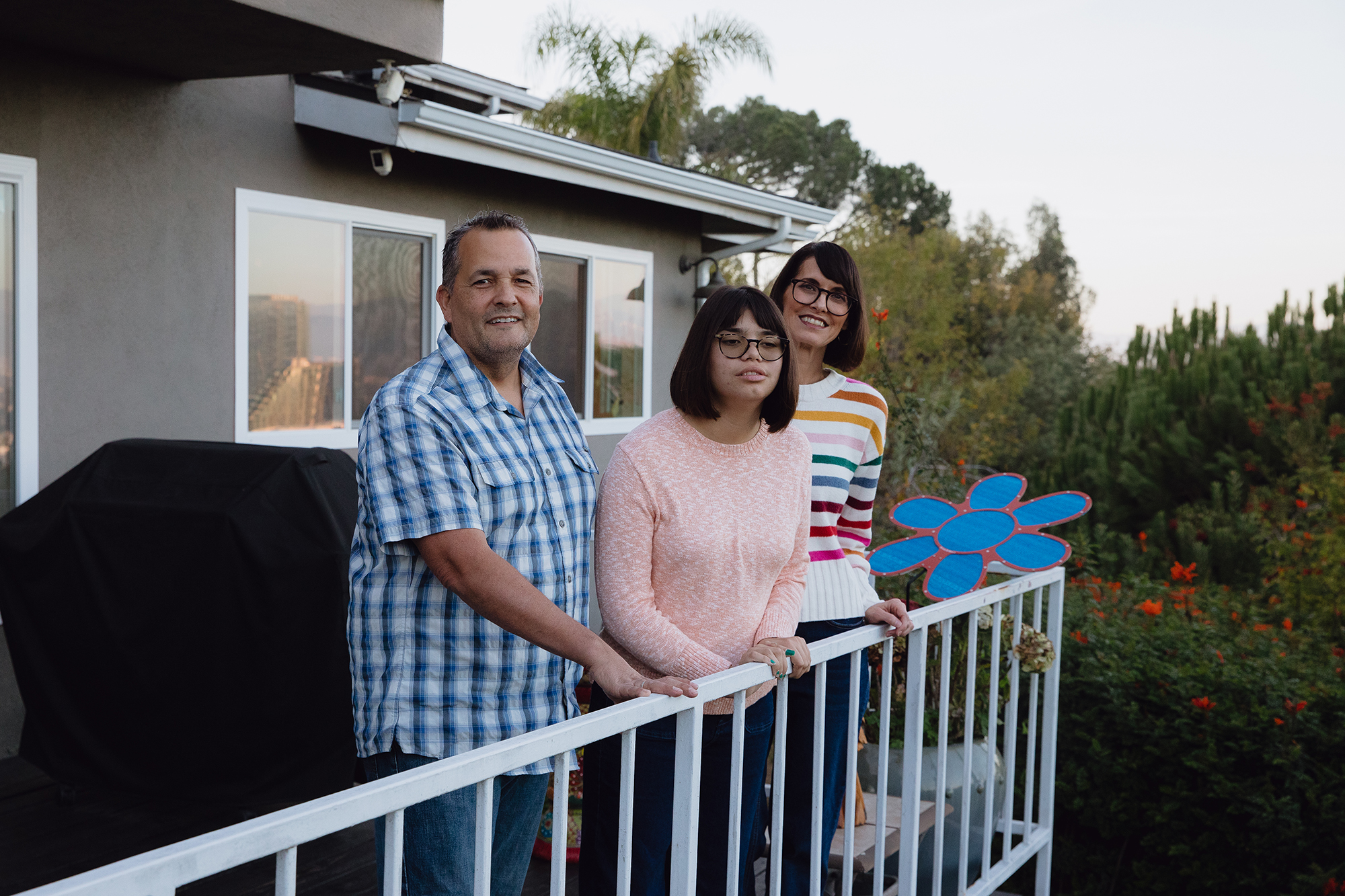
Funny and assertive, she has a few close friends and, like many teenagers, plenty of opinions about her parents. She loves her English teacher and spends most of her day in regular classrooms with help from an aide. Her favorite book is about Malala Yousafzai, the Pakistani activist who won a Nobel Peace Prize for fighting for girls’ right to an education.
Between school and home visits from aides and after-school therapists, Crain feels the family has pieced together an imperfect but mostly successful routine for Lena.