

Young Democratic challengers took on their party’s aging congressional representatives, but incumbents largely held on.

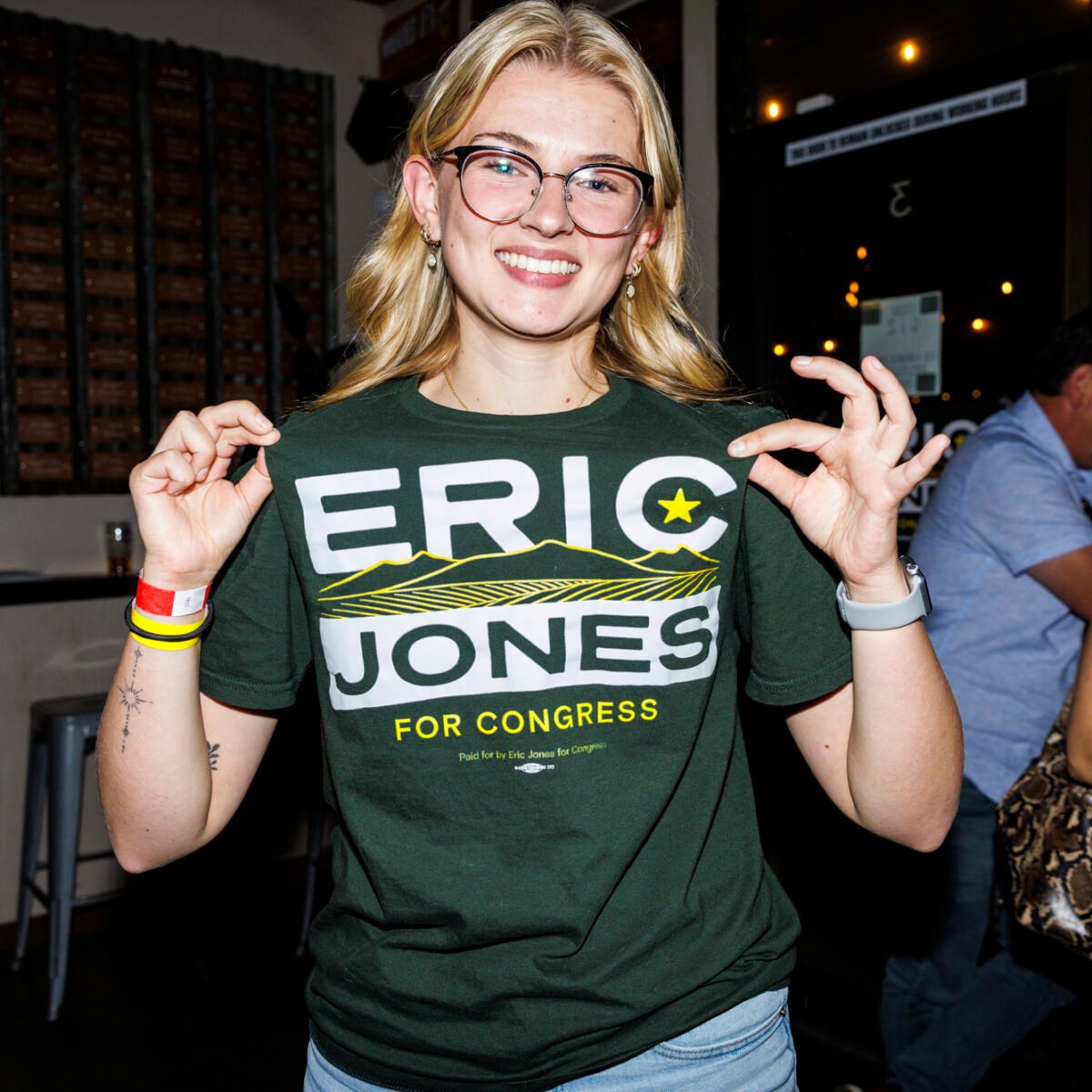
Abby Delanoy wears an Eric Jones shirt at the Democratic candidate’s watch party at Three Mile Brewing in Davis on June 2, 2026. (Gina Castro for KQED)
Sacramento City Councilmember Mai Vang, 41, had the greatest success of any challenger, running a close race against Matsui. As of Tuesday afternoon, with 95% of votes counted, Vang is nearly 2 percentage points ahead of Matsui. In the North Bay, former venture capitalist Eric Jones, 35, is still sweating out the final results, sitting less than 2 percentage points behind Republican business owner Ray Riehle in a contest for second to face Thompson in the runoff.
The results hint at what it takes to mount a successful generational challenge. Age alone, it turns out, is not enough. Candidates and analysts point to name recognition, money and redistricting as key factors shaping the outcomes.
“You have to have a reason other than ‘the person is old,’” said Christian Grose, a political science professor at the University of Southern California. “You have to have a case to make for why you would be better.”
Challengers were generally more successful when they could articulate ideological differences, Grose said. For instance, Vang has criticized Matsui for accepting funding from the American Israel Public Affairs Committee (AIPAC), not calling the war in Gaza a genocide and previously voting to fund Immigration and Customs Enforcement, though her position has changed in recent years.
“Progressivism, I think, helps in a primary,” Grose said. “A left progressive can get people’s attention, especially with the crowd of [the] governor’s election too.”
Vang also attributes her strong showing to a clear progressive platform, running for something instead of against someone.
“Are you for working families? Are you for making their lives better?” Vang said. “It can’t just be that you’re anti-Trump. You’ve got to be for these bold issues for our working families.”
Addisu Demissie, a veteran Democratic political consultant and former campaign manager for Gov. Gavin Newsom’s 2018 bid, told KQED last week that results prove name recognition remains among the biggest obstacles for newcomers.
“I don’t think it’s necessarily an indictment of those candidates or even that much of a celebration of incumbents and incumbency as much as voters tend to go with the name,” Demissie said. “And the name frankly has probably provided for you, in some way, constituent services or representation over the course of several years.”
Matsui was first elected in a 2005 special election to fill her husband’s seat after he died of pneumonia; the Matsui name has represented the Sacramento area for a combined 47 years. Waters is also a nationally recognized figure who first took her seat in 1991, and Sherman has served in Congress since 1997.
Even if voters want generational change broadly, they tend to be less likely to vote against their own representative, Grose said.
“If you ask somebody, ‘Do you want younger people in Congress? Do you want to say goodbye to 80-year-olds?’ People say yes,” Grose said. “But when you ask them about their own Congress member, they really like their own member.”
Jake Levine, a 42-year-old former White House climate aide under Presidents Obama and Biden, said his loss to Sherman should not be interpreted as a rejection of the generational message.
“I think that that is less a reflection of whether people want a new generation and more a reflection of some of the structural aspects of this race,” Levine said.
Levine believes California’s redistricting under Proposition 50, whose new maps debuted in this month’s election, worked against him.
“I really supported Prop. 50, but at the same time, for my district, that made our district significantly more Republican in terms of its complexion,” he said.

In other cases, Grose said redistricting could work against incumbents like Matsui and Thompson by bringing in a swath of new voters who may be unfamiliar with them, weakening their name recognition advantage. Nearly half of Thompson’s District 4 is now new territory.
Levine also argues the state Democratic Party “intentionally make[s] it very difficult for challengers,” noting that he was not allowed to speak at the California Democratic Party convention.
Jones, who challenged Thompson in the North Bay, agreed on this point.
“The Democratic Party is a party built to protect incumbency,” Jones said. “You see that the way the party chooses to endorse, where the California Democratic Party has never once in its history endorsed against a congressional incumbent. And I think that is the biggest uphill battle.”
It is rare for the state party to back a challenger, but not unprecedented. In 2018, the party endorsed former state Sen. Kevin de León for U.S. Senate over then-Sen. Dianne Feinstein.
With California’s count still ongoing, Jones’ campaign manager Brian Parvizshahi said he remains confident Jones will advance to the general election, where he expects to make up ground.
“When you expand the electorate [from the primary to the general election] … they typically become much more young and much more working class and more people of color. And that’s who makes up Eric Jones’ base,” Parvizshahi said.
Parvizshahi previously ran Rep. Ro Khanna’s 2014 and 2016 campaigns against Rep. Mike Honda. In 2014, Khanna gained 17 points between the primary and general election. He lost, but returned to defeat Honda in 2016.
Parvizshahi believes Jones could follow a similar trajectory, arguing that the longer runway to November offers time to build name recognition and that a younger, more diverse general election electorate could help him close the current 16-point gap.
“It’s never good for an incumbent to be under 50%,” Parvizshahi said. Thompson is currently sitting at 38% of the vote. “That’s pretty damning. That’s 62% of the electorate saying, ‘I do not want you as my congressman.’”
Democratic strategist Orrin Evans said if Jones does squeak through to the general election, it would indicate voters have an appetite for the generational change message.
“If two out of five made it through, I would say that’s a pretty good night for the kids,” Evans said.
Money proved to be the biggest hurdle for Sacramento City Councilmember Vang. She raised roughly $800,000, significantly less than Matsui’s $1.5 million. Matsui also loaned her campaign an additional $1.4 million.

“We always knew we were going to be outspent,” Vang said. “The only way to beat money is to have organized people. And that’s what we did. We knocked on thousands of doors and spoke to thousands of voters. We did it because this region is ready for change.”
Money didn’t guarantee challengers would sail through to the general election. Compared to Thompson’s $3.4 million, Jones raised $3 million and poured in an additional $5.2 million of his own money and still found himself fighting for second place.
In San Francisco, Saikat Chakrabarti announced his intent to run for Rep. Nancy Pelosi’s seat before the 86-year-old said she would not run for reelection. Chakrabarti’s incredible $8.8 million in loans to his campaign also did not get him into the runoff, which has been called for state Sen. Scott Wiener and San Francisco Supervisor Connie Chan.
Despite the many hurdles these young challengers face, Grose said this cycle gave them their best shot at a congressional seat.
“They would do really bad in a crowded field of 40-somethings in an open seat,” he said. “Trying to run against an old person who’s an incumbent is the better strategy for them.”