
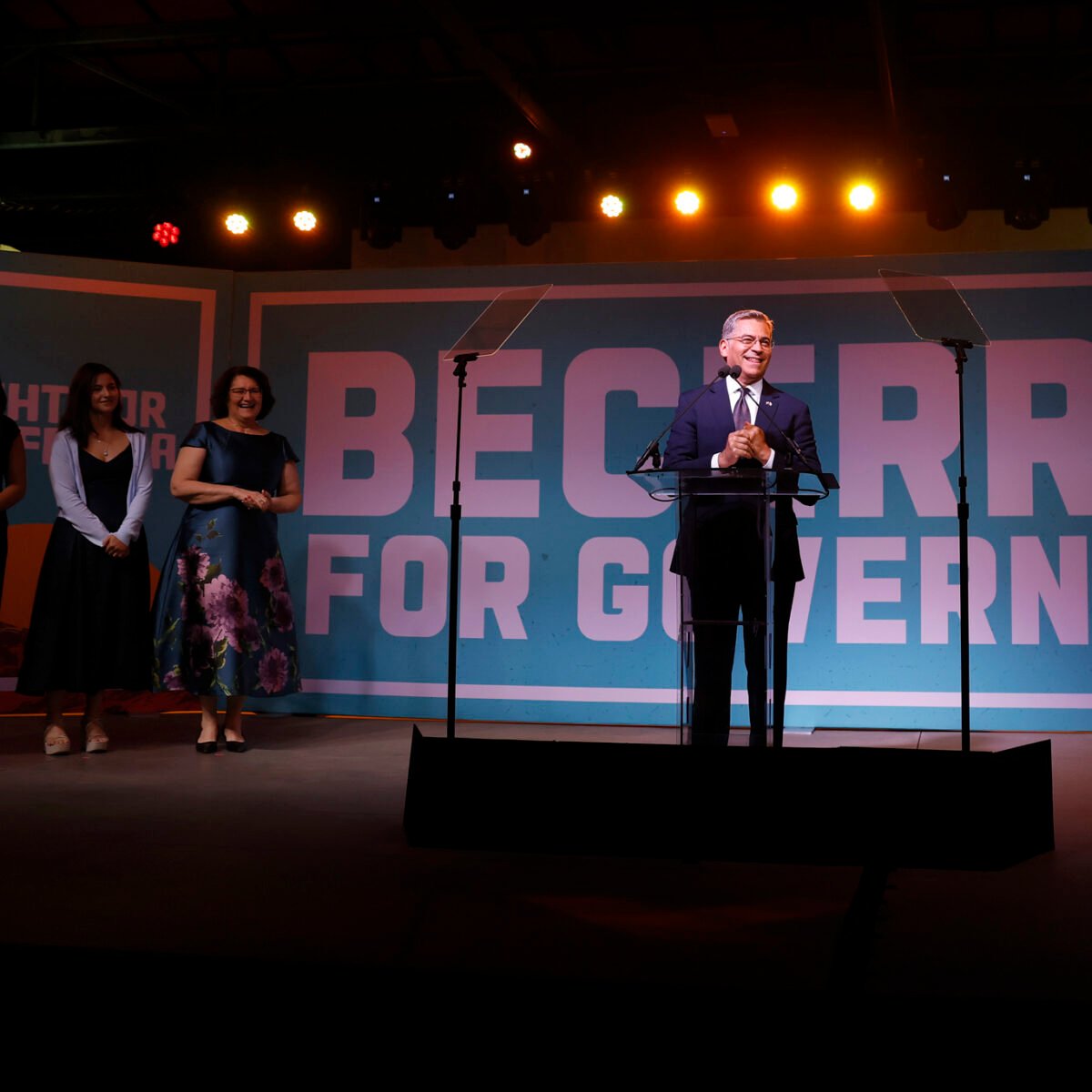
At his victory celebration in Los Angeles on Tuesday night, Becerra, the son of working-class parents from Mexico, reveled in his underdog story, which he called worthy of a Hollywood movie.
“Almost immediately, he’s counted out. An afterthought. Overlooked by many. Outspent by a ton. Even called along the way to drop out and save us all the trouble,” Becerra said. “Well, guess what? The underdog stayed in the fight.”
It will be days before we know for sure that Becerra will make the runoff — there’s still a chance Steyer could sneak into the top two when all the ballots are counted. But for those who said Becerra represents the status quo, play-it-safe, corporate-controlled leadership, remember this: It’s been 150 years since California had a Latino governor — a Republican named Romualdo Pacheco — as voters have chosen one white man after another to lead the state.
Of course Becerra isn’t governor yet, but he’ll be the odds-on favorite if he faces Republican Hilton in November.
“He’s building a really broad-based, multi-ethnic middle-class coalition, said Mike Madrid, a Latino Republican political analyst who helped found the anti-Trump Lincoln Project. He noted that while Becerra attracted solid support from Latino voters, it was less than Antonio Villaraigosa did in 2018 when he ran a losing campaign for governor.
Madrid sees Becerra’s success as drawing from elements of the historic coalition that has been slipping away from Democrats recently — working-class, noncollege-educated whites, among others.
“So there’s something very different happening in the redefinition of Democratic politics in California,” Madrid said. “It’s kind of a reemergence of this sort of FDR wing of the party. And it’s not just an ethnic identity thing; it’s really more of a middle-class identity thing. If there’s an identity, it’s no racial or ethnic anymore, it’s class, which is fascinating.”
If Becerra wins, he’ll become a national figure — a Latino governor of a state often targeted by a president who has made demonizing, demoralizing and deporting immigrants a fundamental priority.
“California is bigger than Trump. Our values are undeniable and undeportable,” Becerra said to supporters on Tuesday night. “To the people and voters of California, this is your state: Este es tu estado. We will not be bought, we will not be bullied, and we are never backing down.”
Meanwhile, in a San Francisco congressional race with national implications, another candidate with an immigrant background had a successful night. Supervisor Connie Chan, with a major boost from Rep. Nancy Pelosi’s late endorsement and solid union support, vaulted into second place in the 11th Congressional District with 29% of the vote. She’ll face state Sen. Scott Wiener, who finished first with 41%.

Ironically, in her first election 39 years ago, Pelosi narrowly defeated openly gay Supervisor Harry Britt in a special election to fill the seat left vacant by the death of Rep. Sala Burton. Now, Wiener is hoping to be the city’s first openly gay member of Congress. Pelosi’s endorsement came with praise for Chan’s immigrant background, being a mother and understanding budgets (Wiener also chaired the state Senate’s budget committee) as reasons for her support. But some saw her determination to derail the candidacy of Saikat Chakrabarti, another Democrat she clashed with when he briefly worked for Rep. Alexandria Ocasio-Cortez in Washington.
Now that she’s accomplished that with Chakrabarti’s distant third-place finish, it remains to be seen how much political capital she’ll spend on what could be an uphill battle to defeat Wiener in November.
We’ll wait for millions of remaining ballots to be counted before we know who will advance to November from the governor’s race to local congressional elections. The state’s top election official knows that can be frustrating, but she’s undaunted.
“I often hear, not only from the governor but from everyone else who (says) ‘we want you to count faster, Shirley,’” Secretary of State Shirley Weber told KQED this week. “Now what do you want? You want me to go fast, or do you want to be accurate? I choose accurate — (but) we’ll be accurate and fast at the same time.”