


Jan Bartek – AncientPages.com – An international research team led by the University of Copenhagen has made a remarkable discovery that deepens our understanding of Europe’s distant past. By studying one of France’s largest Stone Age burial sites, they uncovered evidence of a major population collapse followed by new arrivals from southern Europe. This important finding reshapes how we view the so-called “Neolithic decline,” a time when much of Northern Europe’s population suddenly diminished.
Their research, based on genetic analyses of 132 individuals buried in a large megalithic tomb near Bury, about 50 kilometers north of Paris, is especially impressive. The site was used in two distinct periods, separated by a significant population decline around 3000 BC. The fact that the groups buried before and after this decline were not genetically related highlights a profound population turnover.
“We see a clear genetic break between the two periods,” said Frederik Valeur Seersholm, assistant professor at the Globe Institute at the University of Copenhagen and one of the lead authors of the study.
“The earlier group resembles Stone Age farming populations from northern France and Germany, while the later group shows strong genetic links to southern France and the Iberian Peninsula.”
The findings suggest a sharp reduction in the local population followed by the arrival of new groups from the south.
Disease And High Mortality
Using a DNA analysis method that examines all genetic material preserved in bone, the researchers identified traces of several ancient pathogens. These included the plague-causing bacterium Yersinia pestis and Borrelia recurrentis, which is responsible for louse-borne relapsing fever.
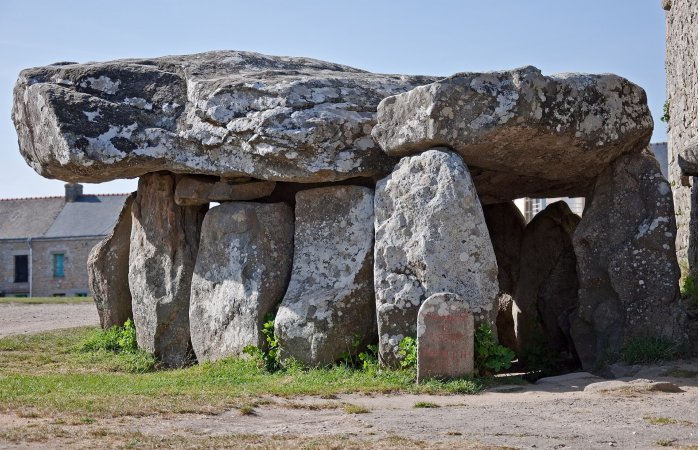
The researchers have conducted DNA analyses of the skeletons from a burial site like this one in France and found traces of several different diseases. Credit: Myrabella – CC BY-SA 3.0
“We can confirm that plague was present, but the evidence does not support it as the sole cause of the population collapse,” said Martin Sikora, associate professor at the University of Copenhagen and senior author of the study. “The decline was likely driven by a combination of disease, environmental stress and other disruptive events.”
Archaeological analysis of the skeletal remains shows unusually high mortality in the earlier burial phase, particularly among children and young people.
“The demographic pattern is a strong indicator of crisis,” said Laure Salanova, research director at France’s National Centre for Scientific Research (CNRS).
Shift In Social Organization
The DNA data clearly show a significant shift in social structure over time.
In the earlier phase, burials included multiple generations from the same extended families, indicating close-knit, family-based communities. In the later phase, however, burials became more selective and were largely associated with a single male lineage, suggesting a more hierarchical or lineage-focused social organization.
“This indicates that the population change was accompanied by a shift in how society was structured,” Seersholm explained.
See also: More Archaeology News
The findings contribute to a growing body of evidence that the so-called Neolithic decline impacted much of northern and western Europe, extending beyond Scandinavia and northern Germany. The study also proposes a potential explanation for why the construction of megalithic tombs and other large stone monuments came to an end across Europe at roughly the same time.
“We now see that end of these monumental constructions coincides with the disappearance of the population that built them,” Seersholm said.
Written by Jan Bartek – AncientPages.com Staff Writer