

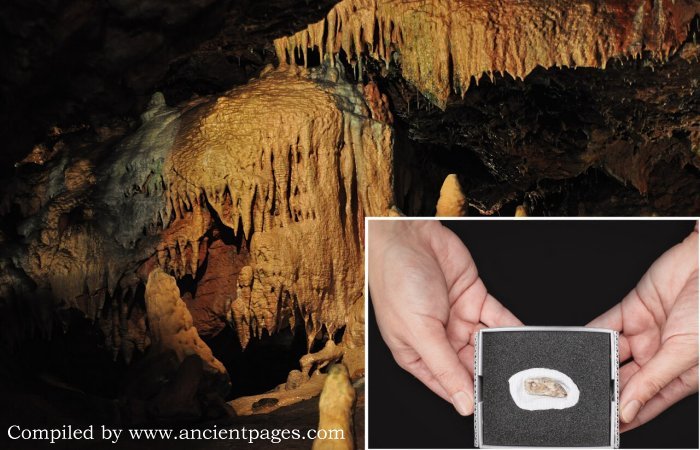
Conny Waters – AncientPages.com – It took many years, but the mystery behind a curious ancient artifact found in Kents Cavern in Torquay, U.K., has finally been solved, and the 15,000-year-old object has a fascinating story to tell.
Discovered almost 160 years ago during William Pengelly’s excavations between 1865 and 1880, this tiny object has turned out to be an extremely rare artifact. Researchers have now identified it as a pendant made from a gray seal tooth, worn by an ancient human more than 15,000 years ago.
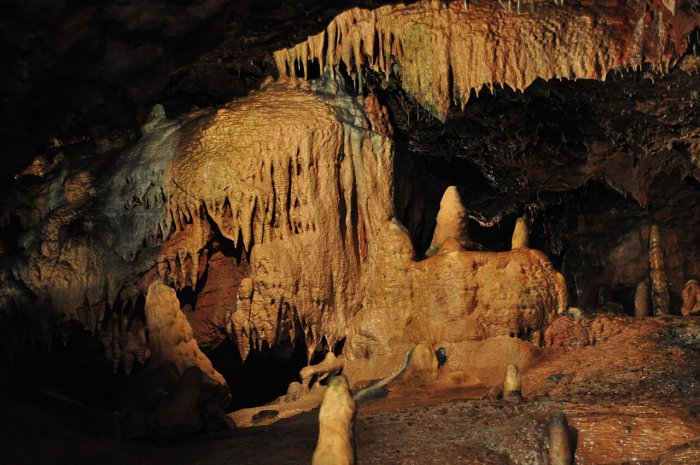
Kents Cavern. Credit: Nilfanion – CC BY-SA 4.0
Pengelly and his team were pioneers in archaeological practice. They carefully recorded where each artifact was found and the layers of sediment surrounding it. Because of this meticulous documentation, their discoveries remain scientifically valuable more than a century later.
Recent re-examination of material from Kents Cavern has brought renewed attention to a tooth artifact that was previously overlooked. Once thought to be from a badger, wolf, or beaver, a new study has revealed that the tooth actually came from a seal.
When the pendant was made 15,000 years ago, the cave lay more than 100 kilometers from the coast. This indicates that ancient humans were traveling long distances, possibly following migrating animals. It also suggests that they were engaged in extensive trade networks across Britain and perhaps with wider European communities. According to Dr. Silvia Bello, a human evolution expert and co-author of the study, this “unique” pendant offers valuable insight into the creativity of Britain’s ancient inhabitants.
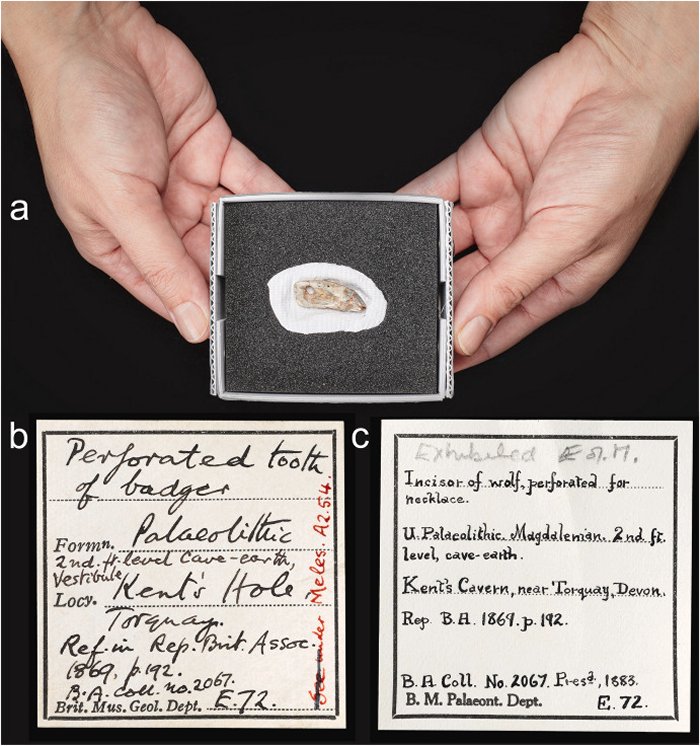
(a) Perforated seal tooth from Kents Cavern, Devon (NHMUK PA E 72). (b, c) Associated specimen labels documenting earlier misidentifications, including attribution to a badger (Meles meles) and a wolf incisor (Canis lupus). Photographs © Trustees of the Natural History Museum.
“This pendant dates to a time when there was a flourishing of engraving and other artistic behavior in Europe,” Bello says. “Upper Paleolithic humans seem to be creating objects not just for practical purposes, but aesthetic ones as well.
“It’s just speculation, but I think this seal tooth pendant might have had some formal purpose—perhaps to show the social identity of the pendant’s owner. It could be an indication that the person, or group they were part of, was familiar with the sea and maybe used to live near the coast. We’ll never know for sure, but it provides a fascinating glimpse into the past.”
How Was The 15,000-Year-Old Pendant Made?
The pendant’s story begins on the windswept shores of ancient Europe, thousands of years ago, as the Last Ice Age drew to a close. In that vast, changing world, a single life—a gray seal, likely a 12-year-old male—came to an end. Whether it was hunted by human hands or claimed by the sea itself, we may never know. But what we do know is that its story did not end there.
An ancient human, standing on that same shoreline, chose to see more than just an animal’s remains. They saw a possibility. With determination and skill, they broke open the powerful jaw to free a single tooth—no small task, given the strength of a seal’s roots. From something ordinary, they began to shape something extraordinary.
Patiently, they scraped and ground away the heavy root, transforming the rough tooth into a smoother, thinner form. Then, with practiced care, they drilled a hole through the remaining root, turning a sharp piece of flint again and again, risking a split with every twist. This was not the work of chance, but of experience, intention, and quiet mastery.
At last, a cord was threaded through the hole, and the tooth became a pendant—perhaps worn on a necklace or bracelet, close to the skin, close to the heart. In a world of ice and uncertainty, this small object may have carried meaning: protection, status, memory, or connection to the animal and the world around them.
Today, we know of only four other seal-tooth pendants from this period. That rarity reminds us just how special this piece must have been.
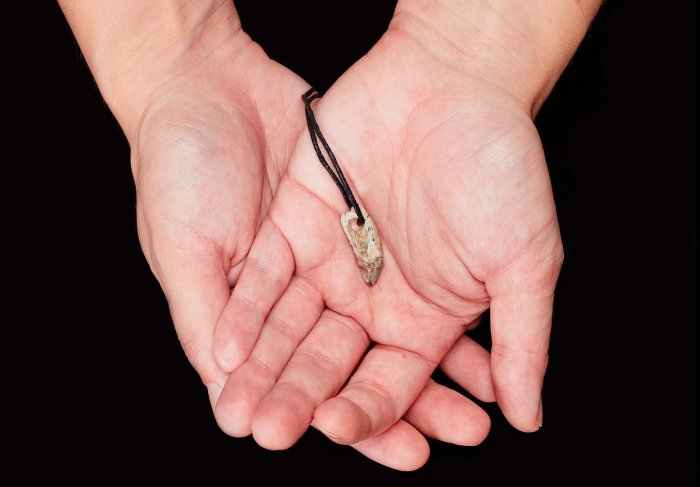
More than a century after its discovery, researchers have now determined that the pendant was crafted from the tooth of a seal. Credit: The Trustees of the Natural History Museum
“The pendant was probably worn for many years, because it’s become smooth through wear and repeated polishing,” Bello says. “A long period of use would also explain why the neat circular hole became more oval shaped, as the cord gradually wore away at the tooth’s interior.”
Eventually, the pendant ended up in Kents Cavern. The cave has been used by both Homo sapiens and Neanderthals on and off for tens of thousands of years, but it was our species that was in residence when the pendant was buried.
“While it’s well-loved, the pendant is still in pretty good shape,” Bello adds. “This means it might have been accidentally lost by its owner when they came to the cave, rather than intentionally discarded.”
Ancient Connections Between The Land And The Sea
The creation of the pendant took place during a remarkable period in Europe’s history, between 21,000 and 13,000 years ago, when ancient humans were increasingly crafting beautiful artifacts from the bones and teeth of marine mammals.
Archaeologists working at Las Caldas in Spain—over 40 kilometers inland—have uncovered an impressive variety of objects made from seals and whales, including a finely engraved sperm whale tooth. Their discoveries suggest that whale skin may also have been brought to the site, as indicated by the presence of barnacle remains that typically live on the outer surface of whales.
It’s especially inspiring to see how artwork depicting marine mammals becomes more common during this time. Some of the most striking examples come from Gönnersdorf in Germany, where several seals were carefully engraved into rocks located hundreds of kilometers from the sea. A similar engraving appears at the nearby site of Andernach, where a whale bone artifact was also found.
These engravings and artifacts were likely created by people who had journeyed to the coast, highlighting the impressive distances ancient Europeans traveled across the continent. The bones and teeth of marine animals may have been traded as their owners met other groups, gradually moving through different communities until they ended up far from their original source.
The research team is eager to learn even more about the remarkable journey of the seal tooth pendant as new analytical techniques become available, deepening our appreciation for the creativity, mobility, and interconnectedness of these ancient peoples.
See also: More Archaeology News
“If we could carry out isotope analyses or ancient DNA studies in the future, we could help to map where this seal came from and where it might have been collected,” Bello says. “This would give us a much better idea of where these humans were traveling.
“As we continue researching the artifacts from Kents Cavern, we’ll also build up a better idea of the culture and behavior of the people that lived there. Even after more than a century of study, there’s still plenty more we’re yet to discover from this site.”
The study was published in the journal Quaternary Science Reviews
Written by Conny Waters – AncientPages.com Staff Writer