
Episode transcript
Olivia Allen-Price: Bay Area Rapid Transit. Our dear friend, BART.
For regular riders, your whirs, squeaks and horns are part of the everyday soundtrack of life.
We always hear you coming.
Whir of a train pulling into the station
Olivia Allen-Price: We appreciate those timely warnings…
The doors are closing please stand clear of the doors
Olivia Allen-Price: And how you help us not miss our stop.
Arriving at 16th street Mission
Olivia Allen-Price: Every now and then, someone real pops in
This is BART operation control…
Olivia Allen-Price: Jimmy Tobin, our question asker, has been fixated on one particular sound in the BART ecosystem. A set of announcements …
Jimmy Tobin: So sometimes it feels like there’s like a lower kind of male voice that’s like, feels like it’s from like war games, like WOPR kind of style.
Wargames Clip: This box interprets signals from the computer and turns it into sounds. “Shall we play a game?”
Jimmy Tobin: And there’s a higher female voice is kind of like 90s Microsoft Sam style.
Microsoft Sam: Hello, I am Microsoft Sam. I am the most popular voice of Microsoft.
Olivia Allen-Price: There are a variety of voices riders hear throughout BART, some of which are voiced by actual people. But it’s these robotic and synthesized voices that Jimmy can’t stop hearing …
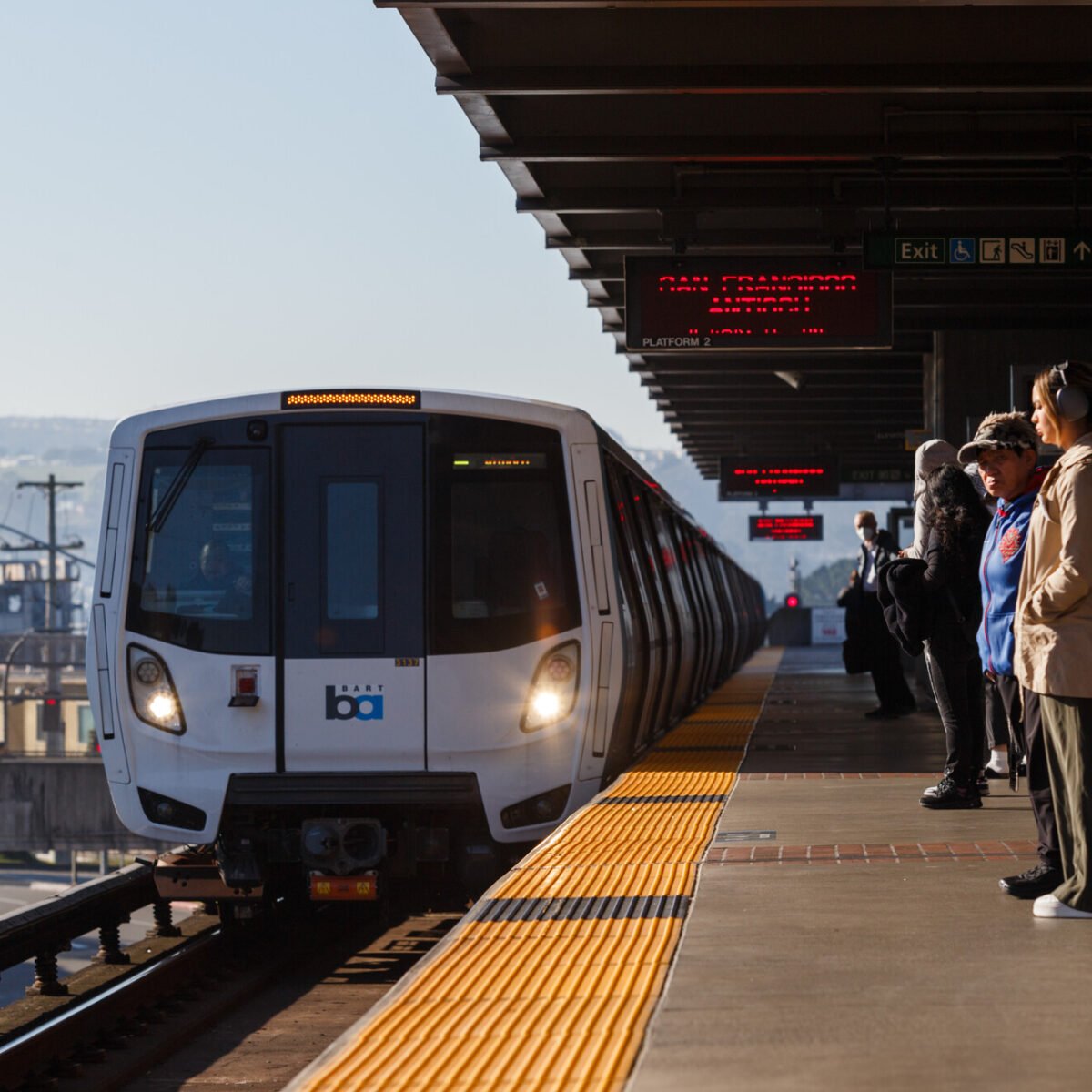
Three car Fremont Train now boarding, platform 2.
Olivia Allen-Price: Jimmy is an audio engineer at Google who actually works on synthesized speech models, and these voices really bothered him. One day when he was waiting for a BART train and heard an announcement for a train heading toward the Oakland Airport.
6-car Blue line train for OAK Airport Dublin in 15 minutes. 6-car Green line train for OAK Airport Barryessa in 19 minutes
Jimmy Tobin: I never understood what it was saying. I always thought it was, like, Oasis? And so I was just like, what is this word? And then I look at the board and it’s like, OAK, and I’m like, why didn’t it say Oakland? Like, and so I’m baffled by this thing.
Olivia Allen-Price: It felt like such a contradiction to him that this was a voice of the transit system going through the home to the AI Boom… where all the newest tech is being developed.
Jimmy Tobin: And I kept being like, it must be for, like, accessibility or maybe it’s like, it doesn’t have accents or something. And I was just like, I just can’t justify why this is so hard to understand and so easy to update. That’s why I came to you guys.
Olivia Allen-Price: He wants to know the backstory behind these voices – and where they came from.
Jimmy Tobin: What has been the decision-making to keep it?
Olivia Allen-Price: I’m Olivia Allen-Price and you’re listening to Bay Curious. Today on the show we answer Jimmy’s questions. Stay with us.
Sponsor Break
Olivia Allen-Price: To tell us more about the voices behind BART, we pass it to KQED’s Ana De Almeida Amaral…
Ana De Almeida Amaral: When BART first opened to the public on Sept. 11, 1972, the world looked different.
1970s music plays
Ana De Almeida Amaral: Richard Nixon was president of the United States. Elvis Presley’s “Burning Love” was charting. And Bay Area residents flocked to try out the new Bay Area Rapid Transit system.
At the time it only ran for 11 stops — from the McArthur Station in Oakland down to Fremont.
BART Commercial: The decade of the 1970s, is the decade of the decade of transportation alternatives…but the first large-scale breakthrough in moving great numbers of people rapidly and economically is the SF Bay Area Rapid Transit system, commonly called BART.
Ana De Almeida Amaral: When BART first opened, there was no live train information for riders.
The only way riders knew when a train was coming was by reading a paper schedule. You might hear an announcement for major occurrences like if a train was completely out of service. But if your train was a little delayed, you’d sit and wait– without any information on when it would actually arrive.
But then in 2000, everything changed.
BART developed a piece of technology called the Advanced Passenger Information System. For the first time, BART knew the live locations of trains throughout the system.
Riders now got real time information about when their train would arrive..
Alicia Trost is the Chief Communications Officer at BART. She told me more about this era.
Alicia Trost: We had digital screens on the platform that gave you the, what we call ETAs, estimated time arrivals of the train.
Ana De Almeida Amaral: And this was a pretty big deal… but at a time where new legislation mandated accessibility for disabled people— BART had to ask some important questions…
Alicia Trost: But what if you’re low vision and you can’t see or you’re blind? And so there was this big policy decision to say anything that’s been written down, we need to also verbally say.
Ana De Almeida Amaral: BART chose a text-to-speech system to voice these announcements. It came from Lucent Technologies– a telecommunications company.
And so in 2000, this synthesized voice speaking for BART was born.
Alicia Trost: It’s a computer with zero emotion, and it’s… every… word… is… spaced… apart.
Ana De Almeida Amaral: Voices were tested at different speeds and levels of breathiness. Riders gave input on the versions that were easiest to understand that led to the final version.
The feminine voice of this system was named Gracie.
Gracie: 6 car richmond train now approaching platform 1
Ana De Almeida Amaral: And the masculine voice was named George.
George: 10 car San Francisco-Milbrae train in 8 minutes
Ana De Almeida Amaral: George and Gracie announce a train’s estimated time of arrival, when a train is actively arriving, and when it is boarding.
In 2000, this was cutting edge technology– announcements made automatically, without any human involvement.
Yes, there were and still also are human voiced announcements when there are big disruptions or delays… but even today, you’ll hear George and Gracie while waiting for a train.
Alicia Trost: So next time you’re in a bart station, really pay attention. You’ll hear George’s voice for one direction only and Gracie’s voice for the opposite direction.
[Beat]
Ana De Almeida Amaral: Since 2000, George and Gracie have been the voices we hear on BART platforms.
And in the past 26 years, there has been very little change. That’s because the actual text-to-speech system is proprietary to Lucent Technologies. And after the demise of the company in the mid 2000s, they haven’t been around to provide any updates. And the kicker is BART doesn’t have access to the source code so they can’t change it. The only thing they can do is change the text that George and Gracie speak.
So, I asked Alicia Jimmy’s question: Why hasn’t this been replaced ?
Alicia Trost: Because it works and BART has really limited funding and when we go for capital funds, that’s the type of money we use to replace this system we have to think about the priority and things like replacing our trains is more important.
Ana De Almeida Amaral: But she says that BART is aware of the limitations of this technology– they’ve gotten that feedback and they want to replace it in the future. So, they are looking at piloting a new PA system.
Alicia Trost: And part of that is introducing what will be new voices. And it makes me nervous to even say that because this is going to cause great fear and debate among riders and the public… Do we introduce new voices or do we actually replicate the old George and Gracie that sounds so dated, but because people love them.
Ana De Almeida Amaral: And, despite their flaws, it seems like lots of people love these voices.
Alicia Trost: We frequently get asked about George and Gracie, and people tell us they love it. And we also know that there’s a lot of young people who adore the sound and have actually built in Roblox full-on BART systems.
Ana De Almeida Amaral: And they include recordings George and Gracie.
So as you’re driving or boarding a virtual BART train in the 3D world of roblox, you’ll hear their voices!
Sounds of Roblox game
Ana De Almeida Amaral: Aside from Roblox, George and Gracie have been a topic of discussion on Reddit and Youtube. And while there are the usual criticisms and suggestions to change it, it’s interesting to see what these voices represent for some people who love them:
Ana De Almeida Amaral: One person on reddit with the username ‘Get-a-Mac’ says:
Voice Over: “I never want those voices gone. They are the voice of BART!
Ana De Almeida Amaral: Another user, COD Gamer 19, says:
Voice Over: Gracie and George are a part of BART’s history, it wouldn’t feel the same without them, they’re a part of the bay as a whole.
Alicia Trost: So I just know that it’s a popular topic because of how much I see it like in the culture of the Bay Area.
Ana De Almeida Amaral: Today, there are questions about the future of BART, especially as “They face a 376 million dollar budget deficit.” It’s forcing us to consider the ways BART impacts our lives and culture. And frankly, what it might be like to live without it.These questions go far beyond George and Gracie.
But still, this little piece of technology, stuck in time, reminds us of how quickly things have changed. And maybe, it brings you a little joy –or frustration –iin the monotony of your commute.
Gracie: George, it’s time to get back to work.
George: You are right as usual, Gracie. Goodbye and thanks for visiting.
Olivia Allen-Price: That was KQED’s Ana De Almeida Amaral. Jimmy Tobin thank you for asking the question. There is no question too big or small for Bay Curious – if you’ve got one that’s been itching in your mind, send it our way over at BayCurious.org or shoot us an email. We’re at baycurious@kqed.org.
Bay Curious is made by Katrina Schwartz, Christopher Beale and me Olivia Allen-Price.
Extra support from Maha Sanad, Katie Sprenger, Jen Chien, Ethan Toven-Lindsey and everyone on team KQED.
Some members of the KQED podcast team are represented by The Screen Actors Guild, American Federation of Television and Radio Artists, San Francisco Northern California Local.
I’m Olivia Allen-Price. Thanks for listening.