

Conny Waters – AncientPages.com – With artificial intelligence (AI) as a powerful new lens, researchers are uncovering inspiring connections hidden across continents and centuries.
By using AI as an essential tool, they have revealed surprising structural similarities among ancient writing systems from Africa and the Caucasus region of Eurasia. Their work suggests that the Armenian alphabet may be more closely related in structure to the ancient Ethiopic writing system than scholars once believed.

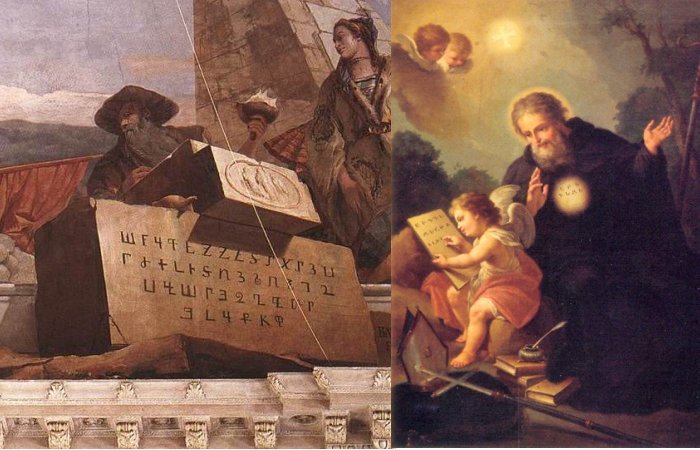
Left: Mesrop Mashtots by Giovanni Battista Tiepolo. Credit: Public Domain – Right: Mesrop Mashtots by Francesco Maggiotto. Credit: Public Domain
AI Unravels Secrets Of Ancient Alphabets
For years, historians sensed a connection: certain Armenian, Georgian and Caucasian Albanian letters resembled those in Ethiopic, or Ge’ez—a script developed in the Horn of Africa more than 1,600 years ago. Yet most early investigations depended on the human eye alone, guided by individual judgment and intuition.
Researchers at San Diego State University’s Department of Mechanical Engineering in the College of Engineering chose a different path. They turned to AI, training a computer program on more than 28,000 images of Ethiopic characters so it could learn the script’s fundamental shapes and patterns. The system learned to recognize curves, straight lines, angles and the overall structure of each letter.
Crucially, the computer knew nothing of history, religion, geography or culture. It saw only shapes. And from those shapes, it began to trace connections. After mastering the Ethiopic characters, the program compared them to letters from the Armenian, Georgian, and Caucasian Albanian alphabets, calculating how similar their forms truly were.
The results were striking. Of the three alphabets tested, Armenian letters showed the greatest similarity to Ethiopic letters. Caucasian Albanian letters showed a moderate level of similarity, while Georgian letters displayed some similarities but with less consistency. For comparison, the researchers also analyzed the Latin alphabet—the script used for English—and found that it demonstrated much lower similarity overall.
“Our aim was to move beyond visual impressions that are difficult to test or replicate,” said Sam Kassegne, a professor of mechanical engineering and lead investigator. “By making our criteria explicit and mathematical, we introduced an objective computational approach that is easily reproducible. We believe that this reproducibility is the key contribution of our method.”
Armenian Alphabet Almost Identical To Ethiopic
One of the most notable findings was that the Armenian alphabet appears almost as similar to Ethiopic as Ethiopic is to its own earlier form. This level of similarity suggests that the resemblance may not be accidental.
The Armenian alphabet was created around 405 CE. At roughly the same time, the Ethiopic writing system was expanding and becoming more widely used. Historical records indicate that people from Ethiopia traveled to regions such as Jerusalem, Egypt, and Syria during this period. The creator of the Armenian alphabet, Mesrop Mashtots, also journeyed through parts of the Middle East. While the study does not prove that one writing system directly copied the other, it does indicate that cultural contact and influence between these regions was possible.
The study further illustrates how modern technology can help address long-standing historical questions. AI is already known for its applications in areas like self-driving cars and medical imaging. In this case, it was used to analyze the shapes of ancient letters, uncovering evidence of historical cultural interactions. By training a computer to precisely measure similarities, researchers were able to move beyond subjective visual impressions and provide numerical evidence to support their conclusions.

From left, characters in the Ethiopic (portions only), Armenian, Georgian and Caucasian Albanian alphabets. Credit: Digital Scholarship in the Humanities (2026). DOI: 10.1093/llc/fqag029
Daniel Zemene, an SDSU graduate student and AI and machine learning researcher at SDSU’s NanoFAB Lab, emphasized the broader implications of the findings.
“What makes the research significant is that computational geometry and historical scholarship converge on the same scripts and time period,” said Zemene, the study’s first author.
“The model had no access to historical records, yet it learned purely from visual and structural data and identified Armenian as the closest structural match to Ethiopic within the very timeframe historians have long debated. That convergence between computation and history is powerful.”
See also: More Archaeology News
The researchers emphasize that similarity does not automatically indicate direct borrowing. However, their findings make it more reasonable to consider that these cultures may have influenced one another. Throughout history, societies have exchanged ideas, including writing systems. Greek, Roman, Persian, and Arabic civilizations, for example, all shaped each other in various ways.
This new research suggests that Ethiopia’s ancient writing culture may also have played a meaningful role in the exchange of ideas across regions. It further demonstrates that AI is not only a modern technological tool, but also a powerful method for studying literary heritage with greater accuracy and detail.
The study was published in the journal Digital Scholarship in the Humanities
Written by Conny Waters – AncientPages.com Staff Writer