
“I just did a very cursory search of your phone book in San José, and I saw a scattering of Cornish surnames,” Long said. Also on his trip to San José not too long ago, he spotted the Ohlone-Chynoweth station sign for the Santa Clara Valley Transportation Authority.
“Chynoweth in Cornish means ‘new house.’ So that got me thinking, well, there’s got to be a reason you have a Cornish name for a Cornish railway station in South San José,” Long said.
The two most prominent settlements at New Almaden were Spanish Town and English Camp, but that was really Cornish Camp, if you ask him.
A 1960 documentary collaboration entitled Quicksilver! noted that, even then, in the mid-20th century, the mine was fading into the mists of time.
“The international flavor of the old mining camp is shown by the names that survive. Manyales. Danielson. Castro. At one time, 26 nationalities were represented in New Almaden, and they helped fill two other cemeteries up on Mine Hill, which have long since been swept bare by souvenir hunters and the ravages of time.”
Cornish culture has largely faded into the rearview mirror in the South Bay, but Long has an idea related to his membership in a Cornish chorus. The Cornish are big singers. Here’s Barrett’s Privateers singing The Miners’ Anthem.
Long wants to take the band on tour to the South Bay, to reintroduce locals to our Cornish connections and light a fire under our interest in the history.
“Maybe to link up with a museum and do some promotional singing in shopping malls and that sort of stuff, to give people an idea that where they’re living has a history that is maybe something they never knew about,” Long said.
Episode transcript
Olivia Allen-Price: This story starts with three things that don’t seem like they belong together: Cornish miners, mercury poisoning, and Abraham Lincoln. They are, however, all connected to a mine in the foothills south of San José. We’re talking about the Almaden Quicksilver mine. Its glory days are long gone, and so Bay Curious gets a lot of questions about it. KQED’s Rachael Myrow knows all sorts of things South Bay, so we called her up to answer some of your questions. Hey, Rachael!
Rachael Myrow: Hey, Olivia!
Olivia Allen-Price: So the Almaden Quicksilver mine sits in what is today Almaden Quicksilver County Park. I visited some years ago, and I remember a sprawling park with rolling hills. I think I went in the summertime, so it was very, very, very hot and quite dry. But I can’t say I remember the mine.
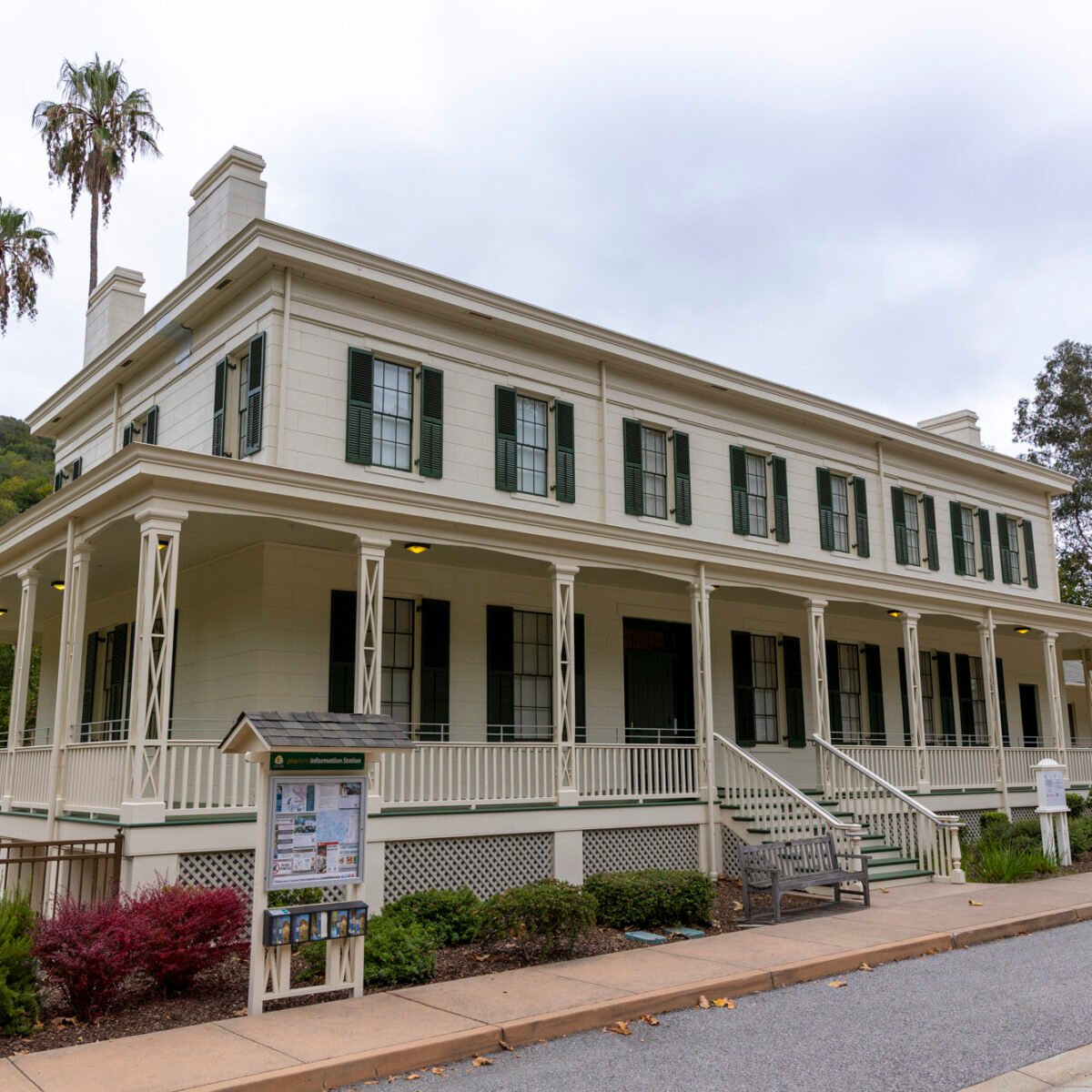
Rachael Myrow: That could be because there’s not a lot of the mining apparatus left. But in its heyday, in the 19th century, 1,800 miners and their families populated these hills, primarily in a couple of self-contained villages. Imagine churches, saloons, a school, and much, much more. Now there’s just a few moldering cemeteries …and the old mine supervisor’s mansion, which has been turned into a museum, with really restricted hours. I’m going to guess it was closed when you hiked or drove past.
Olivia Allen-Price: Hmmm, yeah. Must have been. Now, over the years on Bay Curious, we have done quite a few stories that touch on the California Gold Rush, less about the Silver Rushes that followed, but really nothing about quicksilver. To be honest, I don’t even really know what quicksilver is …
Rachael Myrow: To be honest, Olivia, neither did I before reporting this story out. But mining it was a lucrative hustle during the Gold Rush.
Olivia Allen-Price: OK, well, before we dive in, then, could we do a little quicksilver 101?
Rachael Myrow: Of course! The South Bay is full of cinnabar, a bright red rock the color of a stop sign. It formed 10-12 million years ago during a time of intense volcanic and hydrothermal activity. Chemically speaking, cinnabar is mercury bonded to sulfur. Mercury being a more proper name for quicksilver, by the way …
Olivia Allen-Price: This is really taking me back to high school chemistry class.
Rachael Myrow: As it should! And what do you remember about mercury, Olivia?
Olivia Allen-Price: OK, well, it’s a liquid at room temperature, and that’s unusual for a metal. And it’s a silvery color…
Rachael Myrow: You’ve got it! To get mercury out of cinnabar, you heat the rocks up and the mercury essentially sweats out. Now, mercury was super important during the Gold Rush because it was used by gold and silver miners to extract the precious metals from the crushed rocks they were trapped in. Here’s Lynda Will, parks program coordinator at Santa Clara County Parks and Recreation, to explain further.
Lynda Will: So you pour your mercury over that sand. The mercury kind of grabs onto any precious metal. All the sand and other waste rock is left alone and left behind. And then you have — uh — looks kinda of like a silver putty. So it’s called an amalgam, and then you heat that amalgam to 1,076 degrees, the mercury vapor goes off into the air, and then you are left with your precious metal, which could be gold or silver. It usually looks like spun sugar, almost. It has all these holes where the mercury had been. So then you can take that spun gold, as we call it, and so you can make nuggets or even bars.
Olivia Allen-Price: All right, I get it. And this stuff must have been in high demand after the Gold Rush kicked off in 1848. I imagine?
Rachael Myrow: Exactly. In 1845, California is still a Mexican territory. A Mexican cavalry officer named Andrés Castillero was riding through these foothills when he noticed something unusual — a fiery red-orange paint that local Indigenous people were using on the walls of nearby missions. Castillero knew exactly what he was looking at. He knew that red paint had to have come from cinnabar.
Olivia Allen-Price: But how did he know?
Rachael Myrow: At the time Castillero made his discovery, the world’s main source of mercury was in Almadén, Spain. So Spain controlled the supply. Which meant they could charge what they wanted. Castillero, just from reading the newspapers, would have understood mercury’s importance in economic terms. So when Castillero saw that cinnabar in 1845, he understood he was looking at a potential fortune.
Olivia Allen-Price: What was Castillero doing in San José anyway?
Rachael Myrow: He was sent by the Mexican government to catalogue strategic assets. Now, under Mexican law, officers and citizens could claim mines they discovered for themselves. So when Castillero saw the cinnabar, his life changed forever.
Olivia Allen-Price: And this brings us to one of our Almaden Quicksilver listener questions! It comes from Kiera O’Hara of Santa Clara, who joined you, Rachael, on her second tour of the Almaden Quicksilver Museum. Second, because she first visited when she was seven or eight years old. The museum is a regular pit stop for South Bay school children.
Kiera O’Hara: What was the Civil War history behind the Almaden mercury mine in San José? I remember hearing Abraham Lincoln was involved?!
Rachael Myrow: The museum sits in the Casa Grande, or big house, a 27-room Classical Revival mansion the mine’s superintendents used to live in. As you can imagine, it wasn’t long after Castillero discovered the cinnabar that other people wanted to take the mine from him, especially after the Gold Rush sent demand for quicksilver soaring.
So multiple parties, including private investors and mining companies, tried to claim the land, and the case went all the way to the U.S. Supreme Court. In 1859, SCOTUS recognized Castillero’s claim, but the mine’s ownership remained split among several parties. And then in 1861, the U.S. Civil War started. And this is where we get to Kiera’s question, about whether Abraham Lincoln was involved.
Lynda Will: There was an aide to President Lincoln who went, “Oh, there’s enough questionability about who owns this land, so maybe it’s owned by the U.S. government.
Rachael Myrow: Again, the quicksilver mine is an obvious money maker, and war is expensive. California gold was vital to the Union’s war effort, providing more than $170 million dollars in gold mostly that stabilized the federal currency and paid for roughly 10% of things like weapons and supplies. For those of you wondering, $170 million dollars in the 1860s would be worth roughly $7 billion dollars today.
So this aide is thinking, ‘Why not claim the New Almaden mine and its profits for the Union side of the U.S. civil war?”
Lynda Will: And so he came down with a marshal and even a cavalry behind him to say, “Lincoln’s going to take over this mine. And, you know, you’re supposed to just surrender it to me, the aide.” Then, mine manager, John Young, said ‘no!’
Rachael Myrow: So, just put yourself in John Young’s shoes. Who the heck is this aide showing up all of a sudden with troops behind him and a half-baked plan to take over the mine, because says who?
Lynda Will: He got the miners and said, “If they take over the mines, you’re going to be out of a job. So come down with, you know, your best rifles and your guns and, you know, help me defend this.”
Rachael Myrow: First, Young rallies his workers. And he fires off urgent telegraphs, not only to other mine operators across California, but to a former Almaden manager who now sits inside Lincoln’s administration.
Lynda Will: And said, “This is what’s happening out here. If he takes this mine, there’s the potential that he could take over every mine in California and the western United States.”
Rachael Myrow: Young was essentially saying, if the federal government seizes this mine, it could set off a chain reaction across the West, and at a moment when the Union depends on the support of California’s gold miners. There were people in the state who sympathized with the South during the Civil War. So it would be really, really dumb to piss off Union supporters and drive them into the waiting arms of the Confederacy.
Kiera, our question asker, asked if Abraham Lincoln was involved. Lynda told us it’s possible Lincoln didn’t even know this whole fight was going on, given how distracted he was with the Civil War. Whatever the case, John Young’s quick thinking — his calculated warning framed as patriotism — stopped a bright idea from a government man that could have thrown California and the rest of the Western U.S. to the Confederate side.
Olivia Allen-Price: When we return, we dig in on the environmental impacts of this mine. Plus a listener question about the miners who once worked there. Stay with us.
Sponsor Message
Olivia Allen-Price: So we’ve learned that mercury comes from cinnabar. It was super valuable during the Gold Rush because it helps separate gold from ore. And there was a big kerfuffle over the ownership of the Almaden mine that could have changed California’s posture during the Civil War.
Next, I want to touch on the environment … because you don’t have to be a geologist to know mercury is a neurotoxin, and a huge environmental hazard.
Rachael Myrow: Yes. Unfortunately, some of that mercury made its way downstream, into the San Francisco Bay. In 2002 — not that long ago — scientists identified this mine as the single largest source of mercury in the Bay, making the fish unsafe to eat for humans and birds alike. I asked Lynda Will, parks program coordinator at Santa Clara County Parks and Recreation, about this very question …
Lynda Will: I can tell you a little bit about it. Yeah. When we acquired the land in the mid-70s, 1970s, there was quite a bit of mercury contamination of the land. Under the furnace yards was, you know, pools of mercury. They had paved roads with cinnabar waste rock, which we call calcines. They had just dumped it over the sides of the hills. They had dumped it into the creeks. And so we have been remediating it ever since.
Rachael Myrow: Local governments, including Santa Clara County, which purchased part of the mine property for parkland, found themselves partially on the hook for a multimillion-dollar cleanup effort to comply with the federal Clean Water Act. They did, I should mention, get help from the state and the feds.
Olivia Allen-Price: Is it safe for us to be in this park?
Rachael Myrow: Additional work and monitoring continues, but authorities say it’s safe to picnic, hike, ride horses, et cetera.
Olivia Allen-Price: And what about the fish in the Bay, can we eat them?
Rachael Myrow: Errr, that’s a different story, more complicated. As recently as 10 years ago, 2 years then into the big effort to clean up the Bay, KQED explored this very question. Let’s just say, they were still describing it as problematic, not just because of the direct legacy from mining days, but from stormwater runoff and air pollution. Because mercury converts into methylmercury, which bioaccumulates up the food chain, fish … especially large fish … can carry high levels.
Clip from documentary: The Bay is slowly cleaning itself, washing 3,100 pounds a year out to sea, but because so much has built up over time, it needs a helping hand. … At a minimum, three generations will be impacted by the potent and long-lasting poison still lingering in the Bay mud.
Olivia Allen-Price: So that old adage, “Don’t fish off the pier,” sounds like it remains true today.
Rachael Myrow: Well, the longer-lived, big fish, especially. In 2023, California’s Office of Environmental Health Hazard Assessment, or OEHHA, recommended children and women of childbearing age steer clear of fish like sharks and striped bass. Ocean-going fish like Chinook salmon would be the safer bet.
Olivia Allen-Price: Alright, so that’s two questions dispatched. Let’s move on to question number three. It comes from Andrew Long, who lives all the way over in Cornwall — the county at the far south west tip of England. He came to the Bay Area some time ago to visit a relative and had some questions.
Andrew Long: I’m Cornish from the U.K. I know of the Cornish Camp at the Alamaden Quicksilver Mine. It would be great to know if Cornish culture survived, and is growing, like it is here with our language.
Rachael Myrow: Andrew filled me in on the long, rich history of mining tin and copper in Cornwall, which extends all the way back to the early Bronze Age, circa 2200 BC.
Some of you may be thinking about the British TV series “Poldark,” and you’d be in the right territory. There were more than 300 active mines in Cornwall in the 1860s.
But by the late 19th century, the industry had largely collapsed … and Cornish miners left in droves, traveling across the world to places like New Almaden in search of work.
Andrew Long: So there is a saying, if you go to the bottom of a mine, a hole in the ground, at the bottom of it you’ll find a Cornishman.
Rachael Myrow: They took a bit of Cornwall with them and left cultural evidence everywhere they went. In central Mexico, they introduced the Cornish pasty, which became, in Spanish, the paste. Over in Grass Valley, home to a lot of gold mining back in the day, there’s an annual Cornish Christmas Celebration. But in the South Bay, the history’s more subtle, almost hiding in plain sight. Like cinnabar.
Andrew Long: I just did a very cursory search of your — the phone book in San José — and I saw a scattering of Cornish surnames.
Rachael Myrow: Cornish surnames like “Hicks” and even “Cornish.” Also, on his trip to San José, not too long ago, and he spotted a curious station sign for the Santa Clara Valley Transportation Authority.
Andrew Long: There’s a station called Ohlone-Chy-NO-weth. Or CHIN-oh-weth, as you call it. Well, Chynoweth in Cornish means “new house.” So that got me thinking, well, there’s got to be a reason you have a Cornish name for a Cornish railway station in South San José.
Rachael Myrow: The two most prominent settlements at New Almaden were Spanish Town and English Camp, but that was really Cornish Camp, if you ask Andrew. Today, little remains of the area’s once-bustling village life. Aside from the large mansion that now houses the museum, the only hints are the nonnative cypress and poplar trees, and the spreading vinca ground cover … green survivors of gardens long since forgotten.
Here’s a bit from a 1960 documentary collaboration I dug up between the Museum and Channel 11 News.
Clip from documentary: The international flavor of the old mining camp is shown by the names that survive. Manyales. Danielson. Castro. At one time, 26 nationalities were represented in New Almaden, and they helped fill two other cemeteries up on Mine Hill, that have long since been swept bare by souvenir hunters and the ravages of time.
Rachael Myrow: Cornish culture has largely faded into the rearview mirror in the South Bay, but Andrew has an idea, related to his membership in a Cornish chorus called Barrett’s Privateers. The Cornish are big singers. Here’s Barrett’s Privateers singing The Miners’ Anthem.
Clip of The Miners Anthem
Rachael Myrow: Andrew wants to take the band on tour to the South Bay, to reintroduce locals to our Cornish connections and light a fire under our interest in the history.
Andrew Long: Maybe to link up with the museum and do some promotional singing in shopping malls and that sort of stuff, to give people an idea that where they’re living has a history that is maybe something they never knew about.
Olivia Allen-Price: Thanks to Andrew, Kiera and to you, Rachael.
Rachael Myrow: My pleasure, as always!
Olivia Allen-Price: It’s the start of a month, and that means a new voting round is up at BayCurious.org. Let’s hear your choices …
Voice 1: Why is there a taco truck on every corner in San Francisco and San Mateo? They seem to have sprung up in the last year or two.
Voice 2: Why are there huge fans over the tunnels near the Golden Gate Bridge?
Voice 3: What’s the story with the abandoned cop car in front of the airport off 101? Everyone knows no actual cop is in it, so what’s the scoop with leaving it there?
Olivia Allen-Price: Tally a vote for your favorite of those questions at BayCurious.org.
We’ve still got space in our upcoming Bay Curious Trivia game. Snag some tickets for you and your friends at KQED.org/live.
Bay Curious is made in San Francisco at member-supported KQED.
Our show is made by Katrina Schwartz, Christopher Beale and me, Olivia Allen-Price. With extra support from Maha Sanad, Jen Chien, Katie Sprenger, Ethan Toven-Lindsey and everyone on Team KQED.
Some members of the KQED podcast team are represented by the Screen Actors Guild, American Federation of Television and Radio Artists, San Francisco Northern California Local.
I’m Olivia Allen-Price. Thanks for listening!