
Episode Transcript
Olivia Allen-Price: At the turn of the 20th century, street cars crisscrossed the Bay Area. Nowadays though, you rarely see them. So you might even be thinking to yourself, what even is a street car?
Music starts
Olivia Allen-Price: Think of those old trolleys like the F line on Market Street in San Francisco.
Trolley dinging
Olivia Allen-Price: It’s not a cable car, it’s not modern light rail. It’s an old fashioned train, usually one or two cars, that runs above ground on a track, often with electric wires overhead to provide power.
Electric streetcars were big in the East Bay before the automobile took off. For many people, they were the primary way to get around town – and to San Francisco for work.
Archival video clip: Geared to the needs and dedicated to the service of the East Bay, Key System became one of the largest single businesses in the area.
Olivia Allen-Price: People would walk out their doors in Berkeley, Alameda, Oakland, hop on a slick orange and silver Key System streetcar.
Archival video clip: Transportation to San Francisco was by ferry, a convivial mode of travel that, particularly in the evening, had elements of fantasy.
Olivia Allen-Price: That was the daily commute of many for decades. Our question asker this week, Vanessa Bohm, grew up in Germany and has seen some remnants of the Key system all around the East bay. She’s wondered…
Vanessa Bohm: What happened to the streetcars that used to be around Oakland and the East Bay.
Olivia Allen-Price: Vanessa is not alone. We get questions about what happened to the key system a lot. Some people even wonder if those old streetcar lines could be put to use again.
Here to help us understand the rise and fall of Bay Area streetcarts is the man, the myth, the legend, recently retired, but back, because he just can’t quit, KQED’s transportation editor emeritus, Dan Brekke. Hi Dan.
Dan Brekke: Hi, Olivia.
Olivia Allen-Price: Can you start by painting a picture for us at its height? What would the East Bay have looked like during the streetcar era?
Dan Brekke: Well, you would have had dozens of streetcar lines, either running from neighborhood to neighborhood or from neighborhoods to downtowns, and you would’ve had a collection of trains that were starting at various nodes in the East Bay, like North Berkeley or Downtown Berkeley, University of California, Downtown Oakland, East Oakland, running to a little rail line that ran out into the middle of the bay where people would climb off their trains and catch ferries into the city. And those trains would get you from point A to point B in 35 or 40 minutes.
Olivia Allen-Price: We know electric streetcars became common across the country and in all nine counties of the Bay Area starting in the 1890s, but tell us more about how the key system in particular got started.
Dan Brekke: Early in the 20th century, in the very first years, real estate investors, led by somebody named Francis Marion Smith, whose nickname was Borax Smith, because he’d made a fortune in borax mining in the southwest. He was part of what was called the Realty Syndicate. And they owned something like 20 square miles of East Bay real estate. And it would make this property so much more valuable if there was an easy way for people to get to and from these areas that would then be ripe for development. And pretty much that’s what happened. These street car lines got built, and if you see a route map, there are tendrils stretching throughout what we think of as East Oakland today and north into Berkeley, with many lines that were both neighborhood lines where people could ride, say, from their neighborhood to downtown Oakland, and many lines that were traveling from the East Bay to San Francisco.
Olivia Allen-Price: So sort of a situation where if you build it, they will come.
Dan Brekke: They built it and they did come and much of the streetscape and the way neighborhoods are put together in Berkeley and Oakland really comes from that early streetcar development.
Olivia Allen-Price: One thing I find interesting is that these were not public works projects in the sense that the public owned them or they were, you know, done with tax dollars. These were private companies running these these streetcars.
Dan Brekke: Yeah, that’s right. Those streetcar lines we’re talking about and wherever we’re talking about them, you know, it would be hard to go to a town of any size in the early 20th century and find no street railroad, right? And, of course, Los Angeles was one of the places where they were most prevalent. But all of this was done through private capital that had some kind of investment goal in mind. And often it had to do with developing real estate.
Olivia Allen-Price: They didn’t own the street, so logistically, how did that even work?
Dan Brekke: Yeah, they would get a license from the cities where they wanted to operate and part of the license would be access to the street and also some agreement about who would take care of the tracks in the street because as you know, if you’ve been anywhere where there’s a railroad track in a street, there are usually some kind of pavement problems and so that would be part of the deal.
Music starts
Olivia Allen-Price: Tell me about the experience of actually riding one of these cars. What would it have been like as a commuter to step foot on one?
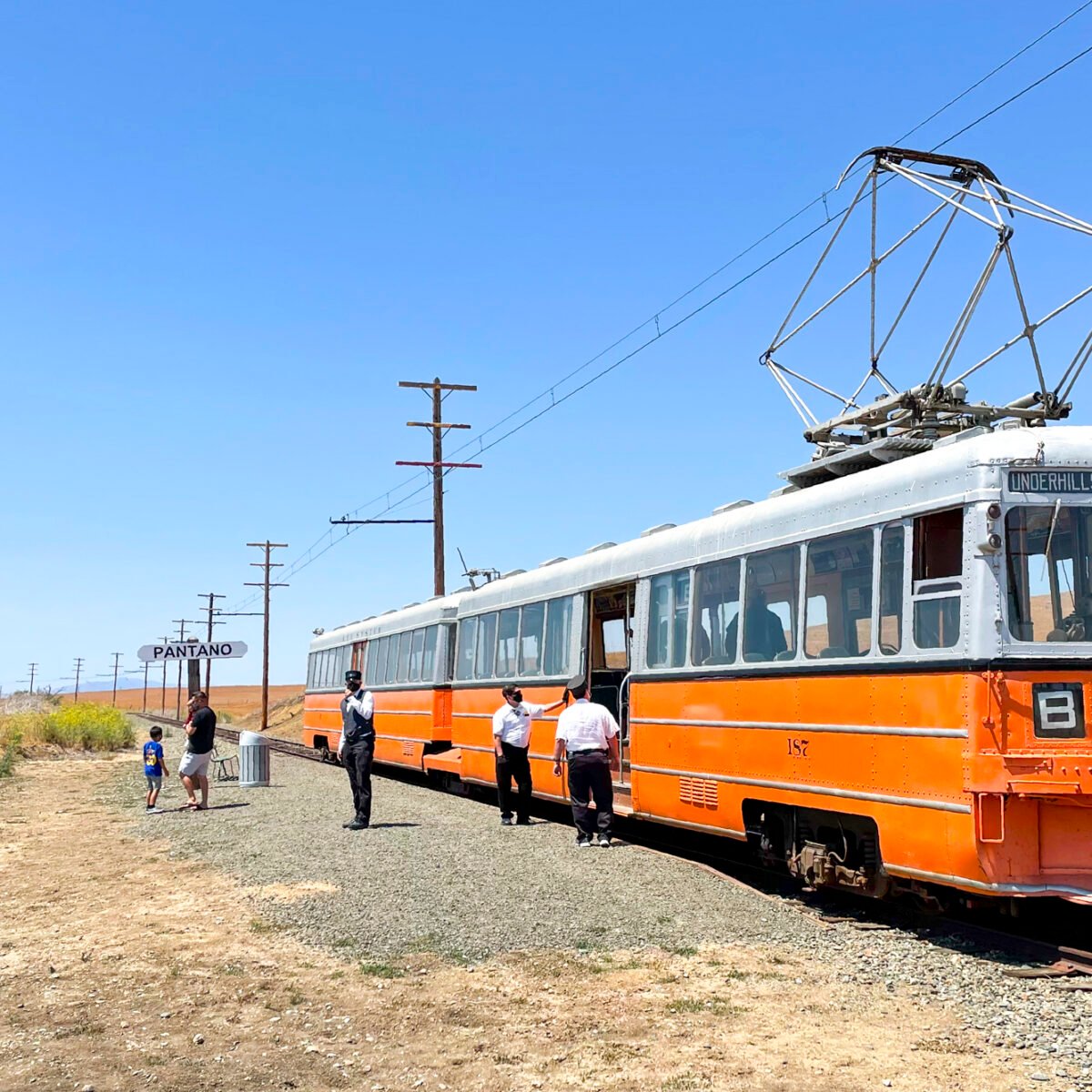
Dan Brekke: If you want to experience what these trains were like, you don’t have to rely on imagination. If you go out to the Western Railway Museum, which is near Rio Vista, there’s an amazing collection of street cars from all different eras.
Dan Brekke in scene: This is so cool. This one used to run in Oakland, going to the ballpark. And this is a Key System one too, this one that says E.
Dan Brekke: When they heard what I was up to, what I was interested in finding out about, they said, well, we can take one of those bridge units out and run it for you. Unbelievable. They roll out this retro, streamlined, two-car, orange and silver train, which is instantly a throwback to what people would have experienced their first day riding on the Bay Bridge in 1939. So then you know we’re on the platform waiting for this train to start up, we climb aboard.
Conductor: Welcome aboard.
Dan Brekke: First thing I notice is the windows don’t open, but that’s okay. There’s ventilation through a front door and we roll out down this, kind of beautifully recreated streetcar line, electrified streetcar line.
Trolley bell
Dan Brekke: In the middle of nowhere, but here’s this train going through this kind of pristine-looking ranch environment, and you come to a little crossroad, you have to slow to a stop, sound the horn.
Horn blares
Conductor: Hey, we’ve got a car for once!
Dan Brekke: Because you don’t want to interfere with any crossing ranch traffic, and then you proceed to a little stop really out in the middle of nowhere. And get off.
Conductor: Okay, thank you.
Dan Brekke: The motorman changes ends of the car and then you head back.
Olivia Allen-Price: That sounds pretty fun. We’re going to take a quick break here, but we’ll get into why this system started to fall apart when we come back. Stay with us.
Sponsor message
Olivia Allen-Price: So, Dan, the scene that you’ve painted so far, it’s very idyllic with all these street cars whisking people from Berkeley and Oakland to Ferries and maybe taking them into the city. And that goes on for what, 40 odd years? When does it all start to change and what factors were behind the changes?
Dan Brekke: Well, the 1930s were a very rough decade for streetcar companies in general. You had the Great Depression, of course, that started in 1929 and deepened throughout the first half of the decade. The transit industry itself either recovered very slowly or not at all. A lot of that was because they were private companies that were locked into pretty disadvantageous contracts with the cities they served. Right? They could only raise fares so much. And they didn’t receive public subsidies. There was a big shift going on toward private automobiles that was also taking away some of their customers. In the Bay Area itself, you know, the relationship between the East Bay and the city of San Francisco changed dramatically in 1936 with the opening of the Bay Bridge.
Archival video clip: A six-lane double deck bridge, eight miles long, connecting San Francisco with the Oakland-Berkeley area, spanning the largest major navigable body of water ever bridged.
Dan Brekke: I mean, there was an incredible influx of traffic across the bridge into San Francisco, basically as soon as the bridge opened, and it just didn’t slow down. And one of the unfortunate things that happened at the same time was that while part of developing the Bay Bridge was to build railroad tracks across it so that these interurban trains could come in from the East Bay, but it wasn’t ready to use until early 1939. One of the factors that people point to in the demise of the key system, is that delay of more than two years where people got to experience that it was much easier to drive into the city and faster, perhaps, than it had been to take the train. Their habits changed, and the key systems never really recovered. And we also had this phenomenon of the slow transition in the key-system itself away from streetcars for their local service to buses. And by the late 1930s, buses were carrying most of the ridership. So all of those things together really started to dim the outlook for the streetcar companies.
Music starts
Olivia Allen-Price: One narrative that I’ve heard over and over is that a big reason that streetcars failed was that essentially car companies bought the key system and then would intentionally run the company into the ground so people would be forced to buy more cars. Is there any truth to that?
Dan Brekke: There’s a kernel of truth to it. You know, when I talked to Ethan Elkind from UC Berkeley, you know, he talked about the effect of one particular movie in the 1980s on this view of history.
Ethan Elkind: Well, in L.A., the conspiracy was really put on steroids by the movie who framed Roger Rabbit.
Judge Doom from “Who Framed Roger Rabbit”: I see a place where people get off and off the freeway. On and off, off and on, all day, all night! Soon, where Toon Town once stood will be a string of gas stations, inexpensive motels, restaurants that serve rapidly prepared food, tire salons, automobile dealerships…
Oh, it’s so great to hear Christopher Lloyd in that. He was so good! And the character he was playing was Judge Doom and his masterplan was to destroy Toon Town, where Roger Rabbit lived, and a key part of the plot is to kill the streetcar system.
Who Framed Roger Rabbit clip: C’mon, Nobody’s gonna drive this lousy freeway when they can take the red car for a nickel. Well, they’ll drive. They’ll have to. You see, I bought the red car so I could dismantle it.
Ethan Elkind: Not an exaggeration that, you know, this 1989 semi-cartoon really fed this idea that it was highway interests that gobbled up the streetcar lines. And the story is much more complex than that.
Dan Brekke: The complexity people are talking about and the grain of truth to Roger Rabbit is because of a lawsuit that was filed against a company that was called National City Lines and some of its investors in the 1940s. And National City Lines was a company that went around the country buying up streetcar systems and they would convert those to bus systems, basically. That’s the long and the short of it. And by doing that, they were really helping out their investors who were General Motors, Standard Oil of California, Firestone Rubber, Phillips 66, companies like that.
National City Lines showed up in Oakland in 1946 and took control of the Key System. And while the Key system had laid plans to sort of keep street cars going and also keep them running into San Francisco. Across the Bay Bridge, the national city lines scrapped most of these development plans, let’s call them, right away. So within a very short amount of time, the streetcar lines in the East Bay turned into bus lines. The streetcar lines were abandoned. The exception was the inter-urban line into San Francisco. That continued running until the late 1950s, but it ran at a loss. It ran with fewer and fewer passengers every year, and the last key system cars ran across the Bay Bridge in 1958.
Olivia Allen-Price: When we start talking about public transportation, I’ve noticed that people are often very nostalgic for the past, and it can, you know, sort of become a little idealized, you know, oh, dreaming about riding across the Bay Bridge and the train, but there were some realities to the Key System that people forget about. Can you tell us about some of the drawbacks of the Key System, even when it was sort of at its height?
Dan Brekke: So there’s very definitely a paradise lost tone to the way people discuss the Key system. If we only hadn’t abandoned this beautiful street car system, just think how much better our world would be. I think that ignores the reality that they had huge power plants to supply the electricity for their systems. In the case of the Key System, they had a huge powerhouse in Emeryville. Kind of close to where Ikea is today. There was a gigantic smokestack there and they were burning coal. Sure, electric trains were much cleaner in terms of the environment around the lines themselves, but they still had an environmental footprint as all of our transportation choices do. And I talked to Mitchell Schwarzer, who’s a professor of architectural and urban history at the California College of the Arts about the social effects of the streetcar system. He wrote a book a few years ago called Hella Oakland.
Mitchell Schwartzer: What the technology allowed for was a vast residential expansion outside of the inner areas of Oakland. And that allowed for the wealthier people to live on larger lots and to live separately and to erect barriers to minorities moving into their communities. Without the streetcar, they couldn’t have done that.
Dan Brekke: I will say also that there was some outrage about the lack of safety for streetcars. The years I’ve looked at were between 1906 and 1910. It’s absolutely hair-raising to see how many people were getting killed in streetcar accidents. The newspapers relished these stories. I mean, they were told in sometimes excruciating detail what happened to the victims.
Olivia Allen-Price: Definitely not insignificant safety and environmental concerns that you’ve brought up. But I do wanna say times are different now, right? We know how to run trains on green energy. We know to put safety protocols in place that will keep people more safe. One of our question askers wanted to know, could the old Key System sort of be a model for public transportation of the future?
Dan Brekke: Well I talked to Ethan Elkind from UC Berkeley Law School about this.
Ethan Elkind: Well, I think you run into the same problems that the streetcars were running into in the old days, which is that a lot of them ran down highway medians. They would get stuck in traffic. They would hit red lights. They would have to wait for cars to pass. And they weren’t necessarily that fast. You need to have a dedicated separate right of way.
Dan Brekke: You have to deal with all the other street traffic. That’s a real problem in imagining streetcar lines flourishing again.
Ethan Elkind: And then to really make transit make sense, you have to be able to serve dense concentrations of jobs and housing where people can easily walk or bike to the rail station. And unfortunately, what we’ve seen too often, especially in the higher income areas in the Bay area, they don’t allow new development. They don’t wanna see new apartment buildings come into their neighborhoods. And that’s what you would need to have to have the ridership really make sense. And so that these streetcar lines could actually have enough ridership where they wouldn’t require as much public subsidy.
Dan Brekke: The other thing is they’re really damn expensive to build. Lots of transportation experts say that the workaround is right in front of us if we only had the political will to do it. And that is to dedicate more street space as bus only space, right? Mostly we’re talking about bus rapid transit where you have dedicated lanes for buses. You have signals that are set so they prioritize the bus traffic. Those are much, much less expensive to build, but they take a lot of planning, and there is an upfront investment that sometimes is difficult.
Music starts
Olivia Allen-Price: Dan Brekke, thank you so much, as always, for reporting on this.
Dan Brekke: You’re very welcome. And as I conclude here, I want to make a couple of acknowledgements. One is, there’s kind of an amazing community of transit historians in the Bay Area, including some who are very painstakingly documenting some of this history of the key system. So that’s one acknowledgement. The other one is, thanks to you and Katrina. You guys are wonderful to work with.
Olivia Allen-Price: Listeners should know that Dan was one of my first editors here at KQED when I started out as a wee baby reporter. And, he’s reported some of my favorite Bay Curious episodes over the years. Like those mysterious East Bay walls, why there are so many crows in the bay area and he’s answered dozens of your transportation questions over the years. We’ll link to a few of his stories in our show notes, so go check those out.
Dan, thank you, thank you, thank you. You are the best. I hope you have a happy retirement, but also, I have a feeling you’ll be back.
Bay Curious is made in San Francisco at member-supported KQED.
If you value what you hear on our show, consider becoming a KQED member. You can choose the level of support that works for your budget by going to kqed.org/donate. Thank you.
Bay Curious is made by Katrina Schwartz, Christopher Beale, and me, Olivia Allen-Price. Extra support from Maha Sanad, Katie Sprenger, Jen Chien, Ethan Toven-Lindsey and the whole KQED team.
Olivia Allen-Price: Some members of the KQED podcast team are represented by The Screen Actors Guild, American Federation of Television and Radio Artists, San Francisco Northern California Local.
I’m Olivia Allen-Price. Have a great week.