
Episode Transcript
Olivia Allen-Price: It’s a Saturday night in San Francisco and a tiny performance space called Red Poppy Art House is packed with people. They’re here to listen to a unique wooden reed instrument called the duduk that has cultural ties to Armenia.
Ethereal music starts
Olivia Allen-Price: And even if you don’t recognize the name duduk there’s a good chance you’ve heard it before — in the soundtracks to some major Hollywood movies – like The Last Temptation of Chris, Dune and Gladiator.
Ethereal music plays
Olivia Allen-Price: It’s now a staple for Hollywood composers
The duduk’s sound is haunting, and almost otherworldly…it transports you.
Khatchadour Khatchadourian: When it hits you, it hits you. It takes you to the place it wants to go
Olivia Allen-Price: That’s Khatchadour Khatchadourian, the duduk musician and vocalist who performed at the Red Poppy.
Sounds of Khatchadourian playing duduk music
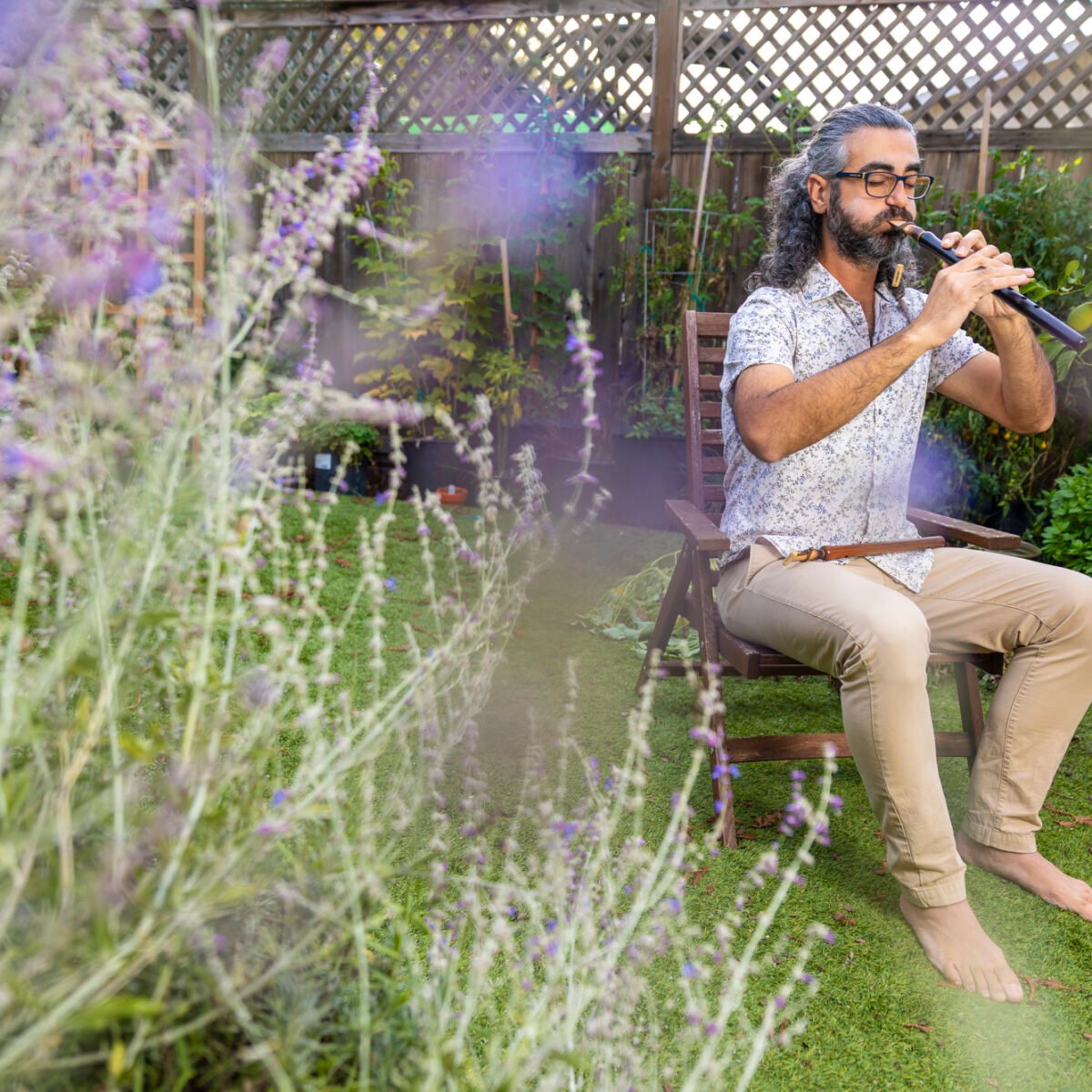
Olivia Allen-Price: He’s one of the few in the Bay Area who plays the instrument. His followers call him “the Duduk Whisperer.”
He uses it to push the boundaries of traditional Armenian music. And, as our producer Elize Manoukian learned along the way, he’s preserving cultural identity through sound.
Elize Manoukian: The duduk is said to be the world’s oldest double reed instrument.
But that doesn’t make it easy to play.
Squeaking sounds
Elize Manoukian: When I play it, I sound like a dying goose. But in Khatchadour Khatchadourian’s hands, the instrument comes to life.
Expert duduk music
Khatchadour Khatchadourian: when you know that something effortlessly flows through you, that’s meant for you. With the double-reed nature, the physical nature of this fantastically torturous instrument, yet utterly beautiful instrument, there is a lot of grappling. It’s a very physical instrument.
Elize Manoukian: Khatchadour, who I call Khatch, and I are sitting in his home studio in Santa Rosa, and he’s explaining the origins of his beloved duduk.
Khatchadour Khatchadourian: Traditionally, the duduk is the pairing of an apricot wood, the more aged the better, the tone of the instrument, paired with a double reed bamboo, which is pliant and soft.
Elize Manoukian: No longer than your forearm, and with only one single octave, the duduk gives off a powerfully tragic, almost melodramatic sound
Khatchadour Khatchadourian: The aged nature of the wood adds a little dark tone that I haven’t found elsewhere. The soul of the instrument is full of longing.
Elize Manoukian: Many Armenians understand this longing. especially those with family members who survived the 1915 Armenian genocide. Khatch’s family fled eastern Turkey along with more than a million others.
For Armenians, the duduk’s mournful melodies are stories told by multiple generations about the warmth, the joy, and the tragedy of their homeland.
Khatchadour Khatchadourian: Armenians as people have been around for several thousand years, we’ve kept our traditions and cultures and language and expressions for a long time. I would say that the duduk speaks to that longevity, to that survival.
Elize Manoukian: The music Khatch plays with the duduk draws from a lot of new age, folk and world music influences. But some of his inspiration comes from a more unusual source: the music of the region’s troubadours, known as ashugh in Armenian.
Khatchadour Khatchadourian: Ashugh people have traveled the region, the villages kind of carrying the wisdom traditions, the metaphor, And embedding that in the song.
Elize Manoukian: Like this song Khatch is playing by an 18th century troubadour. These musicians were like the hippies of the Persian empire. They sang about love and yearning, and crossed cultures and borders to spread their poetry— borders which are strictly enforced now.
Khatchadour Khatchadourian: He wrote an Armenian, Azeri, Persian, Farsi, and Georgian. that is borderless state of artistry it contains all these worlds.
Elize Manoukian: In a sense, Khatch is the latest in a long line of these troubadours. This style is freeing to him as an artist he says — both as a musician and singer.
Khatchadour Khatchadourian: You’re no longer classical, you don’t care about what others think, how the voice soars. You just let the voice soar, you really become your being in that sense that you’re meant to.
Elize Manoukian: Khatchadour was born to an Armenian family in Beirut, which for years was known as the Paris of the Middle East. Before 1975, Beirut had around 200,000 Armenians, who had built new lives there after the Genocide.
But by the time Khatch was born, the city had exploded into civil war.
Khatchadour Khatchadourian: I have pretty dark memories, running to underground refuges, bunkers, or what have you.
Elize Manoukian: This is a familiar story for the people of Lebanon, who were caught up in senseless violence for 15 years. The war separated his family, with his father heading to the U.S., while Khatch, his mother and sister fled across the border to Aleppo, in Syria. Khatch didn’t see his dad again for another 12 years.
For much of his time in Aleppo, Khatch sang with his middle school’s choir.
Sound of child singing
Elize Manoukian: That’s Khatch singing his first solo in 1997. The choir sang Armenian, Arabic and some English songs too. He said it was an important outlet for him as a kid.
Khatchadour Khatchadourian: It was really the funnest thing ever, because we were so restricted between school and just the way life was.
Elize Manoukian: The choir was led by a man who Khatch called Maestro Abadjian.
Khatchadour Khatchadourian: I always remember torturing the maestro like he was such a kind, kind guy but I remember him having very little hair and his hair would just move on his hair a little bit and we would all be children and kind of like giggle.
Elize Manoukian: Performing with this choir and learning from Maestro Abajian became the foundation of his love for music.
Khatchadour Khatchadourian: I remember his green eyes. Such a beautiful person. Like he would carry an artistic torch in a place that probably needed it.
Elize Manoukian: When Khatch was 15, his family moved to Los Angeles, where his dad had been living for over a decade.
The transition was rough. It was hard being a teenager in a new country, especially after living through so much turmoil.
Khatchadour Khatchadourian: I did not do any music for about ten years.
Elize Manoukian: He went to UC Berkeley, hoping to find himself on his own, away from the nest. He almost became a political scientist, researching the Armenian community of Lebanon. But studying his own experience only brought him more darkness, and he was desperate for a creative outlet to channel it.
That’s when he found the duduk.
Khatchadour Khatchadourian: I was suffering, and I was tremendously isolated, um, and to find kind of a meaning within myself, I was in a lot of pain, psychological pain, and the duduk spoke to that. It worked beautifully, I wouldn’t say it’s cheaper than therapy [[laughs]].
Olivia Allen-Price: When we return, Khatch’s duduk career takes off – and takes him around the world. Stay with us…
Sponsor message
Olivia Allen-Price: When Khatch discovered the duduk in college, he had finally found an instrument that could express what he was feeling inside. His initial interest grew into a full fledged career.
Sound of duduk music
Elize Manoukian:Over the past ten years, Khatch has sung and performed the duduk all over the world. He’s recorded five studio albums, all featuring the duduk and voice — including an album of Armenian lullabies.
Lullabies across cultures have been traditionally performed by women, and passed down through their voices.
Khatchadour Khatchadourian: Not that Armenian males don’t sing to their sons and daughters, but I wanted to make kind of a public statement around it.
Elize Manoukian: So Khatch decided to record an album of Armenian lullabies and songs for children, which he released in 2019. He was the first person to do this in a male voice
lullaby plays
Khatchadour Khatchadourian: Underneath all of that, I was also dealing with being raised without a father, saying, “How did that shape the masculine and the male that I am?” And in what sense can I invite others, in this case, the masculine to be vulnerable, to be open, to be tender.
Elize Manoukian: Because the pandemic hit right after the album release he didn’t get many chances to perform it. As fate would have it, he performed that album for the first time at a children’s festival in Turkey.
The Flying Carpet Festival brings music and arts to kids displaced by conflicts like the Syrian civil war and others in the region
Khatchadour Khatchadourian: Singing Armenian to Kurdish, to Arab, to Turkish children was profound because I was a singing about childhood, about innocence, about those energies that in a sense, I hope, we all protect. And in the light of actually what’s happened in Gaza, we failed to do. Just saying it as I see it, we failed to protect children. The most vulnerable, yet, most open of our humanity.
Elize Manoukian: A simple song for a child can be a sanctuary. Take this lullaby from Khatch’s album:
Khatchadour Khatchadourian: When I perform it, I actually tear up as well, it moves a lot in me. It says, the sun is your father, the moon is your mother, the trees rock you. And, you know, it’s elemental.
Elize Manoukian: Khatch was moved by the story the lullaby told about the relationship between the singer and the land. But what he didn’t know when he recorded this album, was that the meaning of that song would soon change for him.
The song comes from a village in Nagorno-Karabakh, an enclave in the former Soviet Union and with a history dating back thousands of years. But just two years ago, conflict escalated between Armenia and Azerbaijan, neighboring countries who both claimed the region. In 2023, more than 120,000 Armenians fled their homes, carrying their belongings and their songs with them.
Khatch now holds onto this music, as a way to hold onto a piece of his people’s history.
Khatchadour Khatchadourian: The fact that you’re singing it, you’re carrying part of a tradition that has endured.
Elize Manoukian: Music and culture are not fixed in stone, he says, nor can they be easily erased. These troubadour love songs and lullabies come back to life whenever they’re heard or played.
Khatchadour Khatchadourian: And hopefully they remain with us as, as more people, more artists see the value of keeping alive these precious jewels.
Elize Manoukian: Khatch is now working on his 6th album, and has spent hundreds of hours composing and arranging original pieces out of these cultural relics.
But the duduk’s power doesn’t just come from what it keeps alive from the past. For Khatch, it’s a doorway to something greater than himself.
The duduk allows him to say what words often fail to capture.
Studio recording of duduk
Khatchadour Khatchadourian: I find myself in my own studio. It’s a lot of darkness I’m going through in a sad moment, that I just put my headphones, I start the practice of playing the instrument. And I feel my soul exalted, something is lifted. And then aww, like just as if I’m among fields of stars or something transformative deep down happened. Yet I am in my studio. So I didn’t go to another edge of the universe, so this instrument does that to you.
Olivia Allen-Price: Khatchadour Khatchadourian, the Duduk Whisperer. His story came to us from producer Elize Manoukian.
This story first aired on The California Report Magazine. Be sure to check out their podcast for more stories from around the Golden State.
This episode was produced by Victoria Mauleon, Suzie Racho, Brendan Willard, Katherine Monahan, Srishti Prabha and Sasha Khokha.
The Bay Curious team is Katrina Schwartz, Christopher Beale and me Olivia Allen-Price.
Both Bay Curious and The California Report Magazine are made in San Francisco at KQED – your local public media station. Join thousands of your neighbors in supported us today at KQED.org/donate.
Some members of the KQED podcast team are represented by The Screen Actors Guild, American Federation of Television and Radio Artists. San Francisco Northern California Local.
I’m Olivia Allen-Price. I’ll see ya next time.