
Conny Waters – AncientPages.com – Nestled among rugged mountains, dramatic coastlines, and distinctive stone tower houses, the Mani Peninsula in the Peloponnese region of Greece has long fascinated travelers, historians, and writers such as Jules Verne and Sir Patrick Leigh Fermor.
Deep Maniots Have Long Lived In Isolation
Recent genetic research has provided new insights into the people of Deep Mani—a community living in one of mainland Greece’s most remote areas. This study reveals that Deep Maniots represent one of Europe’s most genetically unique populations, shaped by over a thousand years of isolation.

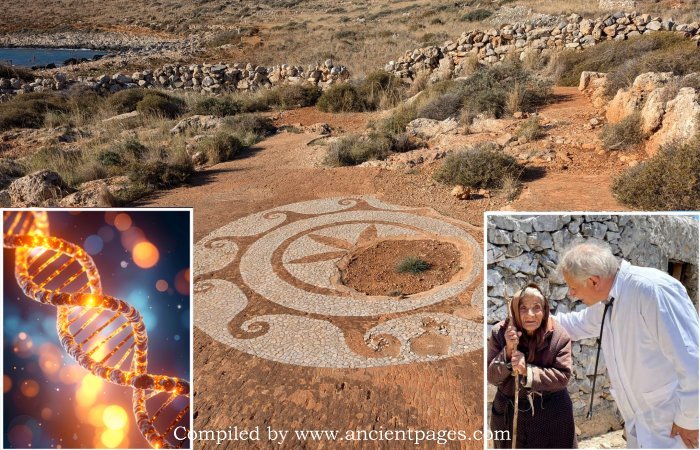
A Roman mosaic discovered at Cape Matapan, also known as Cape Tainaro, is believed to have served as the floor of a bath. During the early Roman period, the Deep Mani region was a vibrant hub of economic activity, drawing individuals from various parts of the Empire. Credit: Leonidas-Romanos Davranoglou.
The research shows that many Deep Maniot lineages can be traced back to Greece’s Bronze Age, Iron Age, and Roman periods. An international team found that those residing at the peninsula’s southernmost tip form a rare genetic “island” within mainland Greece. Their ancestry predates major population movements, such as those following the fall of Rome, which significantly altered other Greek and Balkan populations.
Unlike many other groups in mainland Greece that absorbed later arrivals, such as Slavic peoples (whose migrations reshaped much of southeastern Europe), Deep Maniots show little evidence of such admixture. Most paternal lineages among them trace directly to ancient Greek eras. The distribution patterns of these lineages closely align with Deep Mani’s unique megalithic residential and religious structures found throughout the region. This supports the idea that today’s Deep Maniots may be direct descendants of communities who built and lived in this landscape more than 1,400 years ago.
“Our results show that historical isolation left a clear genetic signature,” said lead author, Associate Researcher Dr. Leonidas-Romanos Davranoglou.
“Deep Maniots preserve a snapshot of the genetic landscape of southern Greece before the demographic upheavals of the early Middle Ages and likely descend from the same people who constructed the unique type of megalithic buildings that are found exclusively in Deep Mani.”
He added, “Our study demonstrates how geography, social organization, and historical circumstances can preserve ancient genetic patterns in certain regions long after they have become altered elsewhere.”

Team member Anargyros Mariolis, Director of Areopolis Health Center, has built deep bonds within the Deep Maniot community through years of dedicated medical and social service. Credit: Anargyros Mariolis
Maternal lineages, by contrast, exhibited greater diversity. This diversity indicates that there were occasional interactions with populations from regions such as the eastern Mediterranean, the Caucasus, western Europe, and even North Africa.
“These patterns are consistent with a strongly patriarchal society, in which male lineages remained locally rooted, while a small number of women from outside communities were integrated. Our study is the first to recover the untold histories of Deep Maniot women, whose origins were largely obscured by male-centered oral traditions,” Senior author Professor Alexandros Heraclides (European University Cyprus) said.
Many Are Descendents of A Single Male Ancestor
The study found that more than half of present-day Deep Maniot men are descended from a single male ancestor who lived in the 7th century CE. This significant genetic pattern suggests that, at some point, the local population was reduced to just a few families—likely due to factors such as plague, warfare, and regional instability.
Researchers employed advanced molecular biology techniques to determine when the founders of various Deep Maniot clans lived and how these clans are related. Their findings indicate that some clan founders date back to the 14th and 15th centuries. This evidence points to those centuries as key periods in which many current Deep Maniot clans originated.
“Many oral traditions of shared descent, some dating back hundreds of years, are now verified through genetics,” said Athanasios Kofinakos, co-author and research advisor on Deep Mani genealogical and historical matters.
“Deep Mani’s geographical isolation and limited economic resources galvanized the warlike character of the locals. In such a harsh environment, family alliances became paramount for individual and collective survival.”
Uniqueness Of The Deep Mani Lineage
Researchers compared Deep Maniot genomes with those of more than one million modern individuals worldwide and with thousands of ancient DNA samples. Their analysis revealed almost no genetic matches to other populations, highlighting the unique and isolated nature of the Deep Maniots from a genetic standpoint. This distinctiveness has long attracted the interest of historians and archaeologists. Unlike much of the Balkans, which saw repeated migrations during Late Antiquity, historical records indicate that Deep Mani remained notably resistant to external influence and control.

The collective memory of Deep Maniot culture is preserved through oral histories, lament songs, and family traditions that are carefully maintained by older generations. Shown here is the renowned Deep Maniot sculptor and painter Michalis Kassis (with lead author Dr. Leonidas-Romanos Davranoglou), whose first-hand knowledge of Maniot oral history, genealogy, and settlement patterns provided invaluable cultural context that helped shape the study’s design. Credit: Vinia Tsopelas.
Even the Eastern Roman Emperor Constantine VII Porphyrogenitus (905–959 CE) remarked on the Deep Maniots’ unusual origins, noting that they “are not of the lineage of the Slavs, but of the Romans of old who were called Hellenes.”

He also noted that the people of Deep Mani continued to worship the Olympian gods well into the 9th century, which is particularly remarkable given that the rest of the empire had been fully Christianized many centuries earlier. These historical details have long indicated that Deep Mani’s inhabitants followed a unique demographic and cultural path compared to much of the Greek-speaking world. Recent genetic research now provides strong biological evidence supporting this perspective.
Because many villages in Deep Mani are home to just a single clan, researchers collaborated closely with local communities to ensure study participants represented multiple villages and clans. This careful approach helped create a more accurate and representative sample for their analysis. The success of this collaboration was made possible by years of trust-building through medical care and community service by co-author Dr. Anargyros Mariolis, MD, Director of the Areopolis Health Center.
See also: More Archaeology News
“The community was engaged in every stage of the research—from planning our sampling strategy and helping their fellow Deep Maniots interpret the results of our research. This study gives a voice to the stories of our ancestors. As a Deep Maniot myself, I wish my forefathers could have witnessed many of their oral histories being verified through genetics. It is a moment of immense pride and connection to our history,” Dr. Mariolis said.
The study was published in the journal Communications Biology
Written by Conny Waters – AncientPages.com Staff Writer