
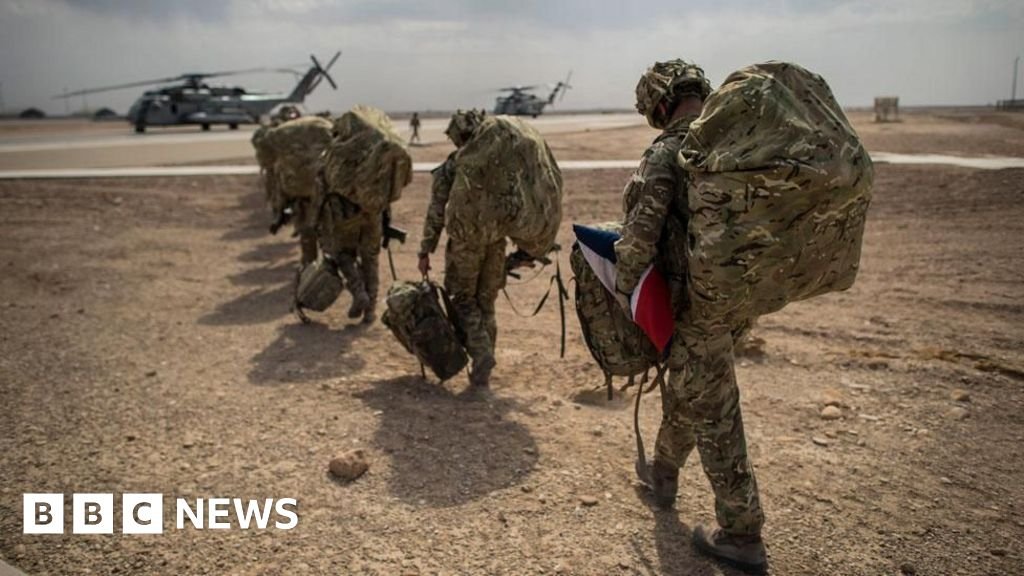
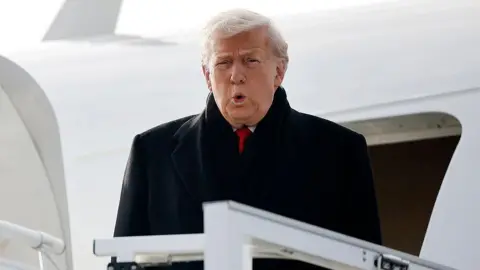
Donald Trump’s claim that Nato troops stayed “a little off the front lines” during the war in Afghanistan is “disappointing”, a minister has said.
Health and Social Care Minister Stephen Kinnock said the UK and other allies had “always stood shoulder to shoulder with the United States” and contributed to US-led missions.
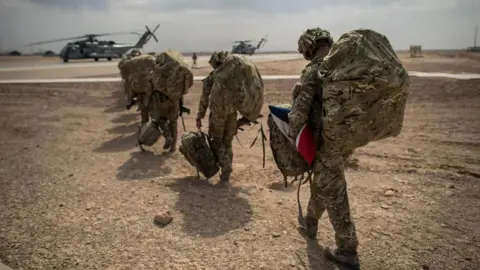
On Thursday, Labour MP Emily Thornberry called it an “absolute insult” to the 457 British service personnel killed in the conflict, while Liberal Democrat leader Sir Ed Davey said: “How dare he question their sacrifice?”
The UK was among several allies to join the US in Afghanistan from 2001, after it invoked Nato’s collective security clause following the 9/11 terror attacks.
The US is the only country to have invoked Article 5 of Nato, which states that “an armed attack against one Nato member shall be considered an attack against them all”.
But Trump told Fox News on Thursday that he was “not sure” the military alliance would be there for the US “if we ever needed them”.
“We’ve never needed them,” he said, adding: “We have never really asked anything of them.”
“They’ll say they sent some troops to Afghanistan,” he said, “and they did, they stayed a little back, a little off the front lines”.
Speaking to BBC Breakfast on Friday, Kinnock said Trump’s claim “doesn’t really add up” and his remarks “don’t really bear any resemblance to reality”.
He paid tribute to the British troops killed in Afghanistan and described Britain’s armed forces as “the definition of patriotism, courage, dedication, [and] professionalism”.
“They put their lives on the line to defend our country. I am disappointed by President Trump’s comments,” he said.
Kinnock also praised the “strong words” of Lucy Aldridge, whose son William died in a bomb blast aged 18 in Afghanistan. She said Trump’s remarks were “extremely upsetting”.
“We live the trauma daily for the rest of our lives because of the contribution that our loved ones made. And they were absolutely on the front line,” she told the Mirror.
Kinnock said Prime Minister Sir Keir Starmer would speak to Trump directly over his remarks.
“He’s incredibly proud of our armed forces, and he will make that clear to the president,” he told LBC.
Kinnock told Sky News Trump’s comments were “deeply disappointing”, adding: “Anybody who seeks to criticise what they have done and the sacrifices that they make is plainly wrong”.
Conservative MP Ben Obese-Jecty, who served in Afghanistan, also rejected the US president’s comments, saying it was “sad to see our nation’s sacrifice, and that of our Nato partners, held so cheaply”.
Former Shadow Justice Secretary Robert Jenrick, who recently defected to Reform UK, said the comments were “offensive and wrong”.

 Getty Images
Speaking to BBC’s Question Time on Thursday, Thornberry, the chair of the foreign affairs committee, said the remarks were “much more than a mistake”.
“It’s an absolute insult… How dare he say we weren’t on the front line, how dare he?
“We have always been there whenever the Americans have wanted us,” she said, calling Trump “a man who has never seen any action” but was now “commander in chief and knows nothing about how it is that America has been defended”.
She said the US was the UK’s “friend” but its leader had “behaved in a way that is bullying, rude, that has deliberately been trying to undermine us, which has been trying to undermine Nato.”
On the same programme, Conservative shadow cabinet member Stuart Andrew also called the comments “disgraceful” and “appalling”.
“There are many people in this country who served both in Iraq and Afghanistan, many of whom lost their lives, but also many more who came back with life-changing injuries and we should say thank you to them.”
He added that the UK-US special relationship was important for both defence and security, and that in recent weeks Trump had directed conversation to the security of the Arctic – where he said there was a “very serious threat”.
 PA Media
Speaking to BBC’s Newsnight programme, Dutch foreign minister David van Weel rejected Trump’s remarks as “false”, saying “Europeans shed blood” in support of US troops in Afghanistan.
He said Nato Secretary General Mark Rutte had rebuffed similar comments Trump made earlier, during a joint press conference the pair held at Davos on Thursday.
Asked about the US president repeating the claim, van Weel, said: “We should speak out for the truth as Mark Rutte did. And if he repeated it, we need to repeat it again because that’s not how history went.”
Meanwhile, former British Army officer Obese-Jecty said he saw “first hand the sacrifices made by British soldiers”.
“I don’t believe US military personnel share the view of President Trump; his words do them a disservice as our closest military allies,” he wrote on X.
Calvin Bailey, a Labour MP and former RAF officer who served alongside US special operations units in Afghanistan, said the president’s claim bore “no resemblance to the reality experienced by those of us who served there”.
“As I reminded the US Forces I served with on 4 July 2008, we were there because of a shared belief, articulated at America’s founding, that free people have inalienable rights and should not live under tyranny,” he told the PA news agency.
“That belief underpinned the response to 9/11, and it is worth reflecting on now.”
The BBC has approached the Ministry of Defence for comment.
A spokesperson pointed to comments made by Defence Secretary John Healey while visiting Nato ally Denmark on Wednesday – before Trump’s comments.
He said: “In Afghanistan, our forces trained together, they fought together, and on some occasions, they died together, making the ultimate sacrifice.”
The US invaded Afghanistan in October 2001 to oust the Taliban, whom they said were harbouring Osama Bin Laden and other al-Qaeda figures linked to the 9/11 attacks. Nato nations contributed troops and military equipment to the US-led war.
More than 3,500 coalition soldiers had died as of 2021, when the US withdrew from the country – about two-thirds of them Americans.
The UK suffered the second-highest number of military deaths in the conflict behind the US, which saw 2,461 fatalities.