

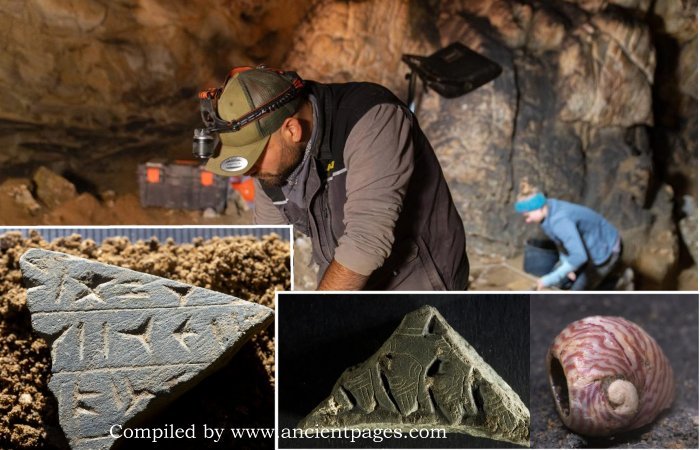
Jan Bartek – AncientPages.com – Katerinská Cave, located in the Moravian Karst of the Czech Republic, is a significant archaeological site known for its remarkable discoveries. Recently, researchers uncovered artifacts over 8,000 years old from the end of the Middle Neolithic period. Among these finds were ancient ornaments crafted from snail shells, manually shaped and used as decorative items.
Credit: : Petr Zajíček/Správa jeskyní ČR. Image compilation AncientPages.com
Neolithic Shell Ornaments Found In The Katerinská Cave
Petr Zajícek, a specialist with the Czech Cave Administration (SJ CR), notes that radiocarbon dating of freshwater animals and plants can yield results up to 700 years older than their actual age. As a result, the true age of these ornaments may correspond with earlier Neolithic artifacts found at the cave entrance and with prehistoric charcoal drawings, 15 of which have been identified in Katerinská Cave’s older sections.
Three specific ornaments were made from shells of Theodoxus danubialis, a freshwater snail species. Holes were ground into one side of each shell so they could be used as beads—likely strung together or sewn onto clothing or headgear as pendants.

Neolithic shell ornaments found in Katerinská Cave. Credit: Petr Zajíček/Správa jeskyní ČR
These items were discovered during an excavation in an unnamed corridor within cultural sediment layers at depths ranging from 0 to 15 centimeters. Previous excavations in this area have also revealed evidence, including remnants of a medieval coin-forging workshop, medieval and prehistoric pottery shards, stone tools, and fragments of an unidentified bas-relief. Additionally, a Neolithic charcoal drawing, similar to those found elsewhere in Katerinská Cave, was dated to this corridor; these drawings are among the oldest known cave art in the Czech Republic.
Examples can be seen on guided tours of Katerinská Cave or at an exhibition near its entrance.
How Did Ancient Hittite Tablets End Up In The Katerinská Cave?
The presence of Neolithic artifacts in the Moravian Karst region is well-documented and expected. However, a recent discovery has raised intriguing questions among researchers. While examining material from Katerinská Cave, scientists found a small fragment of a slate tablet inscribed with cuneiform writing. Analysis suggests that this artifact likely originates from the Hittite Empire, which flourished around 1500 BC in what is now central Turkey. This raises an important question: does this fragment represent an extraordinary archaeological find or could it be an elaborate historical forgery?
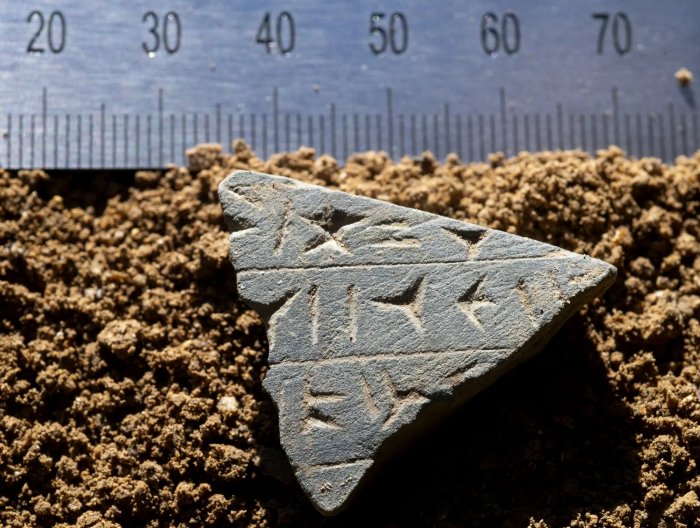
A small fragment with cuneiform writing was discovered in the Katerinská Cave. Credit: Petr Zajíček/Správa jeskyní ČR
Adding to the mystery are two previously discovered slate tablets featuring unusual figures. These images closely resemble depictions of the twelve gods walking through the underworld—a motif famously carved into rock at the Yazilikaya sanctuary near Hattusha, the ancient Hittite capital. The similarities have left experts puzzled and underscore how much remains to be understood about cultural connections and the movement of artifacts in prehistoric Europe.
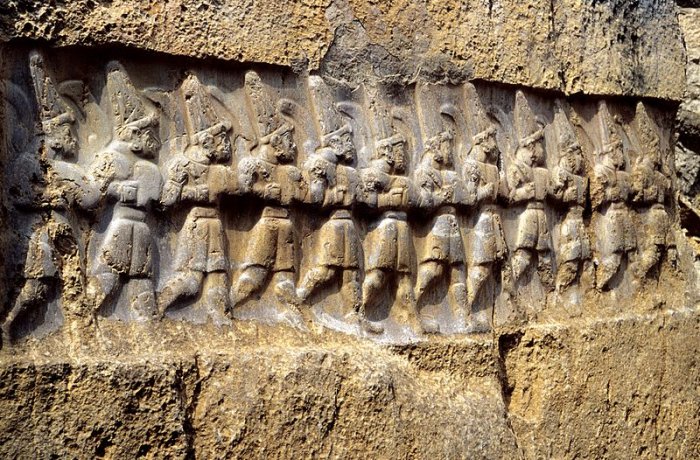
Twelve Hittite gods of the underworld in the nearby Yazilikaya, a sanctuary of Hattusha. Credit: Klaus-Peter Simon, Wikipedia, CC BY 3.0
“It doesn’t make sense. Something like that here? We don’t even know what the fragments come from. It isn’t very clear. Hopefully, laboratory testing will tell us more,” said Ivana Vostrovská from the Department of History at the Faculty of Arts at Palacký University in Olomouc, who is leading the research.

A Hittite relief found in the Katerinská Cave. Credit: Petr Zajíček/Správa jeskyní ČR
The fragments were found twenty centimeters below the surface in the Nameless Corridor of the cave. They depict figures of men walking in a row, neatly behind one another, wearing unusually tall hats and holding swords. The similarity to the relief from the Yazilikaya sanctuary is apparent.
Another notable similarity is found in the technical design. Rather than being engraved into the slate, the figures are rendered in relief; this means that the surrounding stone is carved away, allowing the figures to appear as if they emerge from the surface. Such craftsmanship was unconventional for Central Europe before our era.
See also: More Archaeology News
Additionally, a recently discovered small fragment inscribed in cuneiform has been identified as part of a single piece, alongside two other fragments depicting marching gods; the thickness of all three pieces matches. However, it remains a mystery how these intriguing tablets came to be located in Katerinská Cave. During the Hittite Empire, while advanced civilizations thrived in the Near East, Central Europe was still in prehistory—these were distinctly separate worlds.
“Either the plates from the Hittite Empire somehow made it to the sanctuary in Katerinská Cave, or this historical pottery could have been brought there from Turkey about 150 years ago, when research began in the cave, and was hidden there as a forgery,” explained Zajícek.
Still, this is the second find linking Katerinská Cave to the Hittite Empire, making the story truly fascinating.
Written by Jan Bartek – AncientPages.com Staff Writer
Expand for references