
However, some transportation experts and advocates have questioned whether a Safe System approach, the official strategy for roadway safety in the U.S., goes far enough to end traffic violence. One oft-cited concern is the idea of “shared responsibility” on the road for all users, a key pillar of the approach, which critics have said obscures the main causes of traffic crashes — such as speeding.
“If we actually want to save lives and reduce crashes, then we need to really put the spotlight on who has disproportionate power to save lives,” David Zipper, a senior fellow at the MIT Mobility Initiative, told KQED earlier this year.
In San Francisco, the city has addressed the issue of speeding through the expansion of electronic enforcement. Earlier this year, San Francisco became the first city in California to launch automated speed cameras. Early data from the pilot program shows a 78% reduction in speeding vehicles at camera locations.
Christopher White, executive director of the San Francisco Bicycle Coalition, said the shift toward automated enforcement is critical for protecting cyclists and pedestrians.
“The fact is that officers cannot be everywhere all the time,” White told KQED. “Having the consistency of automated speed enforcement and automated red light enforcement has had such an impact … We want to see it expanded throughout the city, and I think that the mayor’s initiative is going to give a lot of power behind that.”
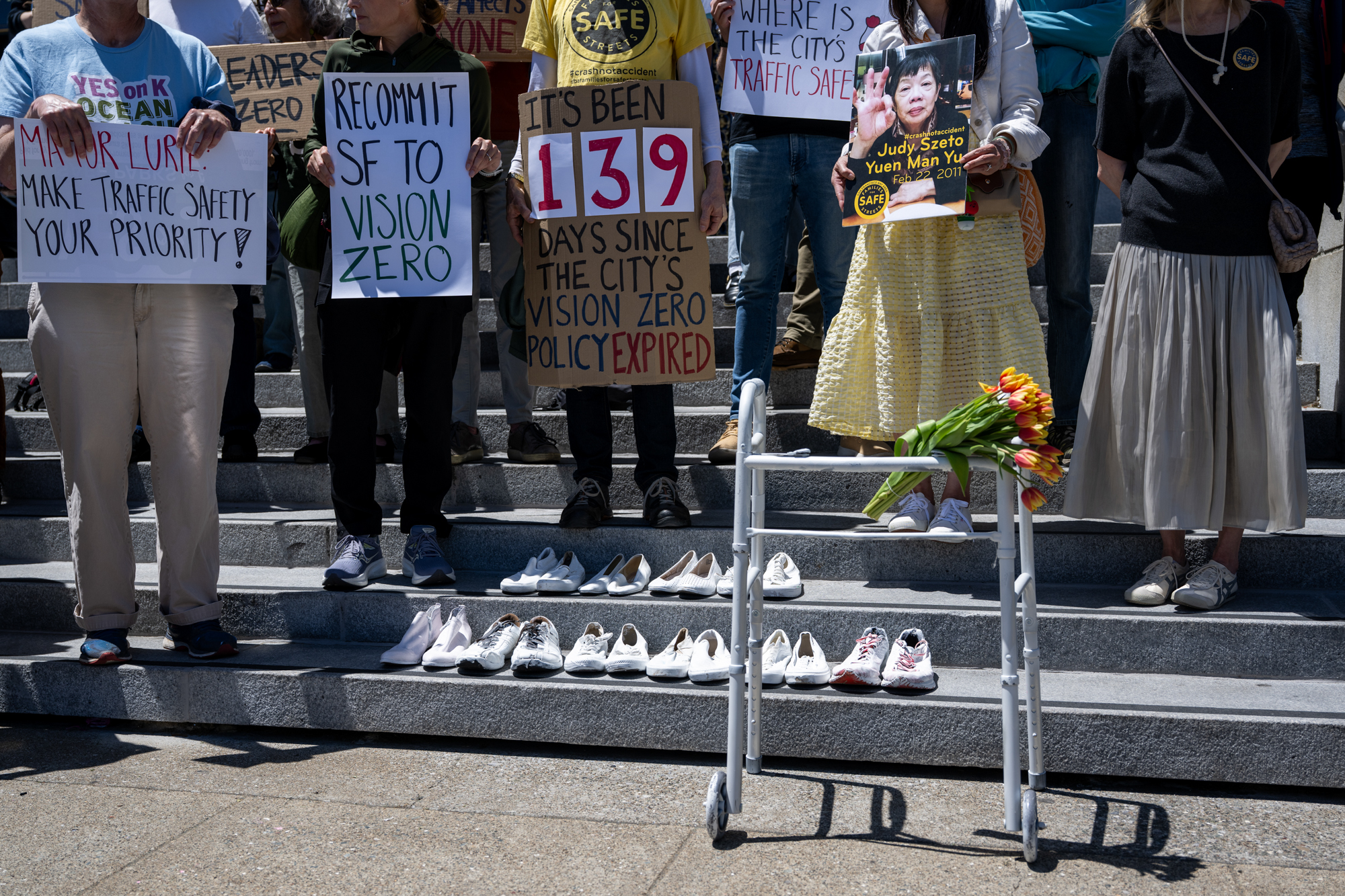
2024 was the worst year for traffic fatalities in San Francisco since 2007, with 41 deaths recorded both years. So far, in 2025, the city has seen 16 pedestrian fatalities in traffic crashes — 23 total deaths.
A primary task within the first 100 days of this directive is to confirm and publish the 2025 High Injury Network — the map of the specific streets where the vast majority of severe crashes occur. Once confirmed, the city is tasked with identifying a priority list of “quick-build” projects, which use paint and physical barriers to rapidly improve safety in high-risk areas.
Within six months, the working group is required to release a Traffic Enforcement Strategy Report identifying the top crash-causing behaviors to target.
For advocates who have spent years pushing for safer streets, the directive represents a hopeful, yet overdue, step. White noted that while the Bicycle Coalition sees this as an extension of previous work, the direct involvement of the mayor’s office offers a new level of accountability.
“The Biking and Rolling Plan passed earlier in 2025, and we want to see that rolled out much faster,” White said. ‘It’s not addressed in the initiative until after year one. We can do a lot of the things in the Biking and Rolling plan sooner than that. It just takes the leadership and will to do it.”