
Sometimes the choice is more complicated – the U.S. isn’t as safe for them as it was, but its school districts still offer things like mental health care and physical therapy that migrant workers fear they won’t get in their home countries. Balanced against that is the possibility of one or both parents being deported, leaving the children with no legal guardians in this country.
Statistically, it’s difficult to even know the number of farmworkers employed today, let alone how much the fear of deportation is affecting employment in the industry. In late October, Ag Alert, a publication of the California Farm Bureau, broke the news that both the U.S. Department of Agriculture and the U.S. Department of Labor canceled annual farmworker labor surveys. That means that, for the first time since the late 1980s, there is no federal documentation of farmworker hours, wages or demographics. Historically, about 40% of farmworkers in the last decade were undocumented.
The nonpartisan Pew Research Center found that more immigrants left the country or were deported this year than the number who arrived. If the trend holds until the end of the year, 2025 will be the first year since the 1960s that the population of immigrants in the U.S. falls.
For Raul, the question of returning is simple. He will need to earn money so he can support his kids, so he plans on coming back.
“Que quisiera un padre? Raul said. “Quiere que sea lo mejor para los hijos.”
What would a father want? He wants what’s best for his children.
A town shaped by a river
The road into Firebaugh rolls up and over a wash, next to the spot where Andrew Firebaugh founded a ferry across the San Joaquin River that became an important stop on stagecoach routes.
The river has always been what kept this town alive, first as an obstacle around which they built a settlement and later as the lifeblood of its farms and fields.

Just outside of town, the pavement has fractured and buckled. The street signs are tiny and faded on the broad grid of roads bounded by fields that push right up to the street. You orient yourself with both cardinal directions and crops.
Prunus amygdalus, also called almond trees, look like they’re raising their arms. Pistacia vera, the pistachio tree, look like they’re shrugging.
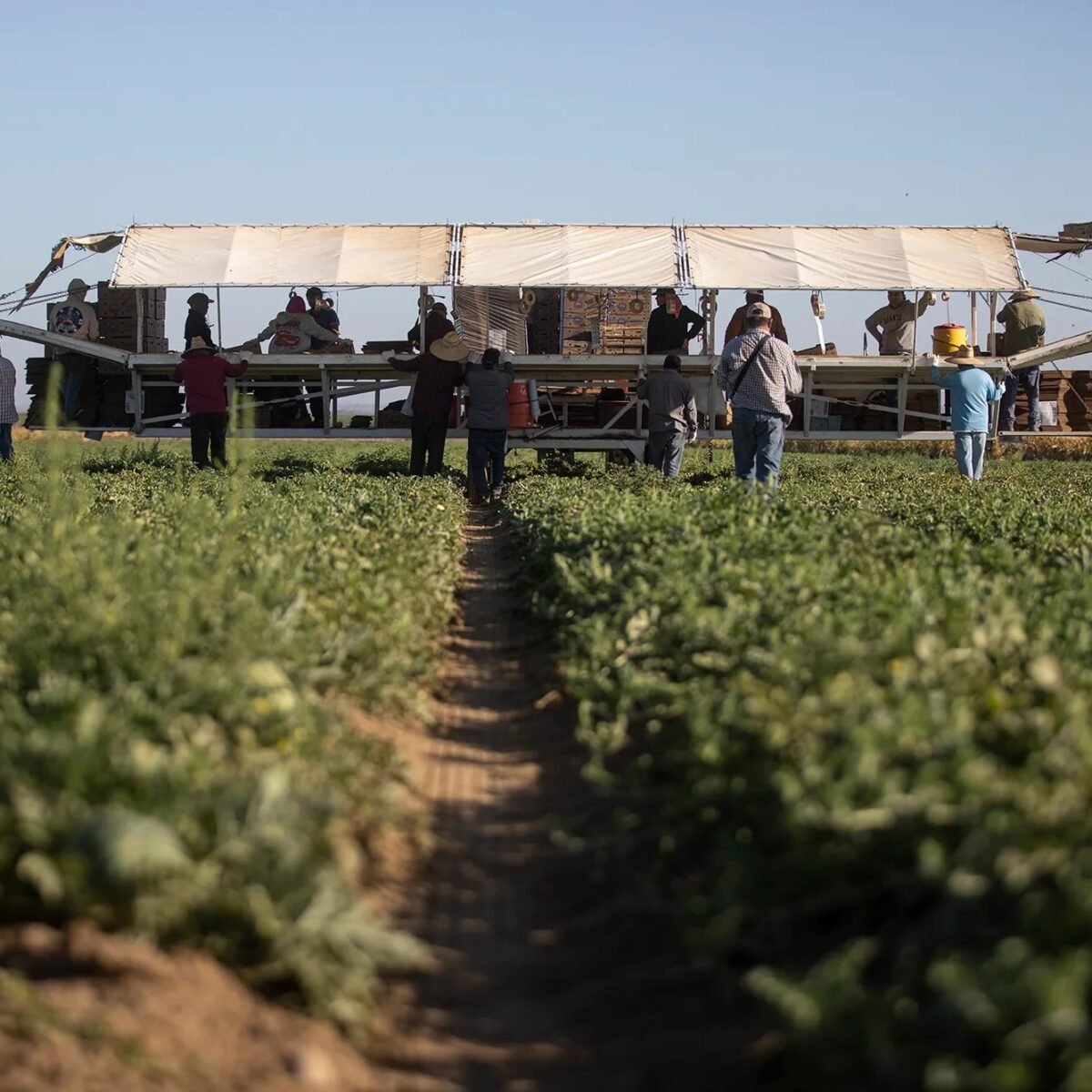
Uncovered truck bed bins spill ripe red tomatoes on tight turns. Tractors with their tillers raised trundle slowly down the highway. On the side of the road bobs of lettuce heads peek out of the ground, followed by a massive pile of unhulled almonds, and then a series of palm trees, some very tall and some a little squat.


At the corner of one of these roads, just before it meets the interstate, is the melon farm owned by Joe Del Bosque, Raul’s employer of 21 years. And the first thing people inclined to these kinds of questions will ask Del Bosque is why he hires undocumented labor.
He begins explaining his trouble hiring people on the federal H-2A visa, which permits employers to hire foreign seasonal workers. It’s not just that he has to pay them $3 more per hour, Del Bosque said. It’s that he must also pay for their transportation to and from the farm every day. He must pay for the rooms where they sleep and the food they eat. It is, he said, economically impossible to rely on the visa program.
The next suggestion is hiring local people. Del Bosque laughed and said he tried that. The locals made it a week, at the most, and then found some other way to make money that didn’t leave them sore all over.
He knows that one day soon, he’ll likely have to turn over operations to the only family member active in the business, his son-in-law. But that’s only if there’s still a farm to hand over.
“I don’t have a lot of confidence that the future of our farm and a lot of farms is looking very good right now,” Del Bosque said.

The U.S. Department of Labor is already sounding the alarm on losing farmworkers and the threat that poses to the nation’s food supply in a notice in the Federal Register in October.
“The near total cessation of the inflow of illegal aliens combined with the lack of an available legal workforce, results in significant disruptions to production costs and threatening the stability of domestic food production and prices for U.S consumers,” the department said in a rule-making proposal that would allow employers to pay H-2A workers less than they are paying now.
“Unless the Department acts immediately to provide a source of stable and lawful labor, this threat will grow,” the notice said, citing the likelihood of enhanced immigration enforcement under the budget bill Trump signed earlier this year.
Those longer-term consequences in the labor market won’t be felt evenly.
This is Trump country
Fresno County and the rest of the Central Valley went for Trump in the 2024 election. Del Bosque calls himself a conservative, though he donates to both parties – Democratic Sen. Adam Schiff and former President Barack Obama have both made public visits to his acreage.
Next to his farm – right up on the property line where everyone will see it – is a massive Trump 2024 sign, erected by his neighbor. No one driving to the Del Bosque Farm will miss it. Del Bosque laughs about it, but it’s also a reflection of how their differing crops help define their politics.

Del Bosque grows melons, which are labor intensive and require lots of people to work long hours. He supports an easier path to employment for undocumented workers. Next door, his neighbor grows almonds. They only require one person to drive a “shaker” to get the nuts out of the trees and another to operate the basket that catches them as they fall. His neighbor, whom CalMatters was unable to contact, doesn’t require much labor at all.
“Here’s the thing, not all farms are the same, not all farmers are the same,” Del Bosque said. “I’m concerned about these people. (The neighbor) is not concerned about that, because he has almonds. He manages his almonds with just him and one or two more people.
“He can do his whole farm with two, three people. So this immigration (enforcement) does not affect him at all.”
Author and Central Valley farmer David Mas Masumoto wrote about neighborly tension in his 1995 “Epitaph for a Peach.”
“We depend on labor from Mexico, part of a seasonal flow of men and families. Many come here for the summer, return to Mexico during the slow winter months, and return the following year. They’re predominantly young men with the faces of boys. We’re dependent on their strong backs and quick hands. And they are hungry for work.…
“This September, farmers drive down the road staring straight ahead, steering clear of a chance meeting with a competitor who was once a neighbor. Eyes avoid eyes, hands hesitate and refrain from waving. It’s an ugly September.”
Politics out here can make it a whole ugly season.
‘Big and rapid change’
What if they don’t come back?
“We don’t have a precedent for trying to understand that major of a disruption to our state’s economy and demographics,” said Liz Carlisle, an associate professor in the Environmental Studies Program at UC Santa Barbara.

Something is changing in one of the world’s most productive agricultural regions. Wine grapes are going unharvested, rotting in the fields, as exports to Canada collapsed under new tariffs and younger consumers started shying away from alcohol.
Land values are cratering in places with limited water, leaving farmers in multi-million dollar debt. Water costs are skyrocketing in part because of a 2014 conservation law that seeks to regulate years of agricultural over-pumping.
“I do think we’re looking at the potential of really big and rapid change to California’s agricultural sector and all of the workers and everything that touches the economy,” Carlisle said. “It’s kind of a perfect storm because you have major shifts in trade policy at the same time as you have major shifts in the workforce at the same time you have major shifts in climate and potential regulatory responses to those climate impacts.
“So that’s a lot of huge transformations for people in the agricultural sector to try to manage at once.”
This year, the problems were the usual problems: Five or six big storms clobbered the Central Valley with rain and hail, hitting young crops just as they were approaching maturity. But larger battles loom.